EU Plans New Drone and Missile Funding for Kyiv as War Costs Mount
Brussels is preparing additional military financing for Ukraine while linking longer-term aid to reforms, reconstruction and European integration.
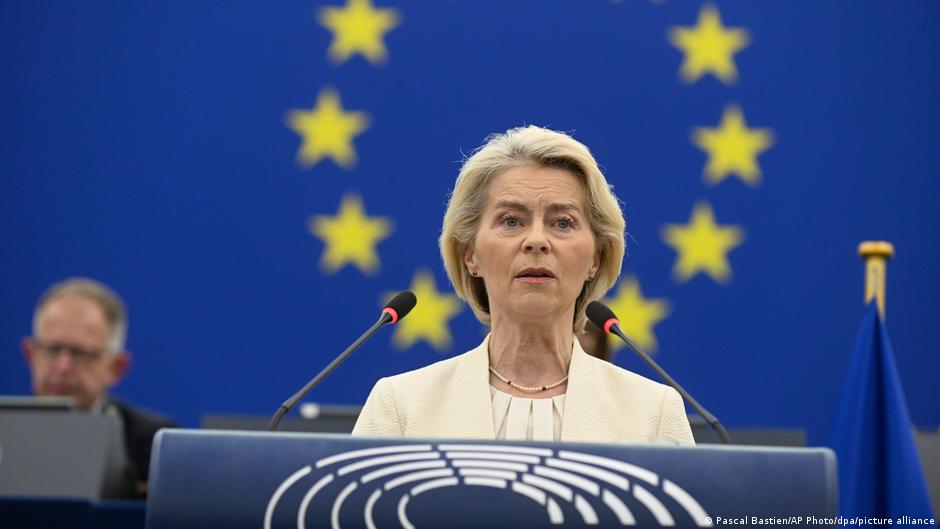
The European Union is preparing to allocate additional funding to Kyiv in mid-October for the purchase of drones and missiles, placing Ukraine’s military needs back at the center of the bloc’s economic and strategic agenda. European Commission President Ursula von der Leyen announced the planned support on Sunday, October 11, after a phone call with Ukrainian President Volodymyr Zelensky.
Von der Leyen said the funding was needed to strengthen Ukraine’s defense and protect its airspace. She did not specify the amount of the new financing or identify the sources from which it would be drawn. That omission matters economically: after more than two and a half years of full-scale war, the EU’s support for Ukraine has evolved from emergency assistance into a recurring fiscal commitment that must be accommodated alongside domestic budget pressures, defense-industrial expansion and competing priorities across member states.
“This is necessary to strengthen Ukraine’s defense and protect its airspace,” von der Leyen said.
Brussels has indicated that the situation in Ukraine will be one of the central topics at this week’s European Council meeting. According to von der Leyen, EU leaders are expected to discuss Ukraine’s financing needs for the coming year and ways to mobilize new international support. The agenda also includes the planned unblocking of two new clusters of issues in Ukraine’s negotiations with the European Union, linking wartime financing to the broader question of Ukraine’s institutional and economic alignment with the bloc.
From Emergency Aid to a Long-Term Fiscal Architecture
The latest pledge sits within a larger transformation of EU policy. At the start of the war, assistance to Ukraine was framed largely as a response to immediate military and humanitarian needs. Over time, however, the economic structure of support has become more formalized. The EU is no longer simply sending money to bridge short-term gaps; it is building a multi-year framework designed to sustain the Ukrainian state, underwrite reconstruction planning and keep Kyiv anchored to a European reform path.
That shift is visible in the Ukraine Facility, the EU mechanism created to provide long-term financial assistance to Ukraine from 2024 to 2027. Earlier, on October 2, the European Commission approved a 2.9 billion euro tranche for Kyiv under that mechanism. Brussels has said the facility will allow the EU to provide Ukraine with up to 50 billion euros in “stable and predictable financial assistance” over the period.
Predictability is central to the economic logic of the facility. A country at war faces extraordinary uncertainty: revenues are strained, infrastructure is vulnerable, investors demand high risk premiums and public spending must prioritize defense. Multi-year commitments help reduce the volatility of external support, allowing the Ukrainian government to plan budget execution, reconstruction priorities and reform sequencing with greater confidence than ad hoc packages would permit.
At the same time, the structure of the Ukraine Facility reflects the EU’s conditional model of economic governance. Payments are closely tied to Ukraine’s implementation of a specific recovery and reform plan, as well as to support for democratic mechanisms, the rule of law and human rights. The Commission has stressed that payments are made quarterly after verification that the conditions for disbursement have been met. In effect, wartime aid is being integrated into the same institutional logic that has long shaped EU enlargement and neighborhood policy: money is paired with reforms, and financial support is used to encourage convergence with European standards.
Drones, Missiles and the Economics of Air Defense
The emphasis on drones and missiles also points to the changing economics of the battlefield. Air defense has become one of Ukraine’s most resource-intensive needs, especially as attacks reach civilian areas far from the front line and place energy infrastructure under repeated pressure. In such conditions, military aid is not only a security instrument; it is also a form of economic stabilization.
Protecting airspace reduces the risk of damage to power grids, industrial assets, logistics networks and residential areas. It helps preserve the functioning of cities, limits emergency repair costs and supports the continuity of economic activity. Conversely, inadequate air defense can multiply the fiscal burden by forcing the state and its partners to spend more on reconstruction, emergency energy imports, humanitarian support and infrastructure replacement.
Von der Leyen’s comments suggest Brussels sees this connection clearly. She said she fully supported Zelensky’s call for a ceasefire that would protect global food supplies and energy infrastructure in Ukraine and Russia. That formulation links the war directly to the wider global economy. Ukraine’s agricultural exports have long been significant for international food markets, and attacks on energy infrastructure have implications beyond immediate military calculations. The war’s economic effects are transmitted through commodity markets, trade routes, insurance costs and energy security.
Her warning that the war has entered a new and darker phase further underlines the EU’s concern about escalation and attrition. According to von der Leyen, Russia is waging a prolonged war on the battlefield and striking civilians far beyond the front line. For Europe, that assessment implies that Ukraine’s needs will not be limited to a single budget cycle. A protracted war requires sustained financing, industrial planning and political coordination among allies.
The new assistance therefore has a dual significance. On one level, it is a targeted measure to help Kyiv acquire drones and missiles. On another, it is a signal that the EU is continuing to treat Ukraine’s defense, fiscal stability and accession trajectory as interconnected elements of one long-term policy. The European Council’s discussions this week will test how far member states are prepared to extend that logic into the next year, particularly as the costs of support become more predictable, more institutionalized and more politically visible.



