Putin Says Armenia’s EU Bid Would Amount to Leaving the Eurasian Union
The dispute over Armenia’s EU accession plans exposes the economic incompatibility between Brussels and the EAEU and raises broader questions about regional integration.
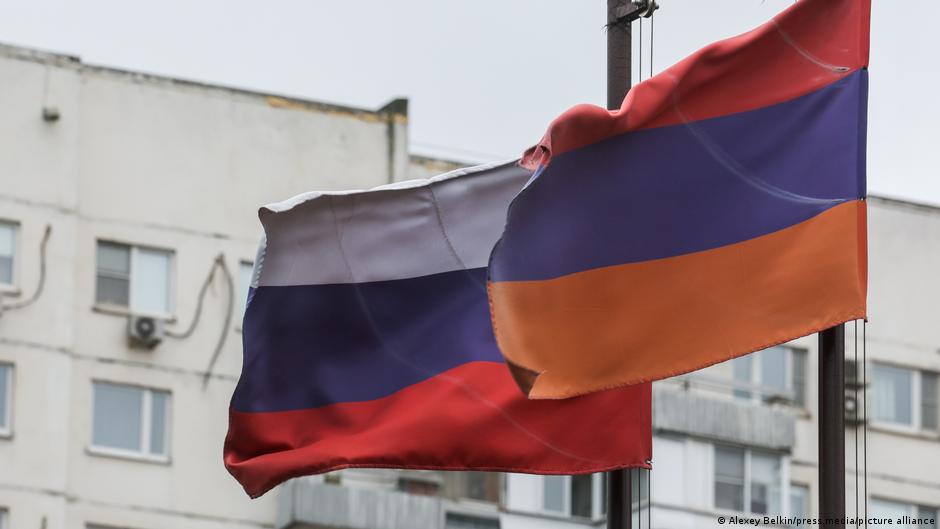
Russian President Vladimir Putin told Armenian Prime Minister Nikol Pashinyan that Armenia’s decision to launch a process aimed at joining the European Union would, in practical terms, mean leaving the Eurasian Economic Union, sharpening a strategic dispute that is also rooted in trade architecture, market access and long-term economic alignment.
The two leaders met on the sidelines of the Shanghai Cooperation Organisation summit in Bishkek. According to a transcript published on the Kremlin’s website on Tuesday, September 1, the central issue in their talks was Yerevan’s plan to submit an application for EU membership.
Putin framed the issue not as a matter of political declaration, but as one of institutional incompatibility. He told Pashinyan that Armenia had said it was not declaring an exit, but argued that adopting a law to begin joining another economic organisation effectively amounted to a statement of withdrawal from the Russia-led bloc.
“The adoption of a law on the start of the procedure of joining another economic organisation in fact means a statement of withdrawal from ours, because being there and there is incompatible,” Putin said, according to the Kremlin transcript.
By “the other organisation,” he meant the EU, and by “ours,” the Eurasian Economic Union. Putin again urged Armenia to hold a referendum on whether to align with the EU or remain in the EAEU, saying the question should be put directly to the public.
Pashinyan rejected the argument that Armenia had breached any of its existing commitments. He said Yerevan had analysed the treaty base governing relations with Russia as well as the legal framework inside the EAEU and had found no violations of Armenia’s obligations to either Russia or the bloc. The Armenian prime minister added that by adopting a law on European integration in 2025, Armenia had in effect moved away from the idea of a referendum on choosing between the EU and the EAEU.
Economic integration at the center of the dispute
The clash highlights a structural reality that has shaped post-Soviet economic diplomacy for years: customs unions, common regulatory spaces and trade blocs are not easily layered on top of one another. The EAEU is not only a political project but a rules-based economic arrangement built around common external tariffs and coordinated market regulations. The EU accession process, meanwhile, is also fundamentally about adopting a dense body of common economic law, standards and institutional obligations.
That is why the argument between Moscow and Yerevan is about more than symbolism. If Armenia moves from exploratory legislation to a formal accession track with Brussels, the question is not simply geopolitical orientation. It is whether a country can simultaneously participate in two integration systems whose tariff policy, regulatory logic and dispute-settlement assumptions pull in different directions. Putin’s position is that it cannot. Armenia’s position, at least for now, is that beginning the process does not yet violate the commitments it has already made.
The sequence of events has added urgency. On August 24, Pashinyan said Armenia intended in the near future to begin the process of filing an application to join the EU. After that announcement, the European Commission said Armenia was now “closer to the European Union than ever before,” while also stressing that accession takes place through a “clearly defined process, based on merit.” That formulation signaled both political openness and procedural distance: Brussels acknowledged movement, but did not offer a shortcut.
For economists and investors, that matters. EU accession is a long, merit-based process that typically entails years of legislative adaptation, institutional reform and gradual market convergence. Even so, the act of applying can alter expectations immediately. It can influence business planning, redirect state capacity, reshape trade strategy and affect how neighboring powers use economic leverage.
That leverage is already visible in the Armenia-Russia relationship. Before Armenia’s parliamentary elections on June 7, Moscow increased pressure on Yerevan, including by banning imports into Russia of a number of Armenian products. The elections were ultimately won by Pashinyan’s Civil Contract party. The September 1 meeting in Bishkek was the first face-to-face meeting between Pashinyan and Putin since those elections.
In that sense, the current dispute fits a familiar regional pattern in which market access becomes a tool of political signaling. For smaller economies, especially those with concentrated export routes and historical dependence on a dominant partner, trade restrictions can become a highly visible reminder of economic asymmetry. Armenia’s debate over Europe therefore carries an immediate domestic cost-benefit dimension, not just an abstract strategic one.
Pashinyan had already said in June that there were no grounds for holding a referendum on joining the EU. He was responding at the time to a joint statement by the leaders of Russia, Belarus, Kazakhstan and Kyrgyzstan. Putin has previously argued that EU and EAEU membership cannot be combined. He has also said that the so-called “Ukrainian scenario” began with Kyiv’s attempt to join the EU.
That comparison is politically loaded, but economically it points to the same fault line: the competition between overlapping integration offers in the post-Soviet space. For Moscow, the EAEU’s credibility depends on members accepting that there is a clear institutional boundary. If one member can move toward another economic bloc without consequences, the union’s coherence is weakened. For Armenia, however, keeping room for maneuver may be economically rational, particularly if it sees European integration as a route to regulatory upgrading, diversification and reduced vulnerability to pressure from a single market.
What happens next will depend on whether Armenia’s EU turn remains a legal and political signal or becomes an operational transition with concrete economic steps attached. For now, Moscow is drawing a bright line around the EAEU’s rules, while Yerevan is insisting that no formal breach has occurred. The deeper consequence is that Armenia’s European course is no longer only a foreign-policy debate. It is becoming a test of whether a small economy can rebalance its integration model without triggering a decisive rupture with the regional system in which it is already embedded.