US Army secretary exits after Pentagon rift, deepening leadership churn
Daniel Driscoll’s reported resignation after months of disputes with Defense Secretary Pete Hegseth adds to instability as Washington juggles military priorities and wartime demands.
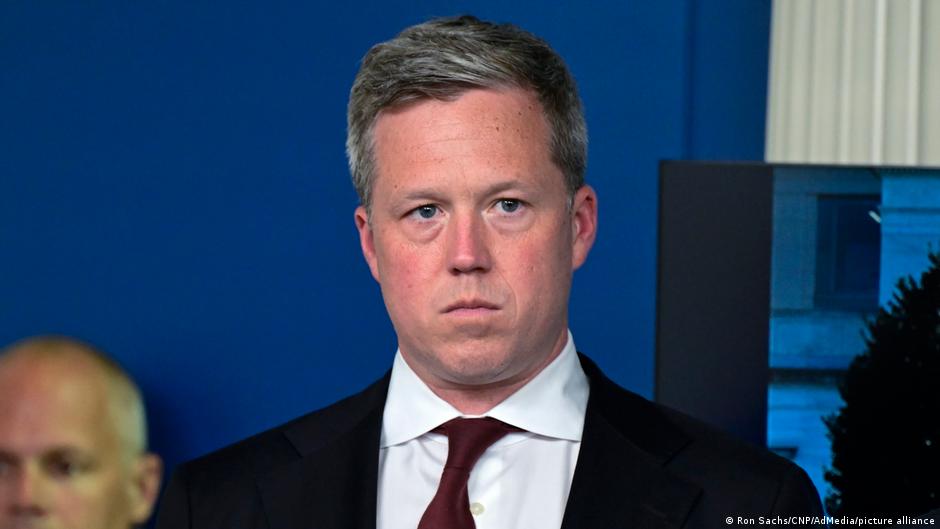
US Army Secretary Daniel Driscoll has asked President Donald Trump to accept his resignation after months of disagreements with Defense Secretary Pete Hegseth over the direction of the US armed forces and the dismissal of several officers, according to The Wall Street Journal and other US media reports published overnight into Tuesday, September 1.
Later, Reuters and AP circulated the same information, while NBC News, citing sources, reported that the White House had accepted Driscoll’s resignation. The Wall Street Journal said Driscoll is expected to leave the Pentagon in the coming days, turning what had been a long-running internal dispute into another visible change at the top of the US defense establishment during Trump’s second presidential term.
For economists and investors, the immediate significance is not only political. Leadership turnover inside the Pentagon matters because the US defense apparatus is not merely a military institution; it is also one of the federal government’s largest centers of procurement, industrial coordination and long-cycle capital planning. When disputes at the top spill into resignations, they can alter signals to contractors, reshape spending priorities and deepen uncertainty in supply chains already adjusting to shifting operational demands.
According to a statement by White House principal deputy press secretary Anna Kelly, cited by The Wall Street Journal and AP, Driscoll had effectively advanced Trump’s “Make America Strong Again” agenda at the Department of the Army, restoring priority to readiness and weapons lethality while assisting negotiations between Russia and Ukraine.
The timing is especially notable because the prospect of Driscoll’s exit had already surfaced on August 21, when The Wall Street Journal reported that he was planning to resign at the end of the year because of his conflict with Hegseth. Reuters commented at the time that Driscoll’s departure would leave the Army without a Senate-confirmed leader as the United States sought to end the war against Iran, which the agency said had begun together with Israel nearly six months earlier.
That detail underscores a structural feature of defense economics: military organizations make procurement and force-design decisions over years, but political conflict can compress those choices into abrupt personnel moves. A secretary advocating one procurement philosophy can be replaced by another with different assumptions about cost, scale and industrial policy. In this case, Reuters noted that Driscoll had supported a “flexible approach,” backed the Army’s purchase of cheaper weapons and criticized major manufacturers.
Those views are economically consequential. A push for lower-cost weapons usually implies pressure on incumbent prime contractors, a potential opening for smaller suppliers and a wider debate about whether the Pentagon should prioritize exquisite high-end systems or a broader inventory of more affordable capabilities. That argument is not new. It echoes earlier periods in US defense planning when cost overruns, lengthy development timelines and battlefield adaptation forced policymakers to reconsider how much technological sophistication the military could buy before affordability and readiness began to suffer.
Leadership turnover and the economics of force redesign
Journalists cited by Reuters described Driscoll’s resignation as a further step in a broader process of leadership change at every level of the Pentagon during Trump’s second term. Reuters recalled the April dismissal of Army Chief of Staff Randy George and some other senior military officials. Taken together, those changes point to a deeper reordering rather than an isolated clash of personalities.
From an economic perspective, that matters because institutional turnover affects more than headlines. It can delay contract awards, complicate budget negotiations and weaken policy continuity just as the defense sector faces pressure to balance current operations with future modernization. When military leadership changes repeatedly, the transaction costs of governing the system rise: program reviews multiply, strategic guidance becomes harder to interpret and companies hesitate over investment decisions that depend on stable federal demand.
The Pentagon has historically functioned as an anchor customer for large segments of US manufacturing, technology development and logistics. That gives internal policy disputes broader spillover effects. If the Army’s civilian leadership shifts during debates over readiness, lethality and cheaper arms purchases, the resulting uncertainty can reach production lines, labor planning and regional economies tied to defense spending. Even when aggregate outlays remain high, the distribution of contracts and the sequencing of purchases can change meaningfully.
Driscoll’s own trajectory adds another layer to the story. He is described as a friend and former classmate of Vice President J.D. Vance. In November 2025, he was appointed as Trump’s new special envoy for Ukraine, replacing Keith Kellogg. He had served as Army secretary since February 2025. That combination of political proximity, diplomatic assignment and procurement views made him more than a routine administrator; it made him a node linking military policy, foreign policy and the economics of rearmament.
The reported White House praise for Driscoll suggests that his departure is not being framed publicly as a repudiation of his service. Yet that only sharpens the analytical question: if an official credited with advancing the president’s agenda is still leaving after months of disputes with the defense secretary, then the underlying issue is likely about control over priorities, personnel and the institutional direction of the armed forces. Markets often interpret such episodes as evidence that strategic alignment at the top is weaker than official statements imply.
There is also a historical parallel in the recurring tension between centralization and service-level autonomy inside the US national security system. Periods of war or intensified geopolitical competition often produce demands for tighter control from the center, while service branches defend their own doctrines, procurement preferences and professional leadership. When those tensions end in firings or resignations, the consequences are rarely confined to the chain of command. They reverberate through appropriations politics, contractor expectations and allied assessments of US policy steadiness.
For now, the facts remain those reported by US media: Driscoll submitted his resignation after months of disagreements with Hegseth; NBC News said the White House accepted it; and he is expected to leave in the coming days. But the broader significance lies in what this episode reveals about the economic mechanics of Pentagon change. Leadership churn at the top of the Army is not simply an internal management story. It is a sign that the allocation of defense resources, the shape of procurement reform and the balance between readiness and industrial interests remain under active contest inside one of the world’s most powerful state institutions.