US tells Russia sanctions relief will wait until war in Ukraine ends
At a G20 meeting in North Carolina, Treasury Secretary Scott Bessent signaled that Washington sees no path to easing pressure on Moscow before the war is over.
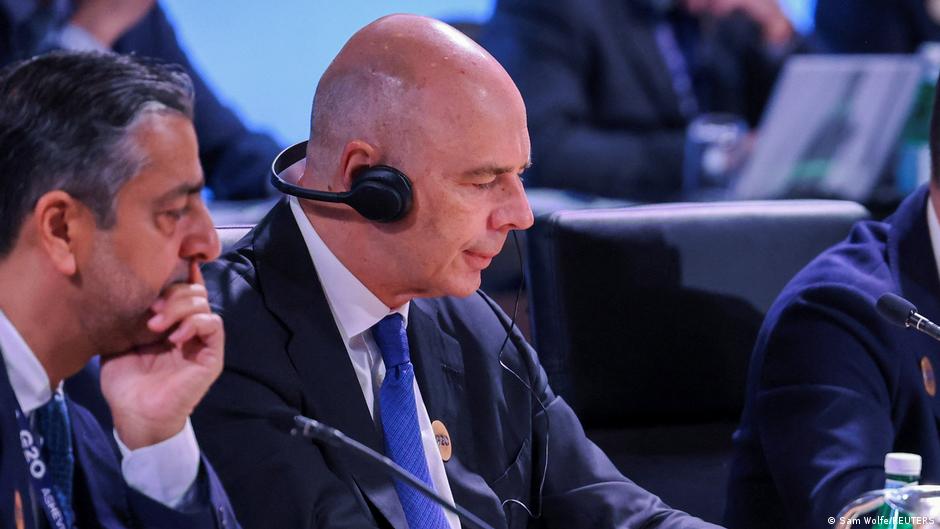
U.S. Treasury Secretary Scott Bessent told Russian Finance Minister Anton Siluanov during talks on the sidelines of a G20 meeting that Moscow should not expect any easing of economic pressure, or agreements on other issues, until the war in Ukraine is over, according to Reuters, which cited a source familiar with the ministers’ bilateral exchange.
The conversation took place during a meeting of G20 finance ministers and central bank governors in Asheville, North Carolina. In practical terms, the message described by Reuters points to continuity in the economic logic that has shaped Western policy toward Russia since the start of the full-scale war: sanctions are not being treated as a bargaining chip for incremental diplomatic normalization, but as part of a wider coercive framework linked directly to the duration and outcome of the conflict.
That distinction matters. Markets and policymakers often look for signs that sanctions regimes may gradually soften through technical carve-outs, side agreements, or selective engagement on unrelated issues. Bessent’s reported position suggests Washington is trying to shut down those expectations. The signal to Moscow, if accurately conveyed, is that the economic perimeter around Russia will remain tied to wartime realities rather than to tactical diplomacy at multilateral gatherings.
“One can find room for clear criticism, debate with each other, and choose clear words about this war, but a joint photo would be too big a step for me at this stage.”
That quote came from German Finance Minister and Vice Chancellor Lars Klingbeil, who said the very presence of Siluanov at the gathering was a “troubling signal.” According to the report, Klingbeil told colleagues from other European countries that he would boycott the traditional group photo if Siluanov were included. He later said other European representatives joined his position, and the photo was ultimately taken without the Russian minister.
Klingbeil also told journalists that during the general morning meeting of participants, he told Siluanov that Russia must end the war in Ukraine and reaffirmed Berlin’s support for Kyiv. The episode illustrates a broader tension inside the G20 format: the group remains one of the few venues where officials from rival states can still occupy the same room, yet those encounters increasingly expose the limits of routine economic diplomacy when war has redefined the political baseline.
Sanctions as a long-war instrument
For Econpress readers, the key significance of the reported exchange lies less in the diplomatic theater than in the economic doctrine behind it. The United States appears to be reinforcing a strategy in which sanctions function as a long-war instrument of attrition. That approach has several structural consequences.
First, it raises the probability that Russia’s external financing constraints, technology restrictions, and broader transactional frictions will remain embedded for an extended period. Even when an economy adapts to sanctions through import substitution, rerouted trade, or informal payment channels, the costs do not disappear. They are redistributed into lower productivity, higher transaction expenses, weaker investment quality, and deeper dependence on narrower pools of partners and intermediaries.
Second, a hard line from Washington reduces the scope for business communities and financial actors to price in near-term normalization. Expectations matter in sanctions economics. If firms believe restrictions may soon ease, they preserve optionality and keep open channels for future re-entry. If they conclude that the regime will endure until a decisive political endpoint, supply chains, capital allocations, and legal compliance systems become more permanent. Over time, temporary dislocation hardens into a new commercial geography.
Third, the episode highlights the growing overlap between multilateral forums and sanctions enforcement politics. The G20 was created as a venue for macroeconomic coordination, crisis management, and financial dialogue. Yet in the current environment, attendance itself can become contentious. The dispute over Siluanov’s participation and the group photograph underscores how symbolic protocol now carries economic meaning: who is included, in what format, and under what conditions can affect both the signaling power and perceived cohesion of sanctioning states.
There are historical parallels here. In past periods of geopolitical fragmentation, economic pressure often outlasted the moments that first produced it. Restrictions introduced as emergency measures tend to build institutional constituencies of their own, from compliance departments and export-control bureaucracies to political coalitions that treat rollback as a concession requiring visible strategic gain. Once that infrastructure exists, unwinding it becomes harder than imposing it.
Against that backdrop, Bessent’s reported message to Siluanov serves two audiences at once. Externally, it tells Russia that economic relief remains conditional on the end of the war in Ukraine. Internally, it reassures allies and markets that Washington is not preparing a quiet softening through side-channel engagement. That is especially relevant because the Russian Finance Ministry had earlier published a statement on the August 31 meeting saying only that Siluanov and Bessent discussed issues of Russian-American interaction on the financial track and cooperation within the G20.
Also on August 31, CNBC reported on its website, citing the U.S. Treasury, that Bessent discussed U.S. President Donald Trump’s “peace plan” for Ukraine with Siluanov in Asheville. Set against Reuters’ later account, that detail suggests the United States is attempting to keep diplomatic communication alive while separating communication from concession. In other words, contact does not imply relief.
For the global economy, the broader lesson is that sanctions linked to major wars increasingly shape not only the target country’s outlook but also the operating assumptions of the international system. They influence commodity flows, reserve management, banking networks, insurance, shipping, and the political risk premium attached to cross-border finance. The longer they remain in place, the more they reshape the structure of economic interdependence itself.
That is why the Asheville encounter matters beyond its immediate diplomatic drama. It suggests that, at least from Washington’s perspective, the war in Ukraine remains the decisive variable in any future discussion of sanctions relief. Until that changes, the economic pressure on Russia is being framed not as a temporary irritant, but as a durable feature of the wartime order.