Why Uzbekistan's First ID Card Fee Has Become an Economic Flashpoint
A debate over the price of a teenager's first identity document is highlighting how administrative fees can amplify inequality and redefine the state's role.
In Uzbekistan, a debate over the cost of a first ID card has moved beyond bureaucratic pricing and into a broader argument about the economics of citizenship. Recent discussion on social media was triggered by journalist Dilnoza Qurbonova's account of meeting a modestly dressed family at a passport office, where a teenage girl had come to receive her first identity document. When the cashier announced the amount due, the father began counting the cash in his wallet piece by piece, and the girl, according to the post, looked first at him and then at the ground. The scene turned an administrative tariff into a public question: how much should a state charge for the first document that confirms a citizen's identity?
He opened his wallet and began counting even the last small coins one by one. In those seconds, seeing the father's anguish and the daughter's eyes turn first to her father and then to the ground, broke my heart.
The emotional force of that episode matters because the fee in question is not tied to a luxury, a convenience or a voluntary upgrade. It is attached to a person's first formal proof of identity. That is why the debate has widened into a test of fairness, and why the comparison across eight countries carries economic weight. A first identity document is the entry point into documented citizenship. When the price is high for low-income households, the state is not merely recovering an administrative cost. It is deciding how much of the burden of legal inclusion should be borne by families at the moment a child moves into formal adulthood.
An indexed fee that is about to rise
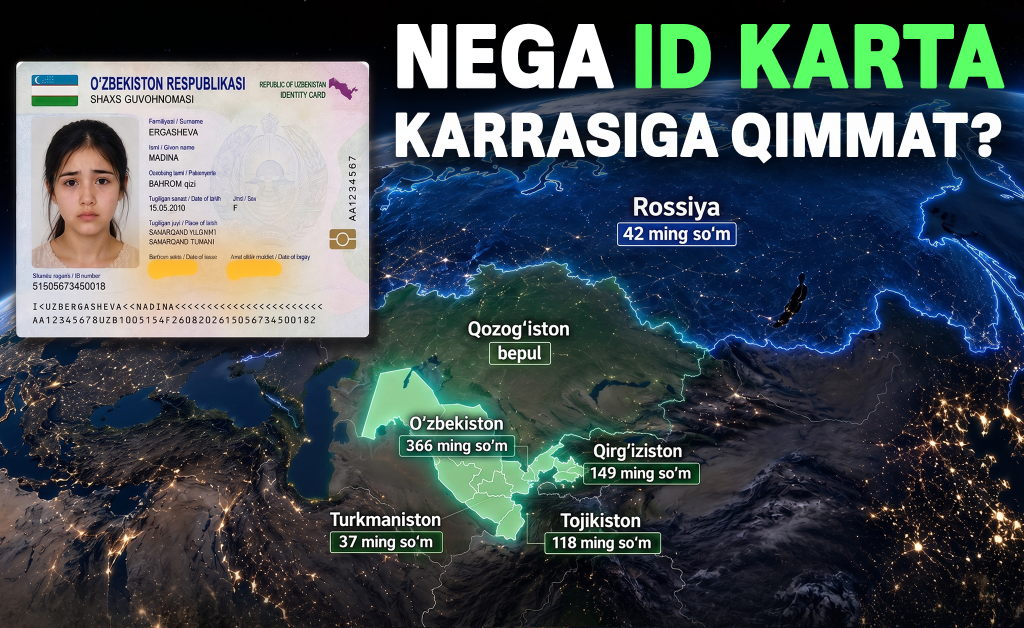
In Uzbekistan, the state duty for a first ID card depends on how the application is filed. If the request is submitted through a migration office, a State Services Center or a consulate, the charge is set at 89 percent of the base calculation amount, or BHM. With the BHM currently at 412,000 soums, that produces a fee of 366,680 soums. If the application is filed online through my.gov.uz, the rate is 80.1 percent of the BHM, or 330,012 soums. The BHM has been set at 412,000 soums since August 1, 2025. From September 1, 2026, it will rise to 440,000 soums. If the ID card rates remain unchanged, the fee will increase to 391,600 soums through migration offices, State Services Centers and consulates, and to 352,440 soums through my.gov.uz.
This structure is economically important because it ties the price of a basic identity document to an indexed administrative base rather than to a separate social policy decision on first issuance. In practical terms, that means the debate is not static. The charge rises automatically when the BHM rises, unless the government deliberately changes the tariff. For households already living close to the edge, a flat fee behaves harshly: the same nominal payment that is manageable for one family can become a moment of visible distress for another. The journalist's account resonated precisely because it transformed a spreadsheet formula into a household budget shock.
Regional comparisons point to a different policy logic
The regional comparison shows that neighboring and nearby states often use a different approach for first-time identification. Kazakhstan moved furthest in that direction. From January 1, 2026, every citizen turning 16 can obtain an ID card for the first time free of charge, and renewal after expiry is also free. The exemption also applies to those obtaining the document for the first time after age 18, to people who have acquired Kazakh citizenship, and in some other cases. The stated aim is to reduce the financial burden on citizens and simplify document processing.
Elsewhere, first issuance is not always free, but the price points described in the comparison are still materially below Uzbekistan's current fee. In Kyrgyzstan, a first ID card issued under the standard procedure within 12 working days costs 1,103 som, or about $12.6 and 149,000 Uzbek soums at the current exchange rate cited in the article. That is about 2.5 times cheaper than Uzbekistan's current 366,680-soum duty. In Tajikistan, the fee is set at $10, collected in somoni at the exchange rate on the payment date, with issuance taking up to 15 days. At the Central Bank of Uzbekistan's official rate on August 21, $10 was about 118,000 soums, roughly 3.1 times cheaper than in Uzbekistan. Turkmenistan does not issue a separate national ID card, and the main identity document is a biometric passport. According to the State Migration Service, the state duty is 60 manat, equivalent at the black-market rate to about $3.2 or 37,000 Uzbek soums, while children under 16 are exempt. That is about 10 times cheaper than Uzbekistan's current charge.
Russia issues an internal passport from age 14. The state duty for first issuance is 300 rubles, or about $3.6 and 42,000 Uzbek soums, making it roughly 8.7 times cheaper than Uzbekistan's first ID card fee. Under Russia's Tax Code, the same 300-ruble duty applies both when the passport is first issued and when it is replaced under the standard schedule, while a lost or unusable passport costs 1,500 rubles. In Turkey, the main identity document is the Turkiye Cumhuriyeti Kimlik Karti. In 2026, its price is 220 lira, or about $5 and 59,000 Uzbek soums. But if a child's birth is registered within the legally prescribed period and the first identity card is issued on that basis, no fee is charged. A late first issuance or a replacement costs 220 lira. In Azerbaijan, citizens receive an identity card from age 15, and the Interior Ministry says standard issuance within 10 days carries a state duty of 5 manat.
The economic lesson is not simply that Uzbekistan is more expensive than several peers. It is that different states are making different choices about whether the first proof of identity should function as a public entitlement or as a fee-backed administrative service. The regional comparison echoes an older policy divide across the post-Soviet space: whether core civil documentation is financed as a collective public good or as a user-paid service. In one model, the government absorbs much of the initial cost because universal identification is treated as part of the state's basic infrastructure. In the other, the charge is passed directly to the applicant and rises alongside a broader indexed base. As Uzbekistan's BHM increases on September 1, the social media controversy is likely to persist because the fee is no longer being read as a neutral clerical payment. It is being read as a signal about who pays for entry into full documented citizenship, and about how sensitive that system is to the cash constraints of ordinary households.