Yury Dmitriev Returned to Russian Penal Colony Without Stroke Diagnosis
The case of the jailed historian highlights the institutional costs of Russia’s prison health system and the broader economics of repression.
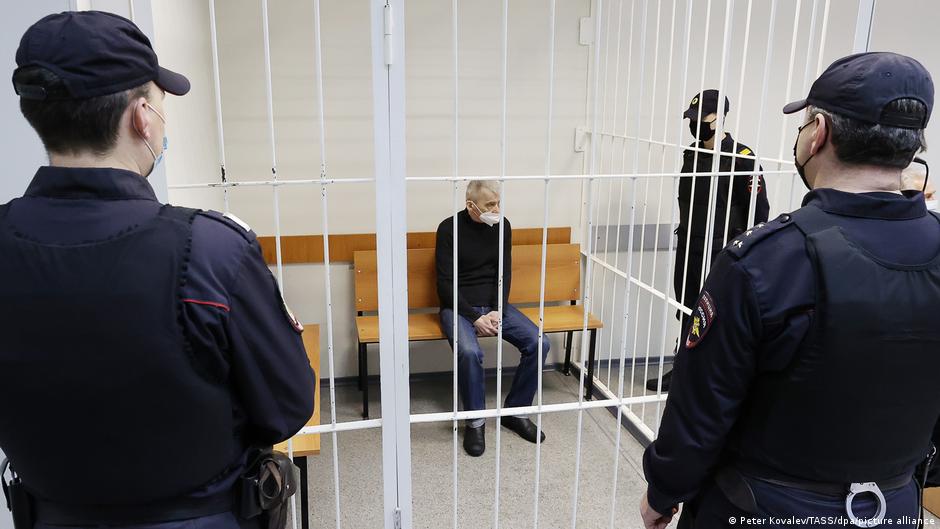
Russian historian Yury Dmitriev, the former head of Memorial’s branch in Karelia, has been returned from a prison hospital to his penal colony after being sent there with signs of a possible stroke, according to the rights project For Human Rights. The group said on Tuesday, October 13, citing an unnamed representative of Dmitriev’s support group, that doctors were unable to establish a diagnosis because the facility lacked the necessary diagnostic equipment.
The account adds another layer to a case that has long stood at the intersection of law, historical memory and state power. For an economic publication, it also points to a structural question often overlooked in political prosecutions: the cost of maintaining a punitive system that expands coercive capacity while leaving basic institutional services, including prison healthcare, under-equipped.
“He is not feeling very well. There was a suspicion of a stroke, but no diagnosis was made: the hospital has no equipment for diagnostics,” the representative told the rights group.
According to the same account, Dmitriev received a course of injections, though it was not known what medication was administered. He was reportedly prescribed bed rest until October 28, but the representative said the colony had not initially been aware of that order and was not allowing him to lie down. She later added that the information about bed rest may have since reached the colony.
The representative also said Dmitriev had repeatedly been placed in a punishment cell for alleged disciplinary violations. The examples she cited included an unfastened top button on his shirt, sitting on a bed, and feeding a cat.
Prison Healthcare and the Economics of Capacity
Dmitriev was urgently hospitalized on September 25 from Penal Colony No. 18 in Potma, Mordovia, to a medical correctional facility in the settlement of Barashevo. The online outlet Current Time reported that he had severe weakness, impaired coordination and was unable to stand on his own.
In economic terms, the reported absence of diagnostic equipment in a prison hospital is not merely a medical detail. It reflects a familiar allocation problem inside coercive institutions: the state can sustain the machinery of confinement while failing to provide the infrastructure needed to manage the health risks that confinement itself creates. Where prison medicine lacks equipment, the burden is shifted onto inmates, relatives, lawyers and outside advocacy groups, while the public system absorbs the long-term reputational and administrative costs.
That imbalance has historical resonance in Russia. Penal systems have repeatedly functioned not only as tools of punishment, but also as mechanisms through which the state distributes scarcity, labor, discipline and social exclusion. Dmitriev’s own scholarly work focused on the victims of political repression in Karelia in the 1930s and 1940s, including the history of the White Sea Canal. He compiled and published Books of Remembrance for victims of Soviet-era repression and identified mass burial sites in Sandarmokh and Krasny Bor.
Those historical parallels matter because they frame the current case as more than an individual legal dispute. Dmitriev’s supporters have argued that the prosecution was connected to his human rights activity and his work restoring the memory of those repressed by the Soviet state. The economic consequence of such cases is hard to measure in conventional budget lines, but it is visible in institutional incentives: archives, historical research, civil society networks and rights monitoring all become risk-bearing activities.
A Long Legal Case
Dmitriev’s criminal prosecution began in 2016, when the first case was opened against him on suspicion of producing pornographic images of his adopted daughter. A court acquitted him, but a new case was launched in 2018.
On July 22, 2020, a court in Petrozavodsk sentenced Dmitriev to three and a half years in a strict-regime penal colony on a charge of sexual violence against a minor. In September 2020, the Supreme Court of Karelia toughened the sentence to 13 years in a strict-regime colony. Dmitriev was also accused of producing child pornography, committing indecent acts and illegally possessing a weapon. On December 27, 2021, the Petrozavodsk City Court issued a final sentence for the then 65-year-old historian: 15 years in a strict-regime colony, taking into account the earlier term.
Dmitriev has denied guilt. On March 15, 2022, the Supreme Court of Karelia rejected his appeal. Calls for his release have come from the European Union, as well as scholars and cultural figures from different countries.
In March 2026, the European Court of Human Rights in Strasbourg ordered Russia to pay Dmitriev, who remains imprisoned, 2,000 euros in compensation for moral damage caused by excessively long pretrial detention and the absence of a fair trial. Kremlin spokesman Dmitry Peskov said at the time that Moscow did not recognize the ruling.
The legal and diplomatic dimensions of the case are already well established. The latest report about Dmitriev’s health, however, highlights a different and more practical issue: whether the institutions responsible for incarceration are capable of providing the care that follows from their control over a person’s life. In a system where court rulings, disciplinary sanctions and medical capacity meet behind prison walls, the economic question is not only what the state spends, but what kind of institutional order that spending produces.



