Russia Labels StopTime Musicians ‘Foreign Agents’ After Year of Pressure
The designation highlights how political controls are reshaping Russia’s cultural economy, informal labor market and artistic migration.
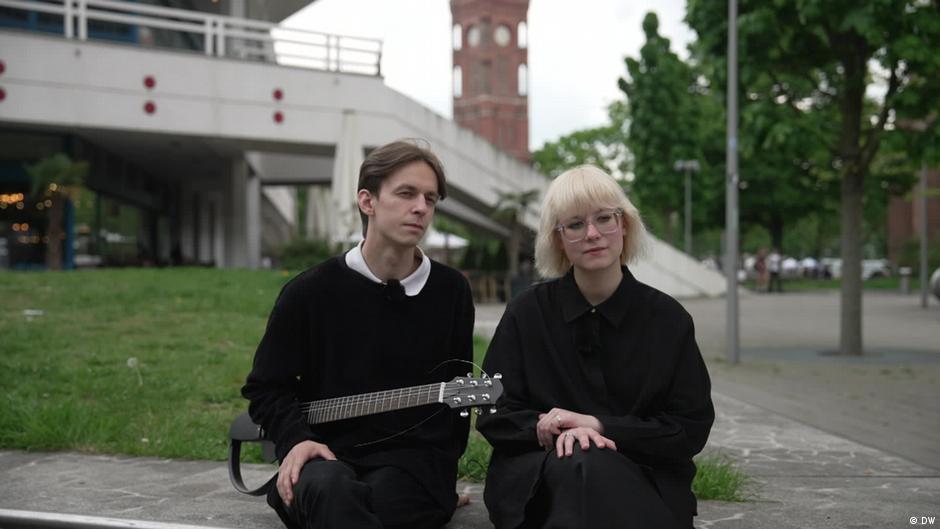
Russia’s Justice Ministry has added two members of the street-music group StopTime to its register of “foreign agents,” marking a new stage in a case that began with performances in central St. Petersburg and escalated through repeated administrative arrests.
The designation covers 19-year-old vocalist Diana Loginova, who performs under the name Naoko, and her husband, 23-year-old guitarist Alexander Orlov. The ministry published the decision on Friday, October 16, exactly one year after the musicians received their first administrative detention orders.
According to the ministry’s stated justification, Loginova opposed the war in Ukraine, disseminated what the authorities described as “inaccurate information” about the decisions and policies of the Russian government, and interacted with people already designated as foreign agents. Orlov, the ministry alleged, “actively participated in the dissemination of anti-Russian materials.”
The case illustrates how a regulatory label can extend the economic consequences of political enforcement beyond a courtroom or detention facility.
The register was also expanded on October 16 to include the movement Malinovy Klin — Independent Kuban. Russian authorities accused the organization, among other things, of calling for a violation of the country’s territorial integrity.
From street performances to sustained enforcement
StopTime emerged as a street group performing in St. Petersburg from the spring of 2025. Until January 2026, its lineup also included drummer Vladislav Leontiev. Concerts were announced through social media and featured songs by Noize MC, Monetochka, Zemfira and the band Pornofilmy. All of those performers have themselves been designated “foreign agents” by the Russian Justice Ministry.
At one performance in October 2025, StopTime played Noize MC’s song “Swan Lake Cooperative.” A St. Petersburg court had ruled in May that the song constituted “information prohibited in the Russian Federation.” The performance therefore placed a small, informal cultural event within a broader system of legal restrictions governing both political expression and the circulation of artistic material.
The musicians’ first administrative case concerned a concert near the Ploshchad Vosstaniya metro station. Police said 70 people attended. Loginova, Orlov and Leontiev were found guilty of organizing a mass event that caused a “disturbance of public order” and were placed under administrative arrest.
When the initial detention periods expired, authorities drew up new reports against the group’s members. These successive cases, often described as “carousel” prosecutions, kept them in custody almost until the middle of November. After a third consecutive arrest, Loginova and Orlov left Russia. Leontiev remained in the country and subsequently departed the group.
The economics of cultural restriction
Although the StopTime case centers on political speech and public performance, it also reveals the economic mechanics of cultural regulation. Street musicians typically operate in a low-cost, decentralized segment of the creative economy. They need no large venue, major promoter or extensive production infrastructure. Social media can connect performers directly with audiences, while public space functions as both stage and distribution channel.
That model becomes more difficult when a gathering can be treated as an unauthorized mass event and when a repertoire can create additional legal exposure. The direct consequences fall on performers through detention, interrupted work and eventual relocation. The indirect effects reach a wider network that can include collaborators, organizers and digital communities. Even without a formal ban on every performance, uncertainty can narrow the range of music that artists are prepared to play and the public spaces they are willing to use.
The foreign-agent designation adds another layer to this pressure. In economic terms, such status can operate as a barrier to participation in the domestic cultural market by increasing compliance burdens and reputational risk. For young artists, whose earnings and professional networks may still be fragile, those constraints can be especially consequential. The timing in this case is notable: the designation arrived after Loginova and Orlov had already left Russia, demonstrating how administrative control can continue to shape an artist’s relationship with the domestic market after physical departure.
Migration and the loss of cultural capacity
The group’s breakup also reflects a structural choice confronting politically exposed creative workers: remain in Russia under heightened legal risk, or move abroad and surrender direct access to a familiar audience and performance environment. Loginova and Orlov chose departure after their third arrest, while Leontiev stayed and left the band. The result was not simply the relocation of two individuals but the fragmentation of a working creative unit.
Historically, periods of tighter political control over culture have often redirected artistic production rather than eliminating it. Work moves from public spaces to private settings, from domestic platforms to audiences abroad, or from formal organizations to looser networks. In the digital era, artists can retain some contact with listeners after emigration, but geographic distance still affects live performances, collaboration and the formation of new local audiences.
For Russia’s cultural economy, the longer-term issue is cumulative. Each individual case may involve a small group, a modest crowd or a limited commercial operation. Taken together, however, repeated enforcement can change incentives across an entire sector. Emerging performers may avoid politically sensitive material, withdraw from public performance or consider emigration before building sustainable careers at home.
The StopTime case began with street concerts attended by relatively small audiences. One year after the first arrests, it has developed into an example of how public-order rules, restrictions on content and the foreign-agent system can combine. The immediate subject is a young musical group; the broader consequence is a more constrained environment for cultural production, informal enterprise and the retention of creative labor.



