Distress Call Exposes Economic Risks Behind Russia’s Shadow Fleet
The sanctioned tanker MYRA’s Atlantic emergency highlights the mounting costs and structural vulnerabilities of sanctions-evasion shipping.
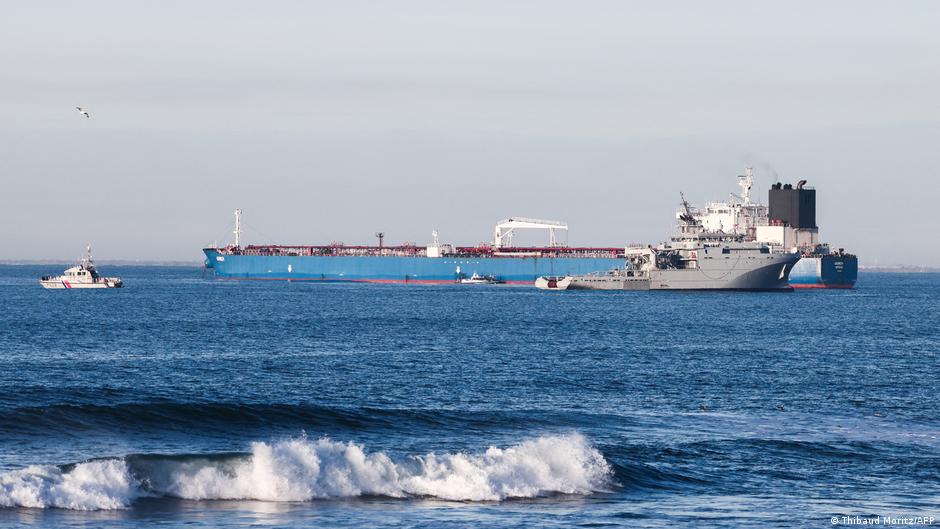
The sanctioned oil tanker MYRA has issued a distress signal in the North Atlantic off Ireland’s northwestern coast, drawing attention to the economic and operational risks embedded in the shipping networks used to move Russian oil around Western restrictions.
SeaNews, a maritime monitoring project, reported on Saturday, October 24, that the distress alert was transmitted through the Inmarsat-C satellite system. The UK Coastguard is coordinating the response.
The 75,000-ton vessel had departed from the Russian port of Ust-Luga and was approximately 348 kilometers from the coast when the alert was sent. Despite extreme weather, it continued moving at around 9 knots, or roughly 17 kilometers per hour. SeaNews said waves in the area reached 8.8 meters, while wind gusts approached 130 kilometers per hour.
The immediate incident is a maritime emergency, but it also illustrates a broader economic consequence of sanctions: trade does not necessarily disappear when formal channels close. Instead, it can migrate into more opaque and potentially fragile networks involving intermediaries, frequently changing corporate structures and vessels operating under multiple layers of jurisdictional complexity.
The economics of sanctions evasion
According to the War & Sanctions database maintained by the Main Intelligence Directorate of Ukraine’s Defense Ministry, known as the GUR, MYRA has been used to export Russian oil and petroleum products to third countries in circumvention of sanctions. Ukrainian intelligence links the ship to Fractal Marine DMCC, a company registered in the United Arab Emirates that the GUR describes as one of the leading operators of Russia’s so-called shadow fleet.
Such fleets have become an important part of the infrastructure surrounding sanctioned commodity exports. Their economic function is to preserve access to buyers and foreign currency earnings when conventional shipowners, insurers, financiers and service providers face legal or commercial restrictions. The resulting system may sustain export volumes, but it also shifts costs away from transparent market channels and into less visible forms of risk.
The MYRA emergency shows how sanctions-evasion networks can preserve trade flows while concentrating operational, financial and environmental exposure in harder-to-monitor parts of the shipping market.
For Russia, the continued operation of these vessels supports the movement of oil and refined products beyond the reach of some Western restrictions. For counterparties, however, the model can introduce uncertainty over ownership, insurance coverage, maintenance standards and liability. A distress signal in severe Atlantic weather does not itself establish that sanctions or ownership arrangements caused the emergency. It does, however, demonstrate why the condition, oversight and financial backing of sanctioned vessels have consequences beyond the countries directly involved in the trade.
A network spanning ports and jurisdictions
The GUR database states that MYRA repeatedly called at the Russian ports of Ust-Luga and Primorsk. It also visited ports in Senegal, Turkey, Brazil, Estonia and Denmark. That geographic reach reflects the international character of energy logistics: even when a cargo originates in a sanctioned economy, its transportation can depend on companies, registries, ports and services spread across numerous jurisdictions.
War & Sanctions records a progressively widening set of restrictions against the vessel. The United States listed MYRA on July 30, 2025, followed by the European Union on October 24, 2025. Switzerland and Ukraine imposed sanctions on December 13, 2025, the United Kingdom followed on February 24, 2026, and Canada listed it on March 25, 2026.
This sequence points to the cumulative nature of maritime sanctions. A vessel may lose access to reputable insurance, finance, technical services or ports as more jurisdictions add it to their lists. At the same time, fragmented enforcement can encourage operators to restructure ownership and commercial relationships, increasing the complexity and expense of monitoring shipments.
The alleged Iranian connection
Ukrainian intelligence alleges that MYRA belongs to a shipping network controlled by Mohammad Hossein Shamkhani. He is the son of Ali Shamkhani, the former secretary of Iran’s Supreme National Security Council and an adviser to the country’s supreme leader, who was killed in a joint US-Israeli operation in February 2026.
According to the GUR’s account, the younger Shamkhani controls a network of tankers, operators and front companies involved in money laundering and the transportation of Russian and Iranian oil, including supplies destined for China. These are claims by Ukrainian intelligence; the source article provides no response from Shamkhani or Fractal Marine DMCC.
If the network operates as described, it would show how the sanctions pressure facing separate oil-exporting states can foster shared commercial infrastructure. Tankers, intermediaries and corporate vehicles can serve more than one sanctioned supply chain, spreading fixed costs across Russian and Iranian cargoes and connecting them to major importing markets.
That structure also creates systemic vulnerabilities. An accident, detention or service denial affecting one vessel can expose relationships extending across multiple companies and jurisdictions. Rescue operations may still fall to public authorities, while disputes over responsibility and compensation can become more difficult when ownership and insurance arrangements are opaque. MYRA’s distress call therefore carries an economic significance beyond one ship: it highlights the hidden costs transferred to maritime safety systems, coastal states and the wider trading network when sanctioned energy commerce moves into less transparent channels.