Italy’s Cost-of-Living Protests Expose Deepening Economic Strains
Demonstrations over prices, fuel costs and public policy reveal widening pressure on households and mounting political risks for Rome.
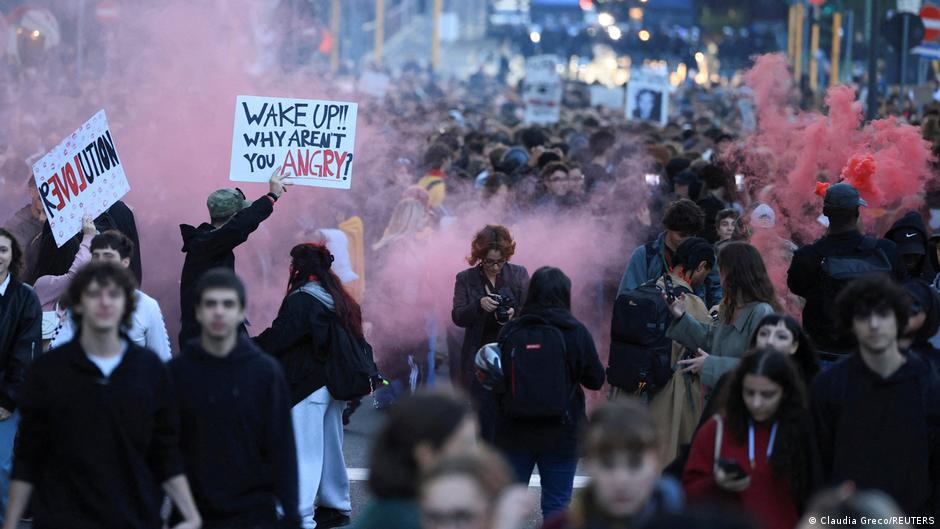
Protests returned to Italian cities on Saturday, October 24, as anger over the high cost of living, rising fuel prices, military expansion and Prime Minister Giorgia Meloni’s government brought demonstrators back onto the streets. Although most gatherings remained peaceful for much of the day, confrontations in Milan, Bologna and Turin underscored the political volatility created when prolonged pressure on household budgets converges with broader opposition to government policy.
Police reported nine arrests and 371 preliminary detentions, including 110 involving minors, according to AFP. The scale of the police response reflected the authorities’ concern following demonstrations on October 17 and 18 that descended into unrest. Ahead of the latest protests, the government strengthened security measures and deployed 500 troops from elite units to Milan.
Authorities also simplified procedures for detaining minors and imposing financial penalties on their parents when property is damaged. Drones and helicopters were used to monitor demonstrations, patrols were reinforced at railway stations, and online activity was closely tracked for new calls to disorder.
Household pressures become a political challenge
The protests illustrate how cost-of-living grievances can expand beyond disputes over individual prices. Fuel costs have an especially broad economic effect because they influence household transport expenses and the cost of moving goods. When such increases persist, consumers may reduce discretionary spending, placing additional pressure on retailers, restaurants and other businesses dependent on domestic demand.
That dynamic can turn inflation from an economic indicator into a question of political legitimacy. Households typically experience the cost of living through recurring payments for food, transport, housing and utilities rather than through national averages. Even when headline inflation slows, the accumulated increase in price levels can leave families feeling that economic conditions have not improved. Governments therefore face a difficult gap between statistical stabilization and public perceptions of continuing hardship.
In Italy, the demonstrations combined material concerns with opposition to increased armament and the Meloni government’s wider agenda. This mixture matters because it creates a coalition of grievances rather than a protest movement organized around a single demand. Economic frustration can give momentum to causes involving public spending priorities, foreign policy and policing, while those issues can in turn broaden participation beyond groups directly mobilized by fuel or consumer prices.
When purchasing-power concerns merge with disputes over public spending and state authority, a cost-of-living protest can become a wider test of government credibility.
Security measures carry economic consequences
In Milan, demonstrations were largely peaceful until the evening, dpa reported, but protesters and law enforcement officers eventually clashed in the city center. Police stopped a procession and used batons. Fearing renewed unrest, owners of many luxury stores barricaded their windows.
The defensive measures taken by retailers show one immediate economic consequence of repeated disorder: businesses begin pricing political risk into daily operations. Barricading storefronts, adjusting working hours and protecting inventory impose costs even when no damage occurs. In high-value shopping districts, the visual closure of stores can also reduce foot traffic and weaken the sense of normal commercial activity on which city-center retail depends.
Police in Bologna used tear gas and water cannon to prevent a column of demonstrators from approaching the railway station. In Turin, officers pushed protesters back with shields. Railway stations are not only transport hubs but crucial nodes in urban and regional economies, making their protection central to efforts to prevent protests from disrupting mobility, commerce and work.
Rome saw a predominantly pro-Palestinian demonstration pass through the historic center. At one point, participants entered the Colosseum, according to dpa. Protests were also held in Naples and Florence, showing that the mobilization was not confined to one city or one regional economy.
A familiar tension in Italian political history
Italy has a long tradition of street mobilization in which labor, student, anti-war and anti-government causes overlap. The latest demonstrations fit that broad historical pattern without reproducing any single earlier episode. Their significance lies in the convergence of economic insecurity, international political concerns and resistance to government policy across several major cities.
The state’s response also reveals a familiar policy dilemma. Stronger policing may limit property damage and protect transport infrastructure, but extensive detentions, surveillance and special measures affecting minors can intensify debate over proportionality. The inclusion of parental fines for property damage shifts part of the financial burden of unrest onto families, linking public-order policy directly to household finances.
For the Meloni government, the structural challenge extends beyond restoring order. If households continue to feel squeezed, enforcement alone cannot resolve the economic sources of discontent. At the same time, any effort to relieve pressure through subsidies or tax reductions must compete with other spending priorities, including defense and security. The protests therefore expose a deeper fiscal conflict: citizens are demanding protection from rising living costs while also contesting how the state allocates limited resources.
Whether the movement persists will depend partly on its ability to unite different demands and partly on the government’s response to the underlying economic pressures. The events in Milan, Bologna, Turin, Rome, Naples and Florence indicate that the political effects of high living costs are spreading well beyond household budgets, influencing public order, retail activity, transport security and the national debate over government priorities.