Brazilian Supreme Court Sentences Eduardo Bolsonaro to Prison Over Foreign Lobbying
Eduardo Bolsonaro, son of former Brazilian president Jair Bolsonaro, received a four-year prison sentence for advocating US sanctions against Brazil.
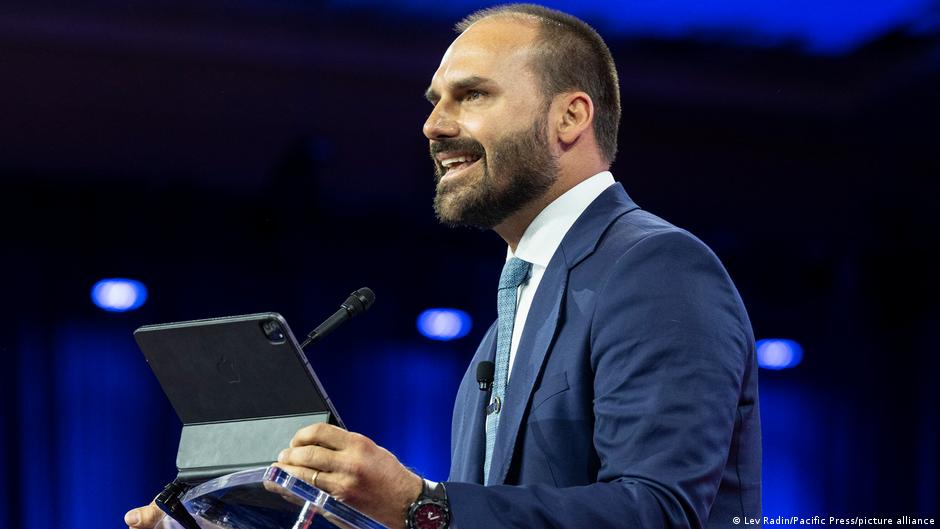
The Brazilian Supreme Court has sentenced Eduardo Bolsonaro, son of former president Jair Bolsonaro, to four years and two months in prison. The ruling was delivered in absentia, as Eduardo currently resides in the United States.
The 41-year-old former federal deputy was convicted for urging the United States to impose sanctions on Brazil amid judicial proceedings against his father. The court concluded that his actions constituted threats against the judiciary and other branches of government.
Lobbying Abroad and Its Political Implications
Judge Alexandre de Moraes stated that Eduardo Bolsonaro lobbied foreign interests that contradicted Brazil's national interests. This conviction also bans Eduardo from holding any public office for eight years. From 2015 to 2023, he served as a deputy in Brazil's lower house of Congress.
The ruling is part of broader legal actions against the Bolsonaro family. Jair Bolsonaro, who was president from 2019 to 2023, was convicted in September 2025 for plotting a coup attempt and trying to violently overthrow the government, receiving a sentence of 27 years and three months in prison.
"Lobbying for foreign interests against the nation's own interests undermines democratic institutions and threatens the sovereignty of Brazil," said Judge Alexandre de Moraes.
Eduardo Bolsonaro's arrest will be enforced if he returns to Brazil. Meanwhile, the political landscape remains turbulent ahead of the presidential elections scheduled for October 2026. Luis Inacio Lula da Silva, the current president, is seeking re-election, while Flavio Bolsonaro, another son of the imprisoned former president, plans to run against him, signaling ongoing political divisions.
Economic and Structural Consequences
The Bolsonaro family’s legal troubles and political divisions have significant implications for Brazil's economic stability and institutional trust. The politicization of judiciary and executive conflicts risks weakening governance frameworks essential for economic reform and investor confidence.
Moreover, Eduardo Bolsonaro’s foreign lobbying efforts and the resulting backlash highlight the complexities of Brazil's international relations, particularly with the United States. Such conflicts may affect bilateral trade negotiations, foreign investment flows, and Brazil’s positioning in global markets.
As Brazil approaches the 2026 elections, the intertwining of political vendettas and judicial processes could prolong uncertainty. Historically, Brazil has faced economic downturns amid political crises, underscoring the importance of restoring institutional balance to sustain growth and social development.