German Protests Against Far Right Signal Rising Institutional Strain
Demonstrations across more than 35 German cities underscored how political polarization is becoming an economic and institutional risk.
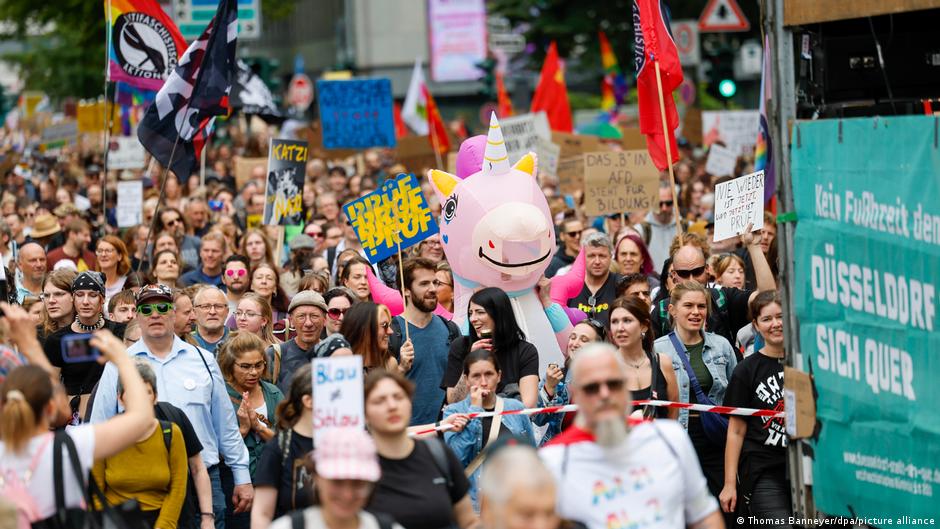
Mass demonstrations against right-wing extremism took place in more than 35 German cities on September 12, drawing tens of thousands of people into the streets one week after the far-right Alternative for Germany, or AfD, won state elections in Saxony-Anhalt. The protests were organized by more than 100 associations and reflected a widening debate over how Germany’s political institutions should respond to a party that has gained electoral momentum while facing scrutiny from domestic intelligence authorities.
In Hamburg, organizers estimated turnout at 25,000 people. In Düsseldorf, about 20,000 people joined the demonstrations, a figure also confirmed by local police. In Berlin, law enforcement estimated that 18,000 people took part, while public broadcaster ARD reported around 12,000 demonstrators in Munich. About 2,000 people protested in Mainz.
Smaller rallies were also held in several state capitals and regional centers. In Magdeburg, the capital of Saxony-Anhalt, around 1,100 people took part. Saarbrücken saw about 1,500 demonstrators, Erfurt several hundred, and Schwerin, the capital of Mecklenburg-Western Pomerania, several dozen. Schwerin’s protest came one week before local elections in a state where polls also showed the AfD in the lead.
Political Risk Moves From Margins to Institutions
For Germany, the protests are not only a social or moral response to right-wing extremism. They point to a deeper institutional stress test for Europe’s largest economy. Germany’s postwar political order has long relied on consensus, coalition discipline, and a broad rejection of extremist politics. That framework has helped support the country’s economic model by giving investors, trade partners, employers, and workers a relatively predictable operating environment.
The latest demonstrations suggest that the question of how to contain or confront the AfD is moving from the margins of political debate into the center of institutional and economic life. The party’s victory in Saxony-Anhalt and its polling strength in Mecklenburg-Western Pomerania have sharpened concerns about whether Germany’s traditional parties can maintain the political barriers that have limited cooperation with the far right.
That barrier is often described as a “firewall” against the AfD: a refusal by other parties to cooperate with it. But the public consensus behind that policy appears contested. An INSA opinion poll conducted on September 10 and 11 found that 46% of Germans opposed the firewall policy, while 34% supported maintaining the barrier and 20% were undecided. Those figures indicate that the issue is no longer confined to party elites or activist networks; it is also dividing voters.
The same poll showed a similarly split public view on a potential ban of the AfD. Some 42% of respondents supported banning the party, while 45% were opposed. For policymakers, that creates a dilemma. A ban procedure could be presented by supporters as a defense of constitutional democracy, but opponents may view it as a restriction on political choice. Either path carries consequences for trust, legitimacy, and social cohesion.
“No step back! Against the AfD and right-wing incitement!” was the slogan used at demonstrations in Düsseldorf.
In Hamburg, protesters marched under the slogan “Time to act — freedom must be defended.” These slogans show how campaigners are framing the issue: not simply as opposition to a party, but as a defense of democratic freedoms. That framing has economic relevance because democratic stability is part of Germany’s broader institutional infrastructure. Courts, regulatory agencies, public procurement, labor relations, and federal-state coordination all depend on confidence that political competition remains bounded by constitutional norms.
The Ban Debate and Germany’s Economic Model
Several demonstrations, including those in Munich, Mainz, Saarbrücken and Magdeburg, were held as part of the Prüf campaign. The campaign calls for thorough scrutiny of parties classified by the Federal Office for the Protection of the Constitution, known as BfV, as either “suspected” of right-wing extremism or “definitely right-wing extremist.” The German word “Prüf” means “check,” and organizers present it as an acronym for “Prüfung Rettet Übrigens Freiheit,” meaning “Checking, by the way, saves freedom.”
As a result, the rallies included calls to launch proceedings to ban the AfD. In May 2025, the BfV classified the AfD as right-wing extremist at the federal level. That classification, however, is not yet in force because the party has filed a lawsuit. This unresolved legal status is central to the current confrontation. Germany’s institutions are being asked to determine whether the AfD should be treated as an ordinary opposition party, a security concern, or a potential target of constitutional prohibition.
The economic implications are indirect but significant. Political fragmentation can complicate fiscal planning, investment decisions, labor market policy, energy policy, and regional development. Germany’s federal structure means that state-level election outcomes can influence national policy capacity, especially when regional governments become harder to form or when cooperation across parties becomes more difficult.
Historical parallels are hard to ignore in Germany’s public debate, though the present situation has its own legal and political context. The Federal Republic was built with safeguards designed to prevent anti-democratic movements from using democratic institutions to undermine democracy itself. That constitutional architecture has always involved a tension between pluralism and protection. The current dispute over the AfD is testing where that line should be drawn in a much more polarized electoral environment.
The protests also highlight a broader structural challenge facing advanced economies: political legitimacy is becoming a core economic variable. When large parts of the population question established political barriers, and when large counter-mobilizations demand stronger institutional action, economic governance becomes harder. Businesses may still focus on taxes, regulation, energy costs, and labor shortages, but the political framework beneath those issues matters.
Germany’s demonstrations on September 12 therefore represent more than a weekend of street politics. They reveal an economy whose institutional foundations are being debated in public squares, courtrooms, party headquarters, and polling data at the same time. Whether the firewall holds, whether a ban procedure advances, and how voters respond in future regional contests will shape not only Germany’s political system but also the predictability on which its economic model depends.