Pussy Riot and Femen Protest Russia’s Representation at Venice Biennale Amid Political Controversy
Activists demand that Russian political prisoners with pro-Ukrainian views represent Russia at the Venice Biennale instead of official state-backed exhibits.
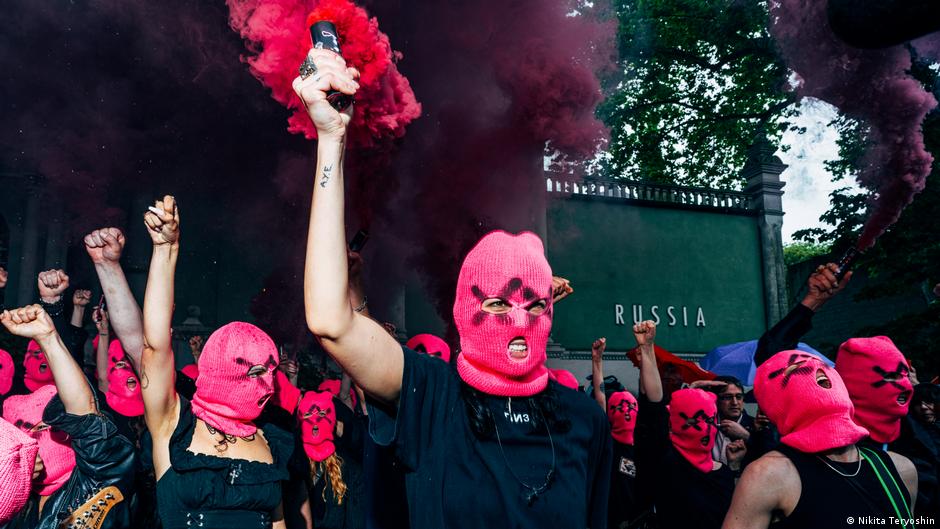
The Venice Biennale, one of the world’s most prestigious contemporary art exhibitions, has become a stage for a potent political protest involving prominent activist groups Pussy Riot and Femen. On May 6, members of these feminist and punk movements staged a demonstration outside the Russian pavilion in Venice, demanding that Russia be represented not by state-backed artists but by political prisoners incarcerated for their anti-war and pro-Ukrainian stances.
Art, Politics, and the War’s Shadow at the Biennale
The protest unfolded with activists igniting pink, yellow, and blue smoke flares—the colors symbolizing the Ukrainian flag—and chanting slogans such as "Russian art is blood." They held placards reading "Enjoy the show - ignore the war," "Curated by Putin, corpses included," and "Art on display, graves below," with some protesters inscribing these phrases on their bodies. Ukrainian flags and masks were hung on statues around the pavilion, starkly challenging the official narrative presented inside.
"The best citizens of Russia are either imprisoned for anti-regime and pro-Ukrainian actions or killed in dungeons, while Europe opens its doors to Putin’s officials and propagandists," said Pussy Riot member Nadezhda Tolokonnikova, emphasizing the need for genuine representation from dissident voices.
Russia’s participation in this year’s Biennale marks its first presence since the full-scale invasion of Ukraine began in February 2022. The decision to allow Russia’s pavilion has been met with sharp criticism from the European Union and Ukraine, with the European Commission stating that it violates EU sanctions legislation. Organizers responded by limiting the pavilion’s public access to only three days—from May 6 to May 8—for invited guests, during which a continuous sound performance titled "Tree Rooted in the Sky" will be featured. The pavilion will remain closed to the general public starting May 9.
This controversy has led to significant fallout within the Biennale’s organizational structure. The jury has excluded Russia and Israel from award considerations and subsequently resigned in protest, highlighting the deep tensions and ethical dilemmas faced by international cultural institutions navigating geopolitical conflicts.
Structural Implications and Historical Parallels
The protest at the Venice Biennale exemplifies how contemporary art platforms are increasingly entangled with global political struggles, especially those involving authoritarian regimes. Historically, art exhibitions have served as arenas for soft power and cultural diplomacy. Yet, this incident reveals the limits of such diplomacy when domestic repression and international aggression collide.
Russia’s pavilion is managed by Smart Art, a company founded by Ekaterina Vinokurova and Anastasia Karneyeva. Notably, Karneyeva is the daughter of a retired general and former deputy director of the state defense conglomerate Rostec, while Vinokurova is the daughter of Russian Foreign Minister Sergey Lavrov. This close connection between the pavilion’s leadership and the Russian political-military elite deepens concerns about the pavilion’s role as a propaganda vehicle rather than an independent artistic forum.
As Tolokonnikova and Femen leader Inna Shevchenko assert, the true foundation of Russia’s exhibited art this year is "invisible but real: Ukrainian blood." This metaphor highlights how cultural events—often perceived as neutral or apolitical—can inadvertently legitimize or obscure the human costs of geopolitical conflicts.
The exclusion of Russia from award nominations and the jury’s resignation reflect broader challenges faced by the global art community: balancing artistic freedom, cultural exchange, and ethical responsibility amid ongoing war and repression. The Venice Biennale’s handling of Russia’s participation may set precedents for how international cultural institutions address similar dilemmas in the future.
In conclusion, the protest by Pussy Riot and Femen at the Russian pavilion in Venice underscores the complex intersection of art, politics, and international conflict. It raises critical questions about representation, legitimacy, and the role of cultural institutions in times of war. Beyond the immediate controversy, it invites deeper reflection on the structural economic and political consequences of sanctioning or shielding state-sponsored art amidst geopolitical crises.