Russian Strikes Kill and Injure Dozens Across Ukrainian Regions
Attacks on homes, shops and energy assets underscore the mounting human and structural economic costs of prolonged war.
Russian strikes across several Ukrainian regions on Sunday, November 22, killed, injured or left missing dozens of people, according to Ukrainian regional authorities. The attacks hit residential buildings, shops, private businesses and infrastructure, illustrating how repeated damage to civilian and productive assets is extending the war’s consequences beyond the immediate casualties.
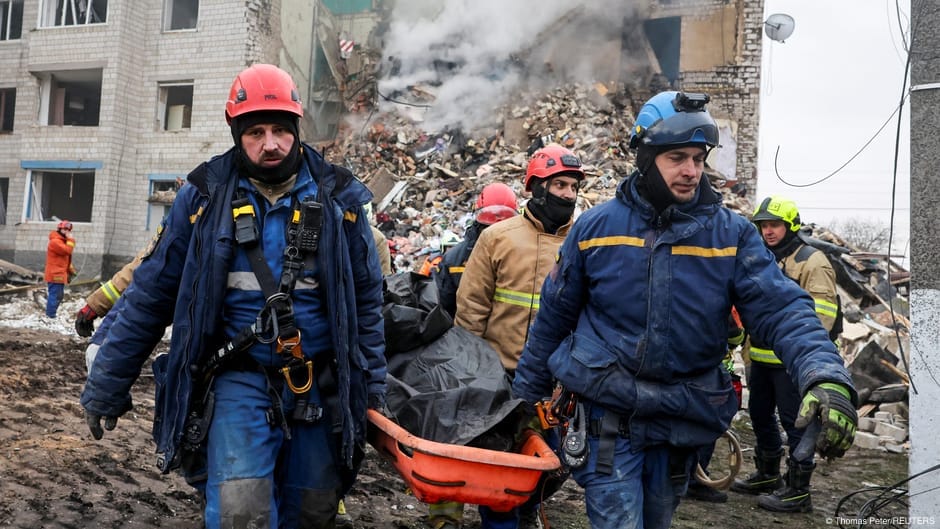
More than 10 people were killed in the Kyiv region. In the settlement of Dymer, in Vyshhorod district, nine people died after a Russian drone struck a five-storey residential building during the night. Rescuers recovered several bodies from the rubble of a destroyed section of the building and saved a child during the clearance operation.
In Vyshneve, in the Bucha district, three people were killed and 15 were injured when Russian forces attacked a supermarket containing shoppers, the Kyiv Regional Military Administration said. One injured person was in serious condition. Firefighters subsequently extinguished a blaze in the building. Ukrainian Telegram channels reported that a Russian drone had struck the Novus shopping centre.
Civilian damage compounds the economic burden
The targeting or incidental destruction of supermarkets, homes, vehicles and enterprises carries economic effects that accumulate alongside the loss of life. Retail sites provide essential goods and local employment, while damaged housing creates additional demand for emergency accommodation, repairs and public assistance. When attacks repeatedly affect the same regions, households and businesses must make decisions under persistent physical risk and uncertainty.
Kyiv regional administration head Tymur Tkachenko said an attack in the Bila Tserkva district caused a fire in a private house. A man was killed, and rescuers recovered his body from beneath the rubble. Four other people were injured. One woman was hospitalized with a traumatic brain injury, while another suffered injuries from the blast wave.
In Bila Tserkva, debris from a Russian unmanned aerial vehicle fell near a shop, injuring two people who were hospitalized. A private home, two cars and an enterprise were also damaged, Tkachenko said. Such dispersed damage can impose costs on households, municipal services and commercial operators simultaneously, complicating recovery even when individual incidents remain geographically limited.
In Dnipro, a woman was killed and two men were injured in Russian attacks, according to regional military administration head Oleksandr Hanzha. Residential buildings and infrastructure were damaged, while energy infrastructure was also struck.
“A woman was killed. A 22-year-old man is in serious condition. A 49-year-old man is in moderately serious condition,” Hanzha wrote on social media.
Hanzha said Russian forces attacked five districts of the Dnipropetrovsk region more than 40 times during the day, using drones, artillery and aerial bombs. The frequency and variety of the attacks demonstrate the scale of pressure placed on emergency responders and infrastructure operators, which must manage repairs while remaining exposed to further strikes.
Three people were injured in the Nikopol district, including a 64-year-old man in serious condition and a 65-year-old woman in moderately serious condition. In the Kamianske district, men aged 51 and 62 were hospitalized in moderately serious condition, and infrastructure was damaged. Two people were injured in the Synelnykove district, where a shop, a vehicle and infrastructure sustained damage. Infrastructure facilities were targeted in the Dnipro district.
Energy and business assets face repeated disruption
Damage to energy infrastructure and private enterprises has broader structural implications because it can interrupt production, commerce and household services beyond the locations directly hit. Repeated repairs consume labor, equipment and financial resources that would otherwise support investment or ordinary maintenance. For private companies, physical destruction can also mean lost inventories, suspended operations and uncertainty over whether facilities can reopen safely.
In the Donetsk region, Russian forces dropped a FAB-500 aerial bomb on a residential building in Sloviansk, the regional prosecutor’s office said. A woman and a 56-year-old local man were killed, while three other people were injured. Nine apartment buildings in the city were damaged.
In the Zaporizhzhia region, Russian forces attacked a civilian car with an FPV drone. The 68-year-old driver was wounded and remained in moderately serious condition, regional military administration head Mykhailo Semikin said. Damage to civilian mobility adds another layer of disruption, particularly where residents depend on road transport to reach workplaces, shops and medical services.
In Kharkiv, a Russian drone hit the roof of a nine-storey residential building in the Saltivskyi district, injuring a woman, according to regional administration head Oleh Syniehubov. In the Poltava district, a Russian drone struck the grounds of a private enterprise. Preliminary information indicated that nobody was injured, the Poltava Regional Military Administration said.
Taken together, the incidents show how the economic geography of the war extends from major cities to district centres and smaller settlements. The immediate priorities remain rescue operations and medical treatment, but each damaged home, store, vehicle, business and energy facility also adds to reconstruction needs. The cumulative result is a continuing transfer of public and private resources toward emergency response, replacement and repair, reinforcing the long-term economic consequences of the conflict.