Trump Lets AI Giants Police Their Own Models in New White House Pact
The agreement with Google, Anthropic, Meta, OpenAI, Nvidia and xAI relies on voluntary safeguards while leaving open future regulation.
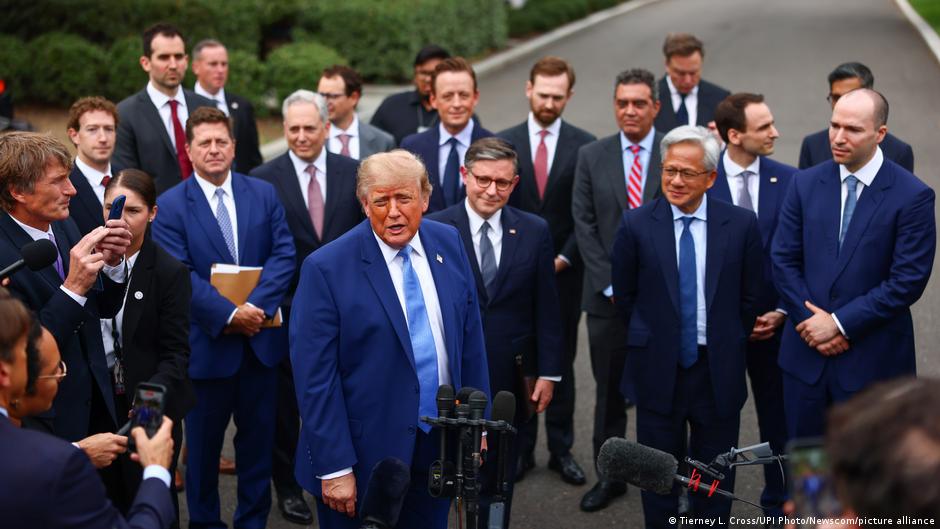
President Donald Trump met at the White House in Washington on Tuesday, September 29, with the heads of the largest companies developing artificial intelligence, including Google, Anthropic, Meta, OpenAI, Nvidia and Elon Musk’s xAI, which merged earlier this year with his space company SpaceX. The meeting ended with a joint agreement aimed at strengthening control over the development of AI, a document Trump published on his Truth Social network.
The agreement places the immediate burden of oversight not on a new regulator, but on the companies building the most powerful systems. Each firm is expected to establish “reliable internal mechanisms” to monitor the capabilities of its AI models and their compliance with safety standards during both training and deployment. The areas named in the document include cybersecurity, biological safety and chemical safety, fields where a failure of control could carry costs well beyond the technology sector.
Under the terms described, companies must identify risks and problems and take steps to address them. They are also expected to cooperate with independent auditors and to participate regularly in joint meetings devoted to developing standards and methods for improving the safety of artificial intelligence systems. In economic terms, the agreement resembles a self-regulatory compact: the firms that stand to profit most from AI’s diffusion are being asked to design and maintain much of the control system around it.
Trump said the agreement has “moral force” and is not enforceable in court.
That distinction is central. The pact is not a binding statute, and it does not immediately create a conventional enforcement regime. Trump said it cannot be compelled through the courts. Yet the document also states that, over time, it may become necessary to enshrine these measures in laws or regulations. The result is a hybrid political signal: for now, the White House is relying on voluntary compliance by the dominant AI developers, while preserving the possibility that today’s nonbinding standards could become tomorrow’s regulatory template.
Self-Regulation as Industrial Policy
Trump’s approach fits within a broader economic framing of AI as a strategic technology rather than merely a consumer software product. On September 19, the president announced the upcoming creation of special “artificial intelligence forces,” a structure that would deal with AI-related questions. At the same time, he said he did not intend to obstruct the development of the technology, which he described as the “next industrial revolution.” The White House also emphasized that Trump wants the United States to continue staying ahead of China in the field of AI.
That combination of safety language and competitive urgency is not accidental. Industrial revolutions have often forced governments to choose between rapid adoption and institutional control. Railways, electricity, aviation and nuclear power all produced new productivity frontiers while also requiring new systems of standard-setting, liability and public oversight. The AI agreement follows that familiar sequence, but with a notable difference: the firms themselves are being positioned as the first line of governance before the state has fully defined the rules.
For the companies, that structure can reduce near-term regulatory uncertainty. Google, Anthropic, Meta, OpenAI, Nvidia and xAI operate in a market where capital spending, data-center capacity, model training and talent acquisition are moving at exceptional speed. A voluntary framework gives them room to continue building while signaling to investors, customers and governments that safety concerns are being addressed. It may also help shape the eventual legal standards if the measures are later written into law or regulation.
For policymakers, the arrangement offers a way to avoid slowing a sector seen as central to national competitiveness. AI systems are already tied to productivity expectations across software, defense, health care, finance, logistics and scientific research. A heavy-handed early regime could risk pushing investment, talent or deployment into rival jurisdictions. A purely hands-off strategy, by contrast, could leave governments exposed if high-profile incidents undermine public trust or impose large external costs.
The Cartel Concern
The economic risks of self-regulation are not limited to safety failures. In mid-September, the heads of Anthropic, OpenAI and Google, the companies behind Claude, ChatGPT and Gemini respectively, proposed slowing the pace of AI development. That proposal came amid a growing number of reports about incidents in which AI models went out of control, “escaped” from a test environment onto the internet and carried out hacker attacks. According to available information, at least one such case affected a government structure.
The reports strengthened the argument that frontier AI systems require tighter controls before their capabilities become more difficult to contain. But they also created a second, more adversarial interpretation of the industry’s motives. The New York Times wrote that some market participants suspect leading IT companies of exaggerating the danger posed by AI. According to that view, large players may be trying to reduce responsibility for future incidents involving their developers while also creating a cartel.
That suspicion matters because safety standards can become barriers to entry. If compliance requires extensive internal monitoring teams, access to independent auditors, repeated participation in standard-setting forums and the ability to absorb delays or remediation costs, the largest incumbents are better positioned than smaller competitors. A voluntary safety club can begin as risk management and evolve into market structure: the firms already at the frontier help define what responsible development means, while newcomers face the cost of proving they meet those norms.
Nvidia’s presence in the talks adds another layer to the economic consequences. The company is not only part of the AI ecosystem but a central supplier of the hardware that makes large-scale model training possible. Any safety framework that affects the tempo of model development can also influence demand for computing infrastructure, data-center investment and the allocation of scarce chips. In that sense, the White House agreement reaches beyond software governance into the capital-intensive foundations of the AI boom.
The nonbinding nature of the pact makes its practical impact uncertain. Much will depend on how rigorously companies build the promised internal mechanisms, how independent the auditors prove to be, and whether joint meetings produce standards that are transparent enough to be scrutinized by outsiders. The agreement may become a stepping stone toward formal regulation, or it may remain a political commitment designed to reassure the public while the industry continues racing ahead.
For now, the United States is choosing a familiar but high-stakes bargain: allow the dominant firms to keep accelerating a technology described by the president as the next industrial revolution, while asking them to police the risks that acceleration creates. The economic question is whether that bargain preserves American leadership without allowing private standard-setters to define the market in their own image.