Armenia’s Parliamentary Elections Signal Strategic Shift Towards EU Integration
Prime Minister Pashinyan’s ‘Civil Contract’ party leads amid rising tensions with Russia over foreign policy direction.
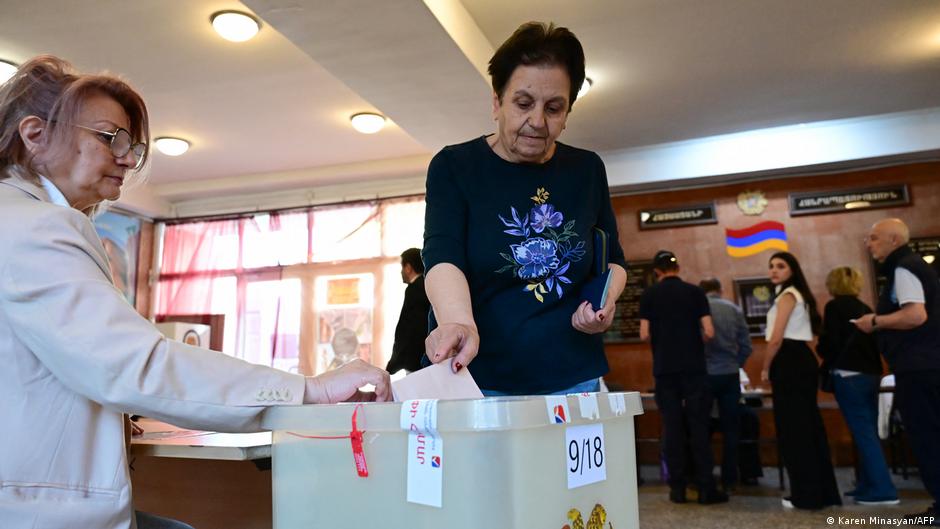
On June 7, Armenia held parliamentary elections with outcomes that could decisively shape the country’s geopolitical orientation for years to come. Preliminary results indicate that Prime Minister Nikol Pashinyan’s party, Civil Contract, is leading with 50.86 percent of the vote after processing 55.95 percent of ballots, according to the Central Electoral Commission (CEC).
The elections, which saw a turnout of 58.97 percent—higher than the 2018 and 2021 contests—featured 18 political parties competing under a proportional representation system. The Armenian National Assembly currently comprises 105 seats, including four reserved for minority communities such as Yazidis, Russians, Kurds, and Assyrians.
Political Landscape and Electoral Outcomes
Beyond Civil Contract’s commanding lead, the main opposition alliance Strong Armenia, headed by Samvel Karapetyan, a Russian-Armenian businessman, secured 23.19 percent of votes. The Armenia bloc, led by former President Robert Kocharyan, garnered 9.6 percent. Other parties surpassing thresholds include Prosperous Armenia at 4.1 percent and Wings of Unity with 2.3 percent.
"The Civil Contract party will form the government alone," declared Pashinyan at an early press briefing, even as less than 20 percent of votes were counted.
The Prime Minister’s premature claim of victory provoked sharp criticism from opposition forces. The Armenia bloc denounced it as a "step toward power usurpation" and an "unwarranted interference" in the Electoral Commission’s work. Arman Tatoyan, leader of Wings of Unity and former ombudsman, described Pashinyan’s statement as unconstitutional and beyond the remit of the head of government.
Legally, a stable parliamentary majority requires 54 percent of seats. If no party or coalition attains this threshold post-election, a second-round vote is mandated. The election threshold stands at 4 percent for parties, 8 percent for three-party blocks, and 10 percent for coalitions of four or more.
Geopolitical Implications and Structural Economic Effects
The election’s stakes extend beyond domestic governance to Armenia’s foreign policy trajectory. In 2025, Pashinyan legislatively enshrined a course toward closer integration with the European Union. This strategic pivot marks a fundamental shift from Armenia’s traditional reliance on Russia, setting the stage for a protracted period of geopolitical recalibration.
While Pashinyan asserts that his administration does not seek a rupture with Moscow, the opposition remains united in its preference to preserve robust ties with Russia. This divide manifests the broader contest between Eurasian and European integration models, each carrying distinct economic and security implications.
Russia’s response to this shift has been notably assertive. Kremlin officials, including President Vladimir Putin, have expressed concern, equating the situation in Armenia to the prelude to the Ukrainian crisis. In the run-up to the elections, Russia imposed import restrictions on Armenian alcoholic beverages, agricultural products, flowers, and fish—measures widely interpreted as political pressure.
Such economic sanctions risk exacerbating Armenia’s structural vulnerabilities. The country’s export-dependent sectors, particularly agriculture and food production, face disruption in their traditional Russian markets. This situation compels Yerevan to diversify trade and investment partnerships, potentially accelerating integration with European markets but also exposing domestic industries to adjustment costs.
Moreover, the political contest between pro-European and pro-Russian factions reflects long-standing historical parallels in Armenia’s balancing act between competing geopolitical spheres. The outcomes of these elections will therefore not only determine the immediate government composition but also influence Armenia’s economic orientation, foreign investment climate, and security arrangements.
As Armenia navigates this complex transition, the consolidation of parliamentary authority under Pashinyan’s party could facilitate the implementation of reforms aligned with EU standards. However, it also risks entrenching polarized domestic politics if opposition grievances remain unaddressed.
In sum, the June 2025 parliamentary elections in Armenia represent a critical juncture with far-reaching structural economic consequences. They epitomize the country’s ongoing struggle to define its identity and strategic partnerships amid regional power rivalries.