Bosnia Vote Reinforces Dodik’s Network and Dayton’s Economic Drag
Preliminary results point to continuity in Bosnia and Herzegovina’s power structure, with ruling parties consolidating control across key institutions.
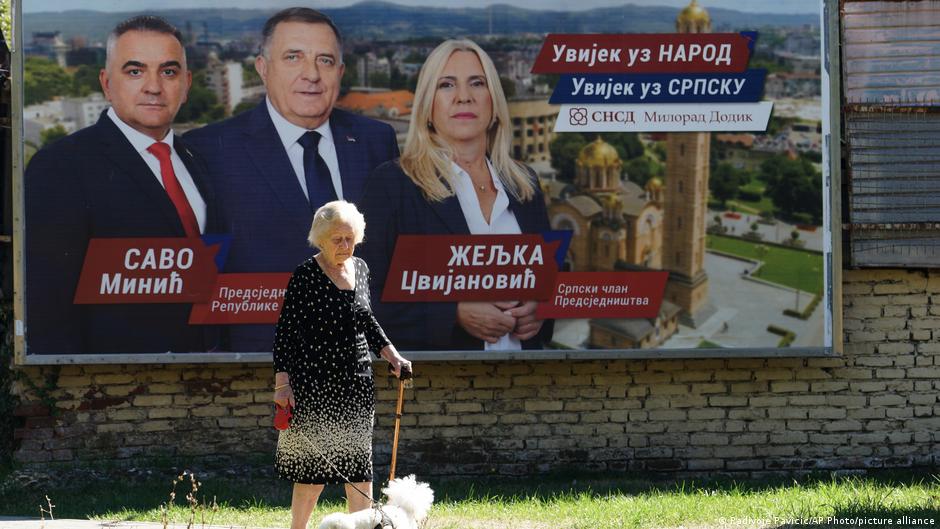
Preliminary election results in Bosnia and Herzegovina point to a familiar political outcome with wider economic implications: candidates from ruling parties have prevailed across the country’s main institutions, while allies of Milorad Dodik, the pro-Russian former president of Republika Srpska, retained influence despite his formal exclusion from politics.
Savo Minic, the prime minister of Republika Srpska, won the race for president of the Serb-majority entity. Minic was backed by Dodik, who remains the central figure in the Alliance of Independent Social Democrats, or SNSD. Dodik’s associate Zeljka Cvijanovic also secured the Serb seat in Bosnia and Herzegovina’s tripartite presidency, according to preliminary results.
The elections covered members of the state presidency, the central parliament, the two regional parliaments and the presidency of Republika Srpska. They produced few surprises. Preliminary results published by the Central Election Commission on Sunday evening, October 4, after 95% of ballots had been counted, showed candidates from parties already in power leading or winning the main contests.
Denis Becirovic, who had previously served as chairman of the presidency, remained ahead for the Bosniak seat with about 38% of the vote. Darijana Filipovic was set to represent Croats in the presidency with about 48%. Cvijanovic led the Serb race with about 55%, returning a politician already familiar with the institution.
Continuity Inside a Costly Constitutional Design
Bosnia and Herzegovina’s presidency is unlike that of most European states. The duties of head of state are performed jointly by representatives of Bosniaks, Croats and Serbs, who occupy three seats in the presidency. This arrangement was created under the 1995 Dayton Accords, which ended the civil war and attempted to balance the interests of Bosnian Muslims, Orthodox Serbs and Catholic Croats.
That architecture succeeded in freezing the conflict, but it also created a state whose economic governance is structurally fragmented. Many analysts regard the system as inefficient. For investors, creditors and trading partners, the issue is not only who wins elections, but whether the country can make and implement decisions across multiple layers of government. The latest vote suggests the answer remains heavily dependent on party machines entrenched inside Dayton’s institutional framework.
Many analysts regard Bosnia and Herzegovina’s post-Dayton system as inefficient, a political settlement that stabilised the country while constraining coherent governance.
The main uncertainty in this election cycle centred on Republika Srpska, the Serb-majority entity within Bosnia and Herzegovina. There, opposition candidate Branko Blanusa challenged Minic for the presidency of the entity. Preliminary results showed Minic ahead in most electoral districts. Blanusa won some districts, but Central Election Commission data indicated that those gains did not alter the overall result.
The contest mattered because Republika Srpska has often been the arena in which Bosnia’s institutional disputes become economic risks. Its leadership affects relations with the central authorities, the enforcement of court rulings and the country’s ability to project legal predictability. A victory for a Dodik-backed candidate therefore signals continuity not only in local politics, but also in the broader pattern of confrontation that can complicate state-level policy.
Dodik’s Formal Ban and Informal Power
Minic and Cvijanovic both ran under the banner of the SNSD, the party founded by Dodik, who previously served as president of Republika Srpska. In 2025, Dodik was forcibly removed from office for failing to comply with decisions of Bosnia and Herzegovina’s Constitutional Court and with international agreements. A court ruling barred him from political activity for six years.
Dodik has refused to recognise the court decision. He also travelled to Moscow seeking support, underscoring the geopolitical dimension behind Bosnia’s domestic political economy. On September 29, Dodik and Minic met Vladimir Putin in the Kremlin. Dodik has already congratulated both Minic and Cvijanovic on their victories.
The SNSD’s strength was not confined to the presidency of Republika Srpska. According to the Central Election Commission, the party was also winning the race for the entity’s parliament, the National Assembly. Most Bosnian Serb voters also backed the SNSD in elections to the lower chamber of the national parliament, the House of Representatives of the Parliamentary Assembly.
For an economic readership, the lesson is that Bosnia’s political centre of gravity remains dispersed but not unstable in a purely electoral sense. The same networks continue to command support. The risk lies elsewhere: in the persistence of a governance model in which party continuity does not necessarily translate into administrative efficiency, reform capacity or institutional credibility.
The Dayton settlement remains the historical reference point. It created peace after war, but the political economy that emerged from it is unusually complex. Power is divided between the state level, two entities and competing communal mandates. Elections therefore often reproduce a system in which legitimacy is fragmented, veto points are numerous and economic policy can be slowed by constitutional design as much as by ideological disagreement.
The preliminary results suggest that Bosnia and Herzegovina is not entering a phase of dramatic electoral rupture. Instead, it is returning to a known equilibrium: ruling parties remain strong, Dodik’s network retains substantial influence in Republika Srpska, and the presidency continues to reflect the balance embedded in the postwar order. For markets and policymakers, that means predictability of personnel, but continued uncertainty over institutional functionality.
In practical terms, the outcome reinforces a political environment where structural economic questions are likely to remain difficult. Reform of public administration, coordination between levels of government and the credibility of legal enforcement all depend on institutions that many analysts already see as inefficient. The election has not rewritten that equation. It has confirmed it.