Czech Media Funding Reform Triggers Protest and Economic Alarm
A plan to replace household broadcasting fees with state funding has intensified concerns over political control and long-term institutional decline.
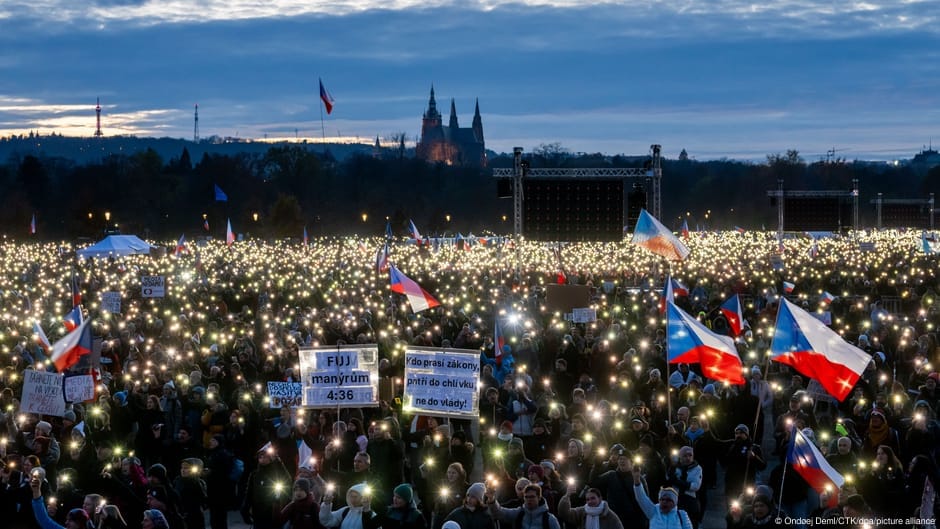
Hundreds of thousands of people gathered in Prague on Sunday, November 15, to oppose the Czech government’s plan to overhaul the financing of public-service media. Organizers estimated that approximately 400,000 people attended, potentially making the anti-government demonstration one of the country’s largest protests since the Velvet Revolution.
The immediate dispute concerns a proposal to abolish the monthly household fee that finances Czech public television and radio and replace it with direct allocations from the state budget. The government presents the measure as fulfillment of an election promise to reduce the financial burden on citizens. Critics see a more consequential shift: transforming broadcasters’ income from a relatively predictable, dedicated revenue stream into an appropriation exposed to annual political bargaining.
That distinction carries economic as well as constitutional importance. Public broadcasters require multiyear investment in staff, technology, archives and regional coverage. A funding model dependent on government budget decisions can create uncertainty even without explicit editorial interference. Managers may postpone investment, reduce programming or avoid confrontations with political leaders who influence future appropriations.
“An elected government has the right to govern the country. But it does not have the right to do whatever it wants and dismantle democratic institutions,” protest organizer Mikuláš Minář said.
Lower household costs, greater institutional dependence
Czech households currently pay 205 koruna per month, equivalent to about €8.50, to support public-service television and radio. Prime Minister Andrej Babiš argues that eliminating the charge would ease pressure on household budgets. In isolation, the saving is straightforward. At the national level, however, the reform transfers the cost rather than eliminating it: taxpayers would still finance broadcasting, but through general government revenue and expenditure decisions.
The proposed transition would also cut the funds available to broadcasters by 15%. The nominal television budget would return to its 2008 level, while radio funding would fall back to its 2005 level, even though operating costs have risen since then. Television and radio companies have called that outcome unacceptable. Public-media employees also staged a strike in early November and restricted broadcasting to underline the expected consequences.
In real terms, restoring nominal budgets from nearly two decades ago would imply a substantially deeper loss of purchasing power than the headline reduction alone suggests. Broadcasters now face higher labor, production, energy and technology costs, while audiences expect services across television, radio and digital platforms. A prolonged squeeze could therefore narrow coverage, weaken regional journalism and leave public institutions less capable of competing for skilled employees or responding to technological change.
The political process has added to the concerns. The bill was introduced for its first reading outside the planned parliamentary schedule on Friday, October 23, with a vote set for 4:36 that same night—an unusually abrupt timetable in Czech politics. The demonstration at Prague’s Letná grounds was consequently named “Letná Against 4:36.” Activists, civil-society organizations and opposition parties have criticized the governing parties for advancing legislation with potentially far-reaching consequences for public media without a conventional period of scrutiny.
Historical parallels and the economics of media capture
The governing coalition consists of right-wing and populist parties and is led by billionaire Andrej Babiš. Coalition members, including the anti-immigration Freedom and Direct Democracy party, or SPD, have previously criticized media coverage of their activities. Opponents of the bill argue that this history makes formal safeguards especially important, regardless of the government’s stated fiscal rationale.
The Czech opposition has compared the proposed changes with Hungary under Viktor Orbán, where the authorities brought public-service media under their control. The comparison does not establish that the Czech reform would produce the same outcome, but it highlights a structural risk familiar across Central Europe: public broadcasters can become more vulnerable when their financing, governance and editorial survival depend on the same political actors they are expected to scrutinize.
From an economic perspective, media independence is part of a country’s institutional infrastructure. Reliable information reduces uncertainty for households and businesses, improves scrutiny of public spending and helps voters assess competing economic programs. If funding pressure weakens investigative or pluralistic coverage, the effects may extend beyond broadcasting into procurement oversight, regulatory credibility and investor perceptions of institutional quality.
Historical experience also shows that institutional erosion often proceeds through changes that appear technical rather than through an explicit abolition of formal independence. Budget rules, appointment procedures and compressed legislative timetables can alter incentives without immediately changing legal guarantees. Once organizations lose experienced personnel, audience trust or production capacity, rebuilding them can be expensive and slow.
Protesters are demanding that the government either withdraw the bill or involve experts who can propose credible guarantees protecting broadcasters from political influence. The central policy challenge is therefore broader than choosing between a household levy and budget funding. It is whether the Czech Republic can reduce visible costs for citizens while preserving predictable resources, transparent oversight and meaningful editorial autonomy. Without such safeguards, a modest household saving could be accompanied by a much larger long-term cost to democratic and economic institutions.