Trump Backs Kyiv’s Role as Great-Power Diplomacy Tests Ukraine’s Agency
The US president’s pledge not to decide Ukraine’s future without Kyiv contrasts with a trilateral declaration that omits the war.
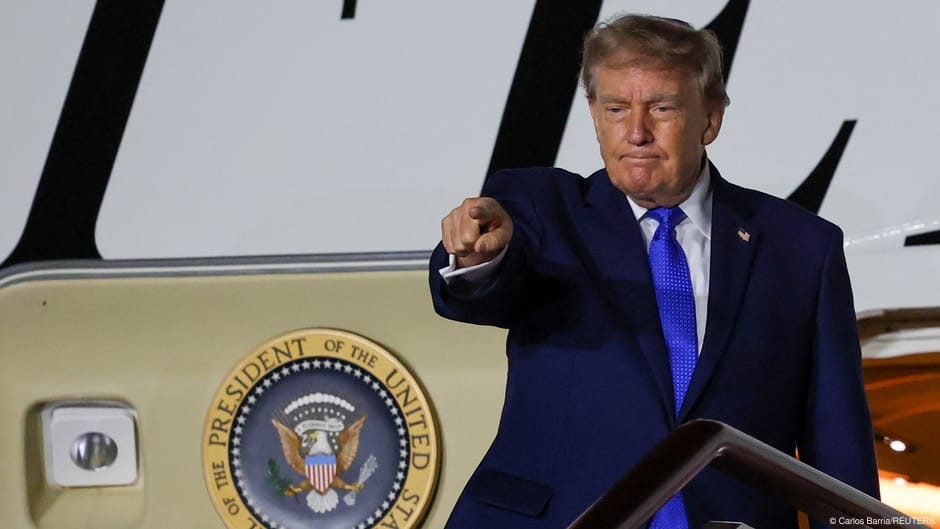
US President Donald Trump has endorsed Ukrainian President Volodymyr Zelensky’s position that Washington should not make decisions about Russia’s war against Ukraine without Kyiv’s direct participation, setting an important political boundary around emerging great-power diplomacy.
In an NBC interview on Thursday evening, November 19, Trump said he agreed that decisions concerning the war launched by Russia in Ukraine must not be taken without Ukraine itself. NBC journalist Gabe Gutierrez quoted Trump on X as saying: “I agree with him. I wouldn’t do anything without him—he’s the head of the country, so I wouldn’t do that.”
The statement carries significance beyond diplomatic protocol. For Ukraine, participation is tied to control over the economic terms of any settlement: reconstruction, sanctions, access to trade routes, the security of energy infrastructure and the conditions under which displaced people and private capital might return. An agreement negotiated without Kyiv could impose costs on the Ukrainian economy while weakening confidence among investors and international donors.
A promise of agency amid great-power bargaining
Trump’s comments followed the first trilateral meeting of the leaders of the United States, China and Russia, held earlier that day in Shenzhen on the sidelines of the Asia-Pacific Economic Cooperation summit. Before the talks, Trump said the meeting would “go down in history.” Chinese President Xi Jinping described it as an event of “historic significance,” while Russian President Vladimir Putin said the three countries had “many overlapping interests in resolving regional conflicts, including the conflict in Ukraine.”
Gutierrez said he also discussed the Shenzhen meeting with Trump by telephone. Asked to assess the encounter with Xi and Putin, the US president replied: “I think it was a 12. On a scale of 0 to 10. It went great. We managed to build an amazing relationship.” Trump said Ukraine was the central focus of the trilateral meeting, although the participants also discussed the “conflict around Iran.”
“The leaders want the situation around Iran resolved as well, and they are making that clear to Iran in the strongest possible terms,” Trump said, according to Gutierrez.
The meeting lasted only about an hour and a half. The participants departed without issuing a joint statement to the press. Xi called the negotiations “positive and constructive,” while Russian presidential aide Yuri Ushakov described the atmosphere as “good.” The limited public detail leaves open the crucial question of whether the three powers reached any practical understanding on Ukraine or merely exchanged positions.
That uncertainty has economic consequences. Markets and businesses respond not only to formal agreements but also to signals about sanctions, commodity flows and geopolitical risk. The United States, China and Russia occupy markedly different positions in the global economy, yet decisions among them can influence energy prices, shipping costs, defense expenditure and investment across Europe and Asia. A short summit without a detailed communiqué may reduce immediate transparency rather than provide a stable basis for economic planning.
The declaration’s revealing omission
After the trilateral summit, the leaders published a joint “Declaration of Peace.” Its principal points included support for reforming the United Nations, agreement that the International Criminal Court should not “abuse its powers,” and a commitment to continue dialogue on reducing nuclear risks and preventing nuclear proliferation. The war in Ukraine was not mentioned.
The omission creates a notable contrast with Trump’s assertion that Ukraine dominated the talks. It may reflect the difficulty of finding language acceptable to Washington, Beijing and Moscow, or a preference for keeping the most contentious negotiations outside a public document. Either way, the absence of Ukraine from a declaration devoted to peace illustrates the limits of consensus among the three powers.
Historically, settlements negotiated by major powers have often combined security arrangements with decisions about borders, trade and financial obligations. In the present case, however, Ukraine’s economy is directly exposed to the outcome. The destruction of infrastructure, disruption of transport corridors and continuing security risk mean that the design of any peace process would shape reconstruction needs and the country’s long-term productive capacity. Trump’s pledge to include Zelensky therefore represents more than recognition of sovereignty; it concerns who has authority to negotiate the distribution of future economic burdens.
In the NBC interview, Trump also said Putin had been upset by Ukrainian strikes on the Crimean Bridge, which caused parts of its structure to collapse. The US president called Putin’s reaction “understandable.” The bridge is strategically and economically important because infrastructure linking occupied Crimea with Russia has military, logistical and transport functions. Damage to such assets highlights how the war’s economic geography remains inseparable from its military course.
The diplomatic message is consequently mixed. Trump has publicly affirmed Kyiv’s right to participate, while praising his relationship with Xi and Putin and describing their meeting in exceptional terms. At the same time, the summit’s formal declaration avoided the war altogether. For governments, investors and reconstruction planners, the decisive test will be whether Ukraine’s promised seat at the table extends to the substantive choices that determine security guarantees, sanctions policy and the financing of recovery.