Georgian Opposition Launches New Protest Wave Amid Party Ban Case
The confrontation raises fresh questions over political stability, EU integration and Georgia’s long-term economic trajectory.
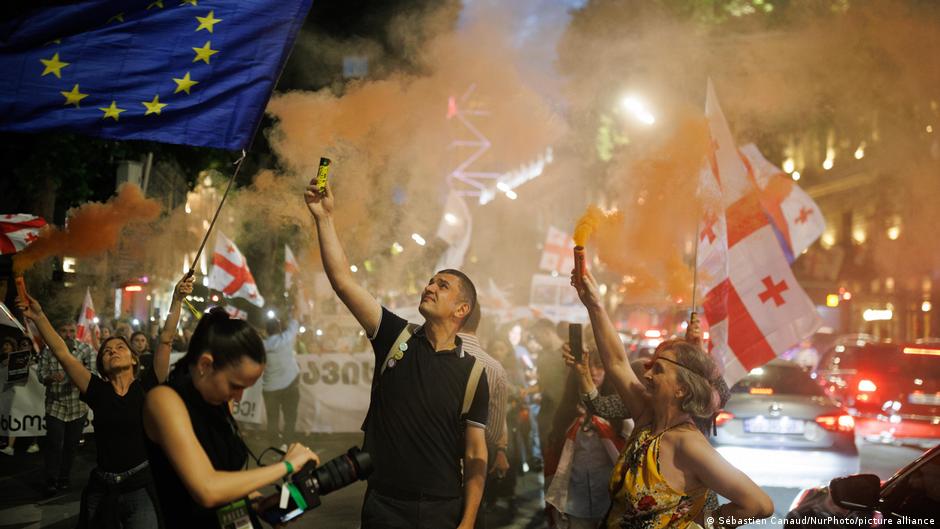
Thousands of demonstrators marched through Tbilisi on Sunday, October 25, as Georgia’s opposition announced a new wave of protests against the policies of the ruling Georgian Dream party. The mobilization comes as the country’s Constitutional Court considers a lawsuit seeking to ban opposition parties, intensifying a political crisis that has developed over more than two years.
Organized by opposition representatives and civil society groups under the slogan “Georgia Without Ivanishvili,” the procession moved from Tbilisi State University toward Rustaveli Avenue. According to Kavkazsky Uzel, participants carried the flags of Georgia, Ukraine and the European Union. A large security presence was also reported.
Nika Gvaramia, leader of the Coalition for Change, described the march as the beginning of a renewed protest campaign. He said the movement would need to reach a culmination, either at a major rally planned for November 28 or in the days that follow.
“We are starting today, and we definitely need a culmination, whether it is November 28 or the following days. It is important that there are very many of us on the 28th, so that the wind cannot extinguish the fire,” Gvaramia said, according to Kavkazsky Uzel.
The November date carries symbolic weight because it marks the second anniversary of the beginning of mass protests linked to the government’s decision to postpone talks on Georgia’s accession to the European Union until 2028.
Political Restrictions Carry an Economic Cost
The immediate conflict concerns democratic institutions and the boundaries of political competition, but its consequences extend into the economy. Court proceedings that could remove established opposition parties from political life risk increasing uncertainty over the durability of Georgia’s institutional framework. For businesses and investors, predictability in electoral competition, judicial decisions and relations with international partners is a central part of assessing long-term risk.
Gigi Tsereteli, the leader of European Georgia, said at the march that a major and important demonstration was planned for November 28. He portrayed the current situation as a reversal for a country once regarded as a leading candidate on the path toward European integration.
“What is happening in Georgia today in terms of the destruction of democracy and disruption is truly unimaginable, given that we were a champion country on the path of European integration and today we are outsiders,” Tsereteli said, according to Georgia Online.
He added that parties were being banned and political life was effectively being restricted, while the presence of political prisoners represented another important challenge.
For Georgia, the European question is not solely geopolitical. The direction of integration influences expectations about access to markets, institutional reform and the broader investment environment. A prolonged rupture between the authorities, opposition groups and civil society could therefore affect economic confidence even without an immediate change in headline indicators. Political polarization can delay investment decisions, divert administrative resources and make longer-term planning more difficult for domestic companies.
A Crisis Rooted in the 2024 Protest Movement
The present mobilization follows a sequence of confrontations that began in the spring of 2024 with mass protests against the law on “foreign agents.” Demonstrations intensified after Georgian Dream won the parliamentary elections. In November 2024, the crisis expanded after the authorities decided to delay negotiations on joining the European Union until 2028.
Those protests were accompanied by clashes with police. Security forces dispersed demonstrators using tear gas and water cannons. The memory of those confrontations remains part of the political environment surrounding the new campaign and may shape both participation and the authorities’ response as November 28 approaches.
Historically, repeated waves of street mobilization in Georgia have reflected a struggle over the country’s political direction and the legitimacy of its institutions. The latest march fits that pattern, but the pending party-ban case raises the stakes: the dispute now concerns not only government policy but also whether major opposition forces will be permitted to continue operating within the formal political system.
If institutional avenues narrow, protest activity may assume a larger role in political competition. That would deepen the gap between official decision-making and opposition mobilization in the streets, prolonging uncertainty rather than producing a rapid settlement. The presence of significant security forces at Sunday’s march underscores the potential for renewed confrontation, although the reported procession itself was presented by opposition leaders as the opening stage of a campaign rather than its culmination.
The size and conduct of the November 28 rally will provide an important measure of the opposition’s ability to sustain public participation. It will also test whether Georgia’s political system can contain the dispute through legal and peaceful mechanisms. Beyond the immediate contest for power, the outcome may influence the country’s European prospects and the institutional credibility on which its longer-term economic development depends.