Kamyševakha Strike Toll Reaches 72, Deepening Ukraine’s Humanitarian Costs
The destruction of an aid distribution center highlights how attacks on civilian infrastructure compound the long-term economic damage of war.
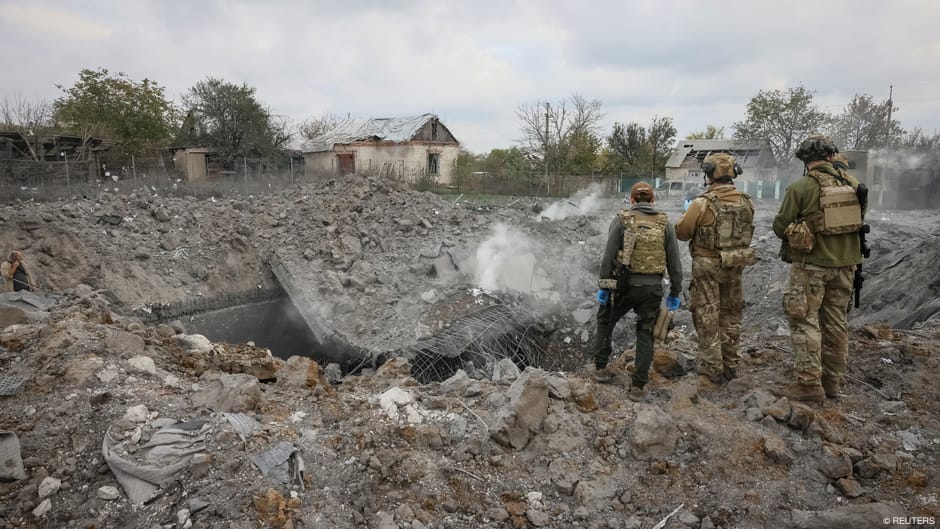
Rescue workers have completed the search of rubble at a humanitarian center in Kamyševakha, in Ukraine’s Zaporizhzhia region, confirming that 72 people were killed by a Russian aerial bomb strike. Four others remained missing two weeks after the attack, leaving open the possibility that the final toll could rise.
The search and debris-removal operation ended on Monday, November 16. Emergency crews recovered 58 bodies from the destroyed building, while one person died in hospital. The deaths of another 13 people were established through DNA testing. The dead included two rescue workers and four police officers, according to Ukrainian Interior Minister Ivan Vyhovsky. Four injured people remained in hospital, while the Zaporizhzhia regional military administration reported that four people were still unaccounted for.
The immediate human loss places the November 2 attack among the deadliest Russian strikes on a single civilian site since the start of the full-scale war. Its wider consequences also illustrate a structural feature of the conflict: damage to humanitarian infrastructure does not end when a building is destroyed. It interrupts the distribution of essential goods, diverts scarce public resources and exposes emergency personnel to repeated danger.
Aid infrastructure becomes an economic lifeline
The targeted building was a disused school serving as a humanitarian aid distribution center. Ukrainian Prime Minister Serhiy Koretsky said Russian forces dropped aerial bombs on the site on the morning of November 2. According to his account, people moved into a shelter, which was then also struck as Russian forces used nine aerial bombs.
The attack occurred while humanitarian assistance was being distributed, contributing to the high number of casualties. The event had been announced officially in advance. Russia has not commented on the strike.
In communities near active combat zones, aid centers perform an economic function as well as a humanitarian one. They substitute for damaged retail networks, disrupted transport links and weakened household purchasing power. When such a center is destroyed, the impact extends beyond those present at the time: residents may face greater travel costs, longer waits for food and medicine, and increased dependence on already strained municipal and volunteer networks.
This dynamic has historical parallels in prolonged conflicts where civilian systems become progressively more expensive to operate. A school repurposed as an aid hub reflects an economy adapting its remaining physical assets to emergency needs. Its destruction therefore represents multiple losses at once: the original educational asset, the replacement distribution facility and the labor required to restore or relocate the service.
Repeated strikes raise the cost of recovery
Search-and-rescue operations in Kamyševakha continued for two weeks under persistent threat. Local authorities said the settlement was subjected to another 11 Russian attacks during that period, nine of them directly targeting the rubble-removal site. Three police officers and four rescue workers were injured in the repeated strikes.
Such attacks increase the economic cost of every stage of emergency response. Equipment must remain deployed for longer, personnel require additional protection and medical treatment, and reconstruction cannot begin while the site remains unsafe. The danger also creates an opportunity cost: rescuers, police and machinery assigned to one location cannot be used elsewhere.
The deaths of emergency and law-enforcement personnel carry an additional institutional burden. These are trained workers whose replacement requires time and public spending, particularly in regions where wartime demand for their skills is already elevated. Repeated attacks can also make recruitment and retention more difficult, weakening the state’s capacity to provide basic services.
The strike has been compared by some media outlets with Russia’s bombing of the Mariupol drama theater in March 2022, although no confirmed casualty figure exists for that attack. The comparison reflects the concentration of civilian deaths at a single location and the vulnerability of buildings used as shelters or gathering points.
Long-term pressure on regional resilience
The cumulative economic effect of attacks on humanitarian sites is difficult to measure through physical damage alone. Each incident can accelerate displacement, reduce local labor supply and undermine confidence that essential services can be delivered safely. Businesses are less likely to reopen where workers and customers face persistent threats, while local authorities must allocate more of their budgets to emergency response instead of infrastructure, education or economic recovery.
For households, the consequences include lost income, medical costs and the disappearance of informal care networks when relatives, police officers, rescuers and volunteers are killed or injured. These effects can persist for years, reinforcing demographic decline in frontline regions and increasing the fiscal burden on other parts of Ukraine.
The United Nations condemned the actions of the Russian military. Danielle Bell, head of the UN Human Rights Monitoring Mission in Ukraine, said the circumstances pointed to a failure to observe fundamental legal protections.
“Either the Russian armed forces were aware that humanitarian aid was being distributed there, or they failed to take the most basic steps to establish what was happening in the settlement they intended to attack. In either case, this strike appears to have violated the most fundamental principles of international humanitarian law.”
The completion of the search operation establishes a toll of 72 dead, but it does not mark the end of the costs. Kamyševakha now faces the loss of residents, skilled public servants and a critical aid facility, alongside the continuing expense of caring for survivors and rebuilding essential distribution capacity under the threat of further strikes.