Khodorkovsky Urges Europe to Offer Exit Routes to Russian Elites
The opposition figure argues that elite defections and institutional reform could reduce the risks of war, repression and violent state collapse.
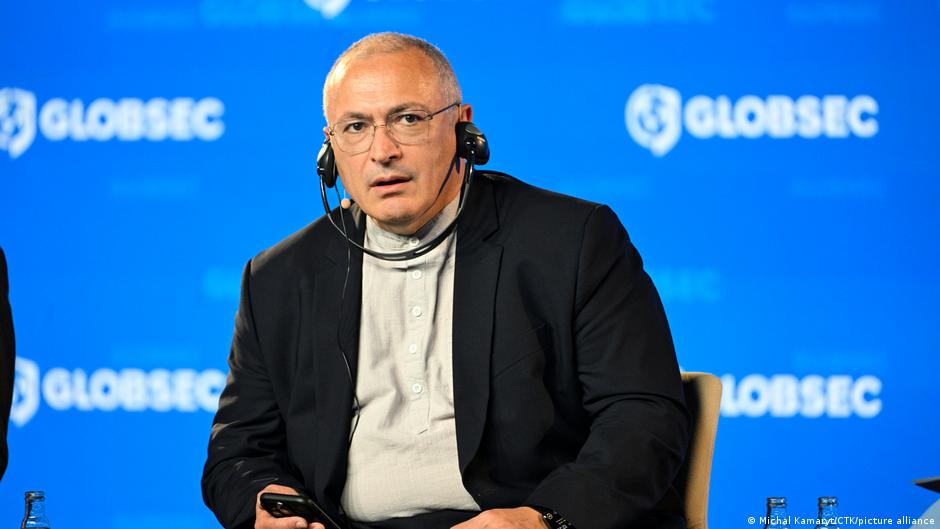
European governments should offer influential Russians a credible alternative to continued support for President Vladimir Putin, according to opposition figure Mikhail Khodorkovsky, who argues that the absence of such an option has helped preserve cohesion among the country’s ruling elite.
Speaking on Tuesday, November 3, at a Brussels conference organized by the Russian Anti-War Committee, Khodorkovsky said powerful figures inside Russia remain tied to Putin partly because they cannot be confident that a political transition would improve their position. His argument shifts attention from the pressure imposed on Russia as a whole to the incentives confronting individual members of its political and economic establishment.
“If we are talking about a split among the elites, then we need to demonstrate opportunities for a personal exit,” Khodorkovsky said.
Such an exit could still entail losses for those involved, he added. He did not specify its terms at the conference, but has previously written that a declaration of disagreement would not be sufficient for people who had cooperated with the regime. He cited donations to Ukraine and testimony to investigators about crimes committed by the authorities as examples of more substantive action.
The political economy of elite cohesion
Khodorkovsky’s proposal rests on a familiar structural problem in authoritarian systems: senior insiders may privately question the direction of policy while continuing to support the leadership because defection appears more dangerous than loyalty. Their calculations depend not only on sanctions or moral pressure but also on expectations about personal security, property, legal exposure and influence after a transition.
From that perspective, European policy faces a difficult balance. Broad pressure can raise the economic cost of supporting the Kremlin, but if every insider expects permanent exclusion regardless of future conduct, that pressure may also reinforce dependence on the existing system. A pathway for individual disengagement would seek to change this calculation by making cooperation with a post-Putin settlement appear possible, though not cost-free.
Khodorkovsky described Europe’s failure to establish such opportunities by the fifth year of the war as a serious mistake. The criticism implies that sanctions policy should be evaluated not only by the resources it denies the Russian state, but also by whether it creates incentives for changes in elite behavior. In economic terms, the central issue is whether external measures differentiate between continued participation in the system and verifiable steps away from it.
The difficulty is that any differentiated approach would have to reconcile competing objectives. Europe would need to preserve accountability, avoid rewarding opportunistic defections and establish credible conditions for relief. At the same time, a policy offering no route out could leave insiders with little practical reason to abandon Putin, even if they doubt the sustainability of his rule.
The economic risks of a punitive transition
Khodorkovsky also warned against treating a future Russian transition primarily as an exercise in punishment. Attempts to prosecute people connected to the war or restrict their rights could provoke armed resistance, he said, because millions of Russians are linked to the conflict. They or their relatives have fought, worked at military enterprises or supported the political order established by the authorities.
Some among this broad group are accustomed to carrying weapons and could resist sweeping measures, he argued. “And we must understand that when we speak about lustration, reparations and trials of war criminals, we are speaking about a new war,” Khodorkovsky said.
His warning highlights a potential conflict between justice and political stabilization. Extensive exclusions could remove experienced personnel from state institutions and strategic industries at the moment when administrative continuity is most important. Armed confrontation would deepen those disruptions, threatening production, public finances, infrastructure and the distribution of authority across Russia’s regions.
Khodorkovsky contrasted transformation imposed by force with national reconciliation and gradual democratization. In his assessment, domestic armed conflict would produce another authoritarian government and postpone democratic change for a further political generation. He issued a similar warning about Russia’s possible disintegration, saying that such an outcome would be paid for in blood and urging policymakers to consider not only their desired destination but also the means used to reach it.
Institutional de-escalation as an economic strategy
Instead, Khodorkovsky proposed what he called “institutional de-escalation”: reducing the threat of war by changing how power is organized in Russia. Even a transition from one-person rule to collective leadership could lower the probability of war, he said. A parliamentary system and greater federalization would reduce it further.
The economic significance of that argument extends beyond formal constitutional design. Concentrated power makes major policy choices dependent on a narrow decision-making circle, while collective institutions can introduce negotiation, competing interests and constraints. Federalization could also shift some authority toward regions, potentially changing how revenues, spending responsibilities and political risks are distributed.
Yet institutional change would not automatically guarantee democratic government or economic stability. Khodorkovsky’s broader point is that a durable transition depends on incentives and procedures as much as on the removal of an individual leader. Without an agreed framework, the struggle over assets, legal responsibility and regional power could become a source of renewed coercion.
The Anti-War Committee’s two-day conference is being held in Brussels on November 3-4 and focuses on scenarios for ending Russia’s war against Ukraine. Its program also includes discussions of sanctions, nuclear risks and the possibility of putting Putin on trial. Together, those subjects underscore the central dilemma raised by Khodorkovsky: how to maintain pressure and accountability while creating a transition that does not reproduce the economic dislocation, violence and authoritarian concentration it is intended to overcome.