Kyiv Seeks Unified European Position for Possible Talks With Russia
Ukraine is preparing a potentially historic coalition meeting as it reviews allied mechanisms and seeks stronger military and energy support.
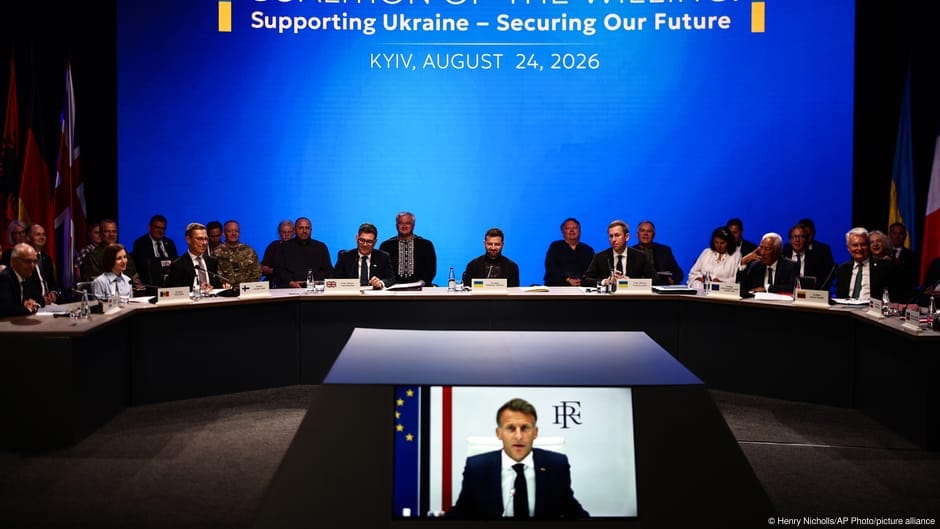
Kyiv is preparing a meeting of the countries supporting Ukraine that could establish a unified European position for negotiations with Russia and give Europe a full role in any future diplomatic process. Ukrainian President Volodymyr Zelensky outlined the objective in a video address published on Sunday, November 15.
The initiative centers on the “coalition of the willing,” a group of 37 countries composed mainly of European states and governments providing military assistance to Ukraine as it resists Russia’s full-scale invasion. France, Britain and Germany are regarded as the grouping’s informal leaders.
“We are preparing a meeting of the coalition of the willing—an important meeting, perhaps a historic meeting. We can define a 100 percent strong European position for negotiations,” Zelensky said.
He argued that a trilateral format involving Ukraine, the United States and Russia should not merely be expanded into a four-party arrangement, but should also become significantly stronger. His remarks indicate that Kyiv wants Europe to participate as a substantive negotiating actor rather than simply finance security commitments or implement decisions reached elsewhere.
Zelensky did not clarify whether he was referring to the coalition’s next expected meeting, scheduled for November 19 in Berlin, or to preparations for a separate summit. That ambiguity leaves open both the timing and institutional form of the diplomatic initiative.
Europe’s Economic Stake in the Negotiating Framework
The composition of any negotiating format carries economic as well as diplomatic consequences. European governments have absorbed substantial responsibilities arising from the war, including military assistance, energy support and the provision of equipment needed to preserve Ukraine’s resilience. A common position could help align those commitments with the terms discussed in a future settlement.
For Kyiv, broader European participation may also strengthen continuity. Military aid, air-defense supplies, reconstruction financing and energy assistance operate on different timelines and through multiple institutions. Bringing Europe more directly into negotiations could connect short-term security requirements with longer-term decisions concerning recovery and economic stability.
The effort recalls a recurring feature of European crisis diplomacy: broad alliances can demonstrate political solidarity, but their economic weight depends on whether members translate declarations into coordinated resources. Coalitions assembled during an emergency often include mechanisms with very different mandates, funding arrangements and levels of activity. Kyiv’s latest initiative therefore includes an assessment of whether the structures created since Russia began its full-scale war are producing concrete results.
Zelensky said Ukraine was conducting a “review” of other coalitions supporting the country to determine which were genuinely carrying out their tasks and which remained empty. He said Kyiv would work to give those mechanisms greater substance.
From Coalition Labels to Operational Capacity
The support architecture includes both formal agreements among Ukraine’s allies and informal groupings or initiatives without clearly defined operating procedures. That distinction matters because a coalition’s public profile does not necessarily reflect its institutional capacity, budget or ability to deliver equipment.
The IT Coalition, established within the Ukraine Defense Contact Group—widely known as the Ramstein format—was created to support Ukraine in cybersecurity and digital technologies and remains operational. By contrast, the so-called tank coalition frequently mentioned in media coverage did not exist as a formal organization in practice, although Ukrainian representatives also used the term at the time.
Kyiv’s review suggests a shift from wartime coalition-building toward performance management. In the early stages of a crisis, flexible initiatives can accelerate political coordination. Over time, however, overlapping formats can create fragmentation, obscure responsibility and complicate planning. Separating active mechanisms from largely rhetorical ones could make external support more predictable and allow scarce resources to be directed toward priorities with measurable operational value.
Energy Resilience and Air Defense Remain Immediate Priorities
The diplomatic effort is unfolding alongside urgent demands for energy equipment and air-defense missiles. In the same address, Zelensky said Kyiv had reached an agreement with European Commission President Ursula von der Leyen on additional energy support for the cities and communities facing the greatest difficulties.
He said the assistance would include additional generators, other equipment and financing intended to support resilience. Such measures are economically significant because energy disruption affects municipal services, household welfare and the ability of businesses to operate. Emergency equipment and financial support can reduce the immediate cost of outages, although they remain part of a broader wartime system requiring sustained external backing.
Zelensky also pointed to an upcoming meeting of allies in the Ramstein format, from which Kyiv expects approval of new deliveries of air-defense missiles. He said the meeting needed to produce results and would send a strong signal to Russia that Ukraine would not be left without support.
Ukraine’s priorities are air defense, he said, and partners should concentrate on missiles for Patriot and NASAMS systems. The emphasis links military requirements directly to economic resilience: protecting population centers and infrastructure can limit damage, support continuity of production and reduce the burden of repeated emergency repairs.
The planned coalition meeting will therefore test more than Europe’s ability to agree on diplomatic language. Its broader significance lies in whether governments can integrate negotiations, defense procurement and energy assistance into a durable strategy. Kyiv’s review of existing coalitions indicates that political unity will increasingly be judged by institutional performance and the delivery of resources rather than by the number of countries or initiatives carrying a common label.