Leipzig Sabotage Probe Exposes Economic Risks Across Europe’s Security System
The investigation links a Latvian passport holder who lived in Russia to the Leipzig airport case, widening scrutiny of logistics, visas and EU economic security.
Latvia has said that a Latvian citizen suspected of involvement in the sabotage case at Leipzig airport had been living in Russia on a permanent basis for the past several years, a disclosure that adds a broader economic-security dimension to an incident already carrying diplomatic consequences for Germany, Italy and the wider European Union.
Riga is cooperating with Berlin in the investigation into the suspected sabotage at Leipzig airport, but has released only limited information about the suspect, who was described as a Russia-born holder of a Latvian passport. Latvia’s State Security Service said he had not been living in Latvia in recent years. The agency also confirmed that it is working with German investigators and providing necessary support, while declining further comment because the investigation is ongoing. Germany’s federal prosecutor has not yet issued official public comment on the case.
German investigators had earlier identified two suspects in the attempted sabotage case. According to reporting cited from Süddeutsche Zeitung and broadcasters NDR and WDR, the suspected attempt to attack a Ukrainian transport aircraft involved a Russia-born man with Latvian citizenship and a Belarusian man with Russian citizenship.
The second suspect reportedly entered the Schengen area using an Italian tourist visa. That visa was issued in late April by Italy’s diplomatic representation in Minsk. After the information became public, Rome said it would review the circumstances under which the visa had been issued.
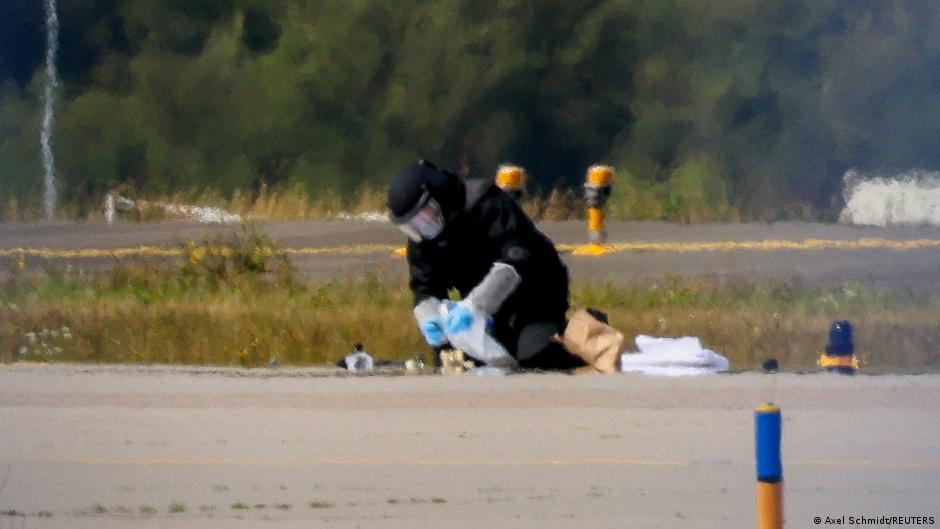
The alleged sabotage attempt against a Ukrainian Antonov An-124 cargo plane took place on August 4. Investigators say at least three drones were involved. One drone fitted with explosives was found near several Ukrainian cargo aircraft. A second is believed to have struck a DHL cargo plane just minutes after the first device was discovered. A third drone was found 10 days later, on August 14, in a field west of the airport. Investigators found about 50 grams of a substance near it that was initially assessed as hexogen.
Berlin has blamed Russia for the incident. In response, the German government decided to close Russia’s consulate general in Bonn and terminate the agreement governing the operation of the Russian House in Berlin. Germany also said it would tighten checks on Russian citizens entering the country and strengthen measures against Russia’s so-called shadow fleet, which Moscow uses to circumvent EU sanctions imposed over the war against Ukraine.
Moscow has rejected the accusations that it organized the sabotage in Leipzig. In response to the closure of the Russian House in Berlin, Russian authorities said they would close the Goethe-Institut branches operating in Russia, in Moscow, St. Petersburg and Novosibirsk.
From an airport incident to a wider economic-security test
What makes the Leipzig case economically significant is not only the apparent target but the institutional chain it touches. A suspected drone attack near Ukrainian cargo aircraft at a major logistics hub immediately raises questions about the resilience of European freight corridors, aviation insurance assumptions and the cost of protecting dual-use transport infrastructure during wartime spillover. Leipzig is not just an airport in this story; it is a node in a wider European network of cargo movement, customs control and industrial supply reliability.
That helps explain why the case has quickly expanded beyond criminal investigation into questions of border governance and sanctions enforcement. If one suspect held EU citizenship while living in Russia and another reportedly entered on a Schengen visa issued by an EU member state, the episode exposes the extent to which Europe’s internal openness depends on trust among national security, consular and law-enforcement systems. Where those systems are tested, the economic effects can be broader than any single security breach.
“The investigation will be carried out. However, all this confirms that there are attempts by a number of countries to act against the EU, including through people who have no criminal record and do not arouse suspicion.”
That warning, given by Italian Foreign Minister Antonio Tajani, points to a structural problem for European policymakers. If hostile operations can rely on low-profile individuals moving through ordinary civilian channels, the likely policy response is not limited to arrests or expulsions. It tends to produce more screening, more friction in cross-border movement and more pressure to fuse migration, visa and security policy into a single economic-security agenda.
There are historical parallels in Europe’s repeated tendency to discover that open commercial systems can become vulnerabilities in periods of geopolitical confrontation. The current version of that pattern is shaped by logistics hubs, sanctions circumvention and civilian infrastructure that sits close to strategic supply chains. Germany’s decision to combine diplomatic retaliation, tighter entry checks for Russian citizens and stronger action against the shadow fleet suggests Berlin sees the Leipzig affair not as an isolated airport case but as part of a larger contest over coercion below the threshold of open conflict.
For businesses, the immediate issue is not necessarily disruption on the scale of a transport shutdown. It is the accumulation of precautionary costs. More intensive screening at ports of entry, more scrutiny around cargo aircraft linked to Ukraine, and stronger enforcement against sanctions evasion can all raise compliance burdens for airlines, freight operators, insurers and exporters. Even when such measures are politically necessary, they make Europe’s trading system less frictionless.
The diplomatic fallout also carries its own economic meaning. The closure of the Russian consulate general in Bonn and the termination of the Russian House agreement in Berlin show how security crises can steadily erode the institutional architecture that once supported routine cross-border engagement. Russia’s retaliatory move against Goethe-Institut branches reinforces the same trend in reverse. These closures do not merely signal worsening relations; they reduce channels for exchange, administration and soft-power contact that often help stabilize commercial ties even in difficult periods.
Seen from the perspective of economic policy, the Leipzig investigation fits a wider European shift: security is no longer treated as a separate sphere from trade, mobility and infrastructure. It is increasingly embedded within them. The central question for the EU is whether it can harden those systems against covert disruption without imposing so much friction that it weakens one of its own core advantages, the efficient movement of people, goods and capital across a large integrated market.
The outcome of the criminal investigation will determine the evidentiary record. But the structural consequences are already visible. Europe is moving toward a more guarded model of openness, in which airports, visas, sanctions and cultural institutions are all being pulled into the same geopolitical ledger.