Macron Says Russian Mobilization of 300,000 Is a Credible Scenario
The French president linked possible Russian troop mobilization to a wider hybrid threat against Europe as Ukraine’s strategic rear.
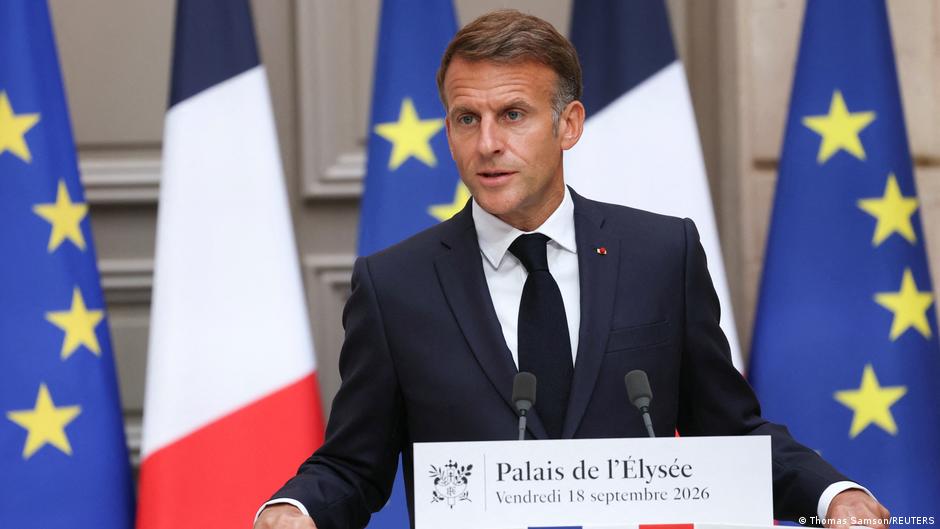
French President Emmanuel Macron has said France regards as credible a scenario in which Moscow could mobilize around 300,000 people, placing the prospect of further Russian military expansion within a broader warning about pressure on Europe’s security and economic infrastructure.
Speaking on Thursday, September 24, on TF1 and France 2, Macron said Russia had appeared to be waiting for its elections, held from September 18 to 20 for the State Duma, before moving toward such a step. He said it was not yet clear whether any mobilization would be publicly announced or conducted in a less visible form.
“They waited for their elections, the elections have passed, and today it is clear that Russia will do this,” Macron said.
The French leader said there had been “several signs” suggesting that Russia was preparing for the measure. He described the assessment as consistent with intelligence from the United States, Europe and Ukraine, calling it “a scenario that seems credible to us.”
For European policymakers, the significance of such a move would extend well beyond the battlefield. A mobilization of roughly 300,000 people would imply that Russia is preparing to sustain or intensify a long war of attrition, with consequences for labor allocation, state spending, military production and the durability of sanctions-era economic management. It would also sharpen the pressure on European governments already balancing defense commitments, energy security, budget constraints and public fatigue.
Europe as Ukraine’s Strategic Rear
Macron linked the possible mobilization to what he described as a wider pattern of hostile Russian activity across Europe. He said such actions had increased in recent weeks and noted that he had convened representatives of political forces the previous week to warn them about the development of the threat and its implications inside France.
According to Macron, Moscow sees Europe as “the strategic rear of Ukraine” because European countries help Ukrainians and because Kyiv has struck oil refineries and facilities inside Russia in an effort to force Moscow to end the war. In that context, he said, Europe itself could become a target.
The channels of pressure identified by Macron are not confined to conventional military activity. He referred to attacks in the information sphere through the spread of falsehoods, as well as cyber operations. Earlier, on September 18, the French president said France was preparing a plan to protect critical infrastructure against the rising threat of hybrid attacks from Russia.
This framing places infrastructure, political cohesion and public trust at the center of the conflict’s economic dimension. In modern European economies, cyber disruption can spill quickly from public administration into payments, logistics, energy distribution, transport and communications. Even limited incidents can impose costs through redundancy spending, insurance repricing, delayed investment and the diversion of public funds toward protection and recovery.
The warning also reflects a shift in how European governments describe Russian activity. Previously, Russia was accused of election interference and of using migrants as an instrument of pressure on Europe. European intelligence services are now said to suspect a Russian trail in acts of sabotage, arson, attacks on critical infrastructure and violations of airspace.
Sources cited in the report said many incidents, especially cyberattacks and hacks, are not publicly disclosed. As a result, the true scale of Russia’s hybrid attacks is understood to be significantly larger than the visible record suggests.
A War of Resources and Resilience
The economic logic behind Macron’s warning is that mobilization and hybrid activity are not separate tracks. They are two parts of a prolonged contest over resources, resilience and political endurance. If Russia mobilizes additional manpower, it signals confidence that the state can absorb the social and fiscal burden of a larger war effort. If Europe is targeted as Ukraine’s rear area, the pressure shifts toward the systems that enable continued support for Kyiv: public budgets, energy networks, industrial capacity, military supply chains and democratic consent.
Historically, long wars have tended to expand from fronts into economies. The longer a conflict lasts, the more states test not only military capability but also administrative capacity, social tolerance and the ability to replace losses. Mobilization on the scale described by Macron would therefore be read not simply as a military step, but as a claim on Russia’s labor force and fiscal base. It would also increase the importance of defense production and logistics at a time when both Russia and European countries are already adapting their economies to a more militarized environment.
For France and other European states, the immediate policy challenge is defensive investment without economic overreaction. Protecting critical infrastructure requires spending on cyber resilience, physical security, intelligence coordination and crisis response. Yet these costs arrive alongside demands for higher defense expenditure, support for Ukraine, industrial subsidies and social spending. That combination can strain public finances even in large economies.
The structural consequence is a gradual reclassification of security from a narrow defense matter into a core economic policy variable. Energy assets, data systems, ports, rail networks, telecommunications and political information channels become part of the strategic balance. Businesses operating in these sectors face a different risk environment, while governments must decide which systems are too important to leave exposed to commercial incentives alone.
Macron’s comments therefore point to a broader European adjustment. If Moscow is preparing a new mobilization and simultaneously treating Europe as Ukraine’s strategic rear, the conflict is moving deeper into the architecture of European economic life. The burden will not be measured only in military aid packages or sanctions lists, but also in the cost of hardening societies against disruption.