North Korea Missile Launch Adds Economic Risk to Korean Peninsula Tensions
The reported ballistic missile launch toward the Sea of Japan follows a border explosion that Seoul says violated the armistice.
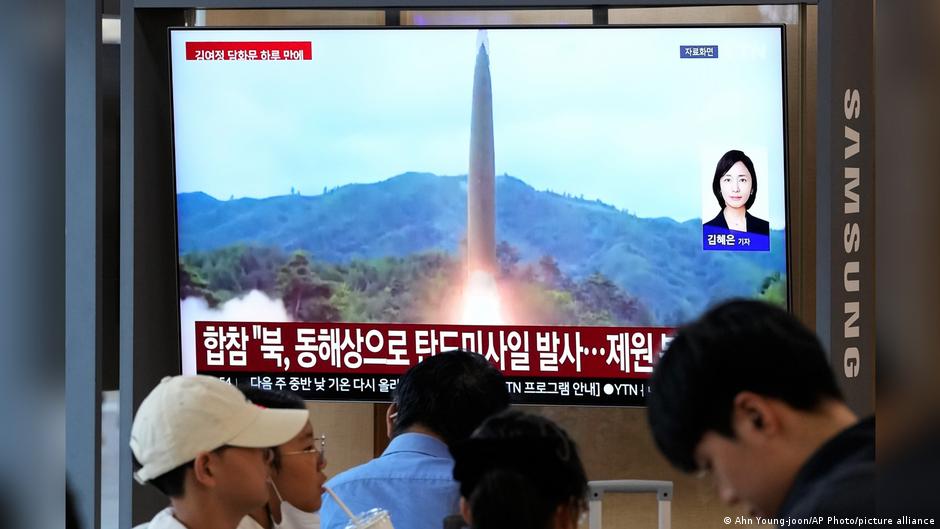
North Korea fired at least one ballistic missile toward the Sea of Japan, according to South Korea’s military, adding another layer of geopolitical risk to a peninsula where security shocks have long carried economic consequences beyond the immediate military sphere.
South Korea’s Joint Chiefs of Staff said on Saturday, October 3, that North Korea had launched at least one ballistic missile in the direction of the Sea of Japan. The statement came after Seoul accused Pyongyang of violating the Korean War armistice following an explosion in the inter-Korean border area on September 21 that injured three South Korean soldiers.
“South Korea, the United States and Japan are maintaining a high level of combat readiness while closely sharing information on North Korean ballistic missiles,” Seoul said.
The episode fits a familiar pattern on the Korean Peninsula: military incidents are not isolated security events, but recurring sources of uncertainty for governments, investors, exporters and regional supply chains. South Korea is one of the world’s major manufacturing and technology economies, deeply integrated into global markets through semiconductors, automobiles, shipbuilding, batteries and consumer electronics. Even limited escalations can raise questions about political risk, insurance costs, currency volatility and the resilience of production networks concentrated near one of the world’s most fortified borders.
A Security Shock With Economic Channels
The immediate facts remain military in nature. Seoul says the missile launch followed the September 21 explosion in a border zone between North and South Korea. AFP, citing South Korean military sources, reported that Seoul believes the blast resulted from the detonation of North Korean anti-personnel mines. Three South Korean service members were injured.
South Korean Defense Minister Kang Shin Chul accused Pyongyang of violating the armistice and announced an intention to take responsive measures. The Joint Chiefs of Staff demanded that North Korea issue an apology.
North Korea rejected the accusation. Kim Yo Jong, the sister of North Korean leader Kim Jong Un, described the South Korean assertion as “extremely low and dirty,” according to comments carried by North Korea’s state news agency KCNA.
For markets and policymakers, the key issue is not only whether a single incident escalates, but how repeated provocations affect expectations. The Korean Peninsula has lived for decades with a form of institutionalized instability. Investors have often learned to discount North Korean military signaling, yet each new launch or border incident tests that assumption. If tensions appear likely to trigger new defense measures, sanctions pressure, diplomatic breakdowns or disruptions to transport and production planning, the risk premium can move quickly.
That matters because South Korea is not a peripheral economy. It is a central node in global manufacturing. A sustained rise in perceived peninsula risk would be felt through several channels: financial markets, procurement decisions, defense budgets, energy security planning and the strategic calculations of multinational companies that rely on Korean suppliers. Japan and the United States, both named by Seoul as partners in information sharing, are likewise bound into the economic consequences of any prolonged crisis.
The Armistice Economy
The latest episode also underscores the unusual legal and historical structure that frames inter-Korean risk. South and North Korea are still formally at war. The Korean War ended in 1953 with an armistice agreement, not a formal peace treaty. The two countries are divided by the Demilitarized Zone, with a military demarcation line running through the middle of a heavily mined strip of land. It is one of the most fortified and mined borders in the world.
This unresolved status has shaped the economic development of the peninsula for more than seven decades. South Korea built a high-income export economy under the constant shadow of military confrontation, while North Korea remained largely isolated, militarized and subject to recurring sanctions pressure. The armistice has functioned as both a constraint and a stabilizer: it has prevented a full return to war, but it has never removed the possibility of sudden escalation.
That ambiguity imposes structural costs. South Korea must maintain high readiness and significant defense capacity. Firms operating in or trading with the region must account for low-probability, high-impact disruptions. Governments coordinate intelligence and military posture while trying to preserve conditions for trade, investment and financial stability. The latest statement that South Korea, the United States and Japan are maintaining a high level of readiness reflects that permanent balancing act.
Historical parallels are instructive. Peninsula crises have often produced sharp headlines but limited lasting economic damage when escalation was contained. Yet the repetition itself is consequential. Each event strengthens the case for higher defense spending, tighter security coordination and more cautious assumptions about regional integration. In an era when global supply chains are already being reshaped by geopolitical competition, military activity around the Korean Peninsula becomes part of a wider reassessment of concentration risk.
The Sea of Japan launch also lands in a region where security and economics increasingly overlap. Missile testing affects not only diplomatic relations but also maritime awareness, defense procurement, technology controls and alliance planning. Those are not abstract policy categories. They influence public budgets, corporate compliance costs and the direction of industrial policy, particularly in advanced technologies with dual civilian and military relevance.
For now, the reported launch and the disputed border explosion have not altered the basic structure of the peninsula: a heavily armed standoff governed by an armistice, backed by allied readiness, and punctuated by accusations and denials. But the economic significance lies precisely in that continuity. The Korean Peninsula remains a place where unresolved history is priced into the present, and where every military incident carries a reminder that one of Asia’s most dynamic economic regions still rests on an unfinished peace.