Poland’s Constitutional Court Crisis Deepens Institutional and Economic Risk
A struggle over judicial authority has drawn in Poland’s president, government and police, raising broader questions about investment and governance.
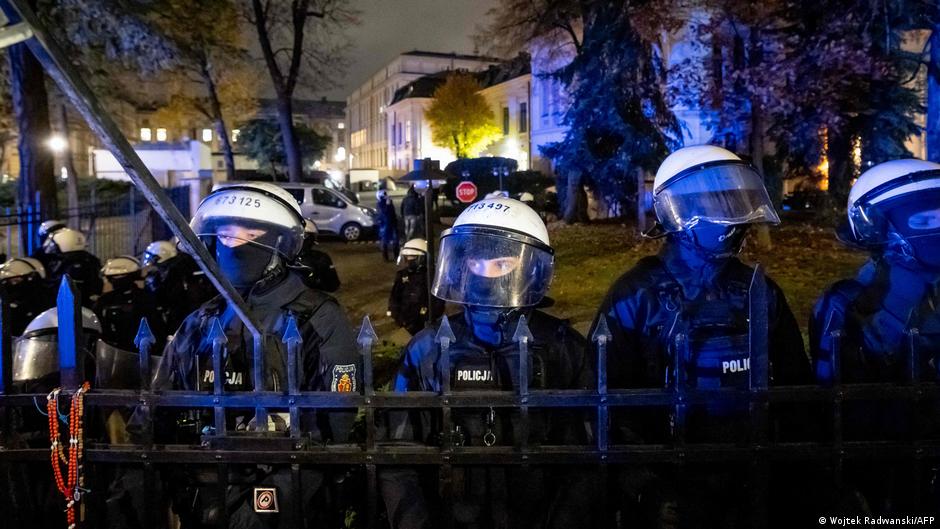
Poland’s long-running conflict over the rule of law escalated sharply on October 30, when Constitutional Tribunal judge Anna Korwin-Piotrowska announced the one-month suspension of the court’s president, Bogdan Święczkowski, and vice-president, Bartłomiej Sochański. Police cordoned off the tribunal’s Warsaw headquarters as demonstrators gathered outside, while President Karol Nawrocki abandoned a planned trip to Senegal and returned to Poland.
The immediate dispute concerns who has the legal authority to lead the tribunal and which judges may participate in its proceedings. Its economic significance is broader. Courts determine how contracts, taxes, regulations and property rights are interpreted. When rival institutions no longer agree on who constitutes a lawful court, uncertainty can spread from constitutional politics into routine economic decisions, increasing the risks faced by businesses, investors and public agencies.
A divided court and competing claims of legality
Korwin-Piotrowska, one of the tribunal’s 15 judges, published her decision on the institution’s website on Friday evening. She said the two senior officials had, among other things, prevented judges elected by the Sejm in 2026 who had taken their oaths from hearing cases. She based her authority on a 2016 law governing the tribunal’s organization and procedures, which she said empowered its longest-serving judge to act. She also called a general assembly of tribunal judges for November 3.
A sharply different account appeared on the tribunal’s page on X, which described an “illegal takeover” of the website. The post maintained that Święczkowski and Sochański remained president and vice-president, denied that Korwin-Piotrowska was a tribunal judge and accused those involved of committing the crime of a coup. The tribunal’s website, in turn, said the X account had no connection to the institution. The competing digital statements illustrated a deeper institutional fracture: even the tribunal’s official channels no longer presented a common version of who controlled the court.
“I have no idea what is going on. Ms Anna Korwin-Piotrowska called me and said that she now runs the tribunal. I know nothing more,” Sochański told Rzeczpospolita.
Sochański called the action unprecedented and said he knew of no legal provision allowing his suspension or such interference with the independence of the tribunal or an individual judge. He also characterized the events as a coup.
Government and presidency enter the confrontation
Prime Minister Donald Tusk, whose government and parliamentary majority are opposed to Nawrocki, backed the temporary removal of the tribunal’s leadership. He said restoring the rule of law after years of illegality under the Law and Justice party, or PiS, was a difficult and sometimes painful process requiring decisive action.
Nawrocki said he turned his aircraft around because of the crisis. After returning, he met Święczkowski and Supreme Court First President Zbigniew Kapiński, then entered the tribunal building with Kapiński, according to presidential chief of staff Paweł Szefernaker. Korwin-Piotrowska had said she was prepared to meet the president only at the Presidential Palace.
Maciej Berek, a tribunal judge elected by the Sejm but not permitted by Nawrocki to take the oath, accused the president of choosing “physical confrontation” by seeking entry. He also said people identifying themselves as presidential staff had attempted to obtain keys to tribunal rooms.
Warsaw police said Prosecutor General and Justice Minister Waldemar Żurek had asked officers to pay particular attention to security during protests around the building. Police also received a letter from a tribunal judge warning of a potential threat to life and health. Officers cordoned off the premises but said they did not enter the building. According to police, protesters threw dangerous objects at officers, and three demonstrators were detained after climbing over a barrier and entering the tribunal grounds.
Economic costs of unresolved institutional conflict
The standoff follows months of conflict between Tusk’s government and the political camp associated with Nawrocki and PiS. It began when the president refused to accept the oaths of judges elected by the new parliament. Święczkowski likewise declined to recognize their authority or allow them to hear cases. The government considers the tribunal illegitimate because judges chosen under the previous authorities remain on its bench, while the governing coalition and sympathetic judges regard Nawrocki’s actions as unlawful obstruction.
On October 30, Żurek also said he had submitted five applications to the Constitutional Tribunal seeking the lifting of immunity, including applications concerning Święczkowski and Sochański. That move raises the stakes by linking the battle over court administration to potential legal proceedings against its leadership.
For Poland’s economy, the central risk is not a single ruling but prolonged uncertainty about which rulings will be accepted. Historical experience across emerging and developed markets shows that institutional disputes can impose costs before any formal breakdown occurs. Companies may delay capital expenditure, demand higher returns or devote more resources to legal contingencies. Public bodies can become cautious about procurement and regulation if officials fear that decisions will later be invalidated.
The crisis may also complicate Poland’s relations with European institutions, where judicial independence has long influenced political and financial negotiations. The immediate confrontation remains domestic, but its structural consequences could extend to confidence in regulation, the predictability of public policy and perceptions of sovereign risk. A durable settlement therefore requires more than control of the tribunal building or its communications channels: it requires a broadly recognized process for determining who may sit, lead and rule in Poland’s highest constitutional court.