Russian Strikes Kill Four in Ukraine as Civilian Infrastructure Bears Costs
Attacks in Kherson, Sumy, Odesa and the Kyiv region underscored the mounting human and economic burden of repeated strikes on urban infrastructure.
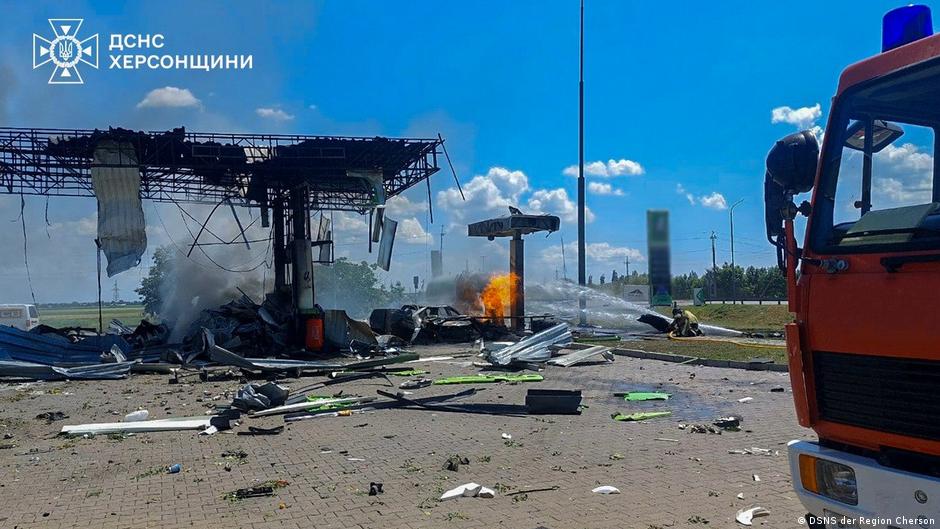
Four people were reported killed in Ukraine after a new wave of Russian attacks hit several regions, damaging residential, medical, administrative and storage facilities and again exposing the economic fragility created by repeated strikes on civilian infrastructure.
In the Kherson region, two people died after a Russian drone strike on the settlement of Tekstylne on Friday evening, September 18. Oleksandr Prokudin, the head of the regional military administration, said the incident occurred at around 18:00 and that two men suffered injuries incompatible with life.
“As a result of an enemy drone strike, two men received injuries incompatible with life,” Prokudin wrote on his Telegram channel.
Throughout the evening, Prokudin repeatedly reported air-raid alerts in the region, including warnings linked to possible launches of guided aerial bombs by Russian forces. The same day, one of Kherson’s city hospitals was also attacked when a drone dropped explosives on the grounds of the medical facility. No casualties were reported in that incident.
The pattern is economically significant as well as humanitarian. Repeated drone and bomb attacks on hospitals, residential blocks and administrative buildings impose costs that go beyond immediate reconstruction. They interrupt medical services, divert emergency resources, raise insurance and security costs where coverage exists, and deepen the uncertainty facing households and businesses already operating in a war economy.
Repeated Strikes and the Cost of Emergency Response
In Odesa, emergency officials reported further consequences from Russian attacks on September 18. A strike hit an 11-storey administrative building and caused a fire. Some time later, while emergency services were working at the scene, the same building was attacked again. Ten people were reported injured, including two rescuers.
Such repeat attacks are especially costly for local authorities because they target not only physical assets but also the response system itself. When rescuers are injured at an active scene, municipalities lose personnel, equipment availability and operational time. That has a compounding effect: each subsequent incident becomes harder to manage, and emergency services must operate under higher risk premiums in practical, human terms.
Odesa was attacked again during the night of September 19. After an air-raid alert was declared in the city and reports emerged of incoming Russian small missiles, local residents posted footage on social media showing a fire that had started in a residential building within the city. Initial details of the incident were not provided.
The reported attacks in Odesa show how the war’s economic geography has expanded from front-line devastation to repeated disruption in major urban and logistical centers. Odesa has long been central to Ukraine’s commercial life, and while the source reports only the immediate incidents and casualties, the broader structural issue is clear: repeated urban attacks can degrade administrative capacity, damage housing stock and impose persistent costs on local budgets.
Residential Damage in Sumy
On the evening of September 18, the city of Sumy also came under Russian strikes. One projectile hit a multi-storey residential building, with reports indicating that it was a guided aerial bomb. The blast damaged several apartments and the building partially collapsed.
According to preliminary data from local authorities, at least two people were killed in the strike and seven others were injured. The use of a guided aerial bomb against an apartment block, as reported locally, places heavy pressure on municipal housing systems. Even when the number of destroyed units is limited, partial collapse can render surrounding apartments unsafe, forcing temporary displacement and creating demand for inspections, repairs and emergency accommodation.
Historically, wars that bring repeated damage to housing stock produce long-lasting economic scars. Families that lose homes also lose collateral, savings and proximity to work. Cities lose tax base stability and must redirect spending from development to urgent repairs. In Ukraine’s case, these effects accumulate alongside the direct fiscal demands of defense, social support and infrastructure restoration.
The attacks reported on September 18 and 19 therefore form part of a broader economic pattern: destruction is not limited to headline infrastructure such as power grids, ports or factories. The ordinary assets that allow urban economies to function — hospitals, apartments, administrative buildings, warehouses and emergency services — are also under strain.
Warehouses Hit in the Kyiv Region
The military administration of the Kyiv region also reported consequences from Russian strikes on the evening of September 18. Timur Tkachenko, the head of the regional military administration, said two men were injured in the Bucha district after strikes on warehouse premises. Storage facilities were also damaged in the Boryspil district.
Damage to warehouses has a different but equally important economic effect from damage to homes or hospitals. Storage sites are nodes in supply chains. They hold goods, equipment or inputs that may be destined for businesses, humanitarian distribution, construction, agriculture or public services. Even without detailed figures on the contents of the damaged facilities, the reported strikes point to disruption of logistics capacity in a region central to national administration and commerce.
For Ukraine, the structural consequence of repeated attacks across multiple regions is the constant diversion of scarce resources. Local governments must clear debris, repair buildings, maintain emergency services and support displaced residents. Businesses must assess risks to premises and inventory. Households must make decisions under conditions of permanent uncertainty.
The latest reported fatalities in Kherson and Sumy, together with injuries and damage in Odesa and the Kyiv region, underline how the war continues to impose costs across both human and economic systems. The immediate toll is measured in deaths, injuries and damaged buildings. The longer-term burden is measured in weakened urban resilience, disrupted services and the cumulative erosion of productive capacity.