Serbia’s Student-Led Opposition Poses an Economic Test for Vucic
A mass rally ahead of Serbia’s snap election has turned anger over alleged corruption into a challenge to the country’s governing model.
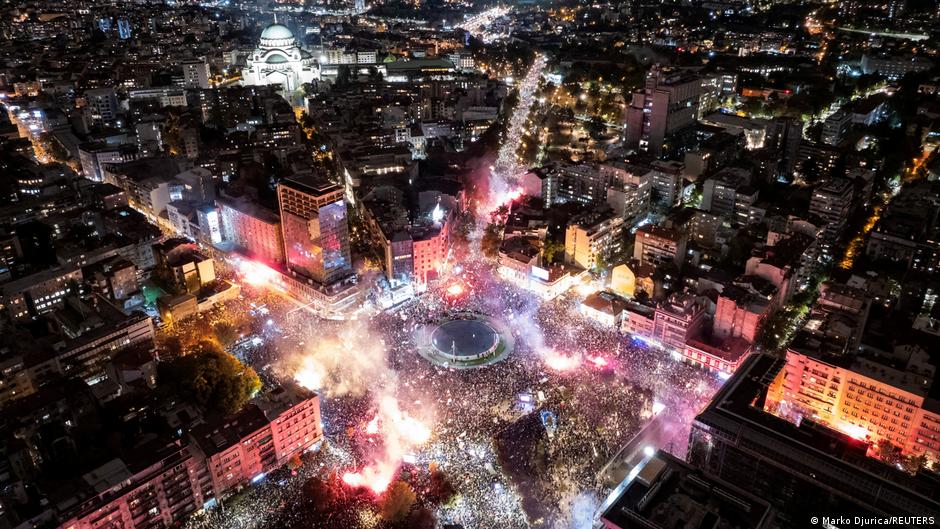
About 150,000 opposition supporters gathered in Belgrade on Thursday, October 22, according to organizers, in a demonstration tied to Serbia’s snap parliamentary election. The rally’s scale underscored how a protest movement triggered by a deadly infrastructure failure has developed into a potentially decisive political and economic challenge to President Aleksandar Vucic and his Serbian Progressive Party, or SNS.
Demonstrators called for an end to the rule of Vucic, who has been Serbia’s head of state since 2014 and intends to remain in power despite announcing that he would resign. They also urged voters to support the Student List, a movement that emerged during a wave of student protests and has since become a significant political force.
The immediate electoral stakes are unusually high. A survey by the New Serbian Political Thought project, published on October 20, put support for the Student List at 44.5%, ahead of the SNS at 42.7%. An equivalent poll in early October gave the Student List 44.4% and the governing party 41.7%. Although the margins are narrow, the consistency of the results suggests that the challenge is more than a temporary surge in public anger.
From infrastructure disaster to institutional crisis
The early parliamentary election, scheduled for October 25, follows nearly two years of protests that began after the collapse of a canopy at the railway station in Novi Sad in November 2024. The station had been renovated only shortly before the disaster, which killed 16 people. Serbia’s independent media and opposition identified corruption as one of the principal causes of the tragedy.
That allegation gave the disaster significance beyond a single construction project. Public infrastructure is one of the clearest points at which state capacity, procurement practices and political accountability intersect. When a recently renovated public facility fails with fatal consequences, the economic questions concern not only how much was spent, but whether contracts were awarded transparently, whether oversight worked and whether public investment delivered genuine value.
The election has become a referendum not only on political leadership, but on the institutions governing public money, infrastructure and accountability.
Student groups became the main driving force behind the protests. Their campaign produced the Student List, an organization without an obvious leader and without professional politicians among its electoral candidates. Instead, the students want academics, activists and public figures to represent the movement.
This model breaks with Serbia’s established pattern of party-centered politics. Its strength is that it can present candidates as independent of the professional political class and the networks of patronage that protesters oppose. Its weakness is that a decentralized protest coalition would have to translate moral authority into parliamentary discipline, administrative competence and a coherent economic program if it entered government.
A contest over control of the executive
Most Serbian opposition parties have withdrawn from the race and called on voters to support the students. That consolidation reduces fragmentation among government opponents, while placing considerable responsibility on a movement that was not originally built as a conventional electoral organization.
One of the students’ main demands since 2024 has been Vucic’s resignation. He has repeatedly said that he would take that step, but in practice he intends to change offices rather than leave power. On October 25, he will seek the post of prime minister. An SNS victory would therefore allow him to remain in control.
The institutional shift matters. Under Serbia’s constitution, the prime minister has broader powers than the president, even though Vucic became the most recognizable face of the governing forces during his presidency. He previously served as prime minister from 2014 to 2017 and left that office after winning the presidential election. Since then, the premiership has continuously been held by representatives of his party.
Vucic’s planned return to the premiership therefore carries a historical parallel within his own career: political authority would again move between offices while remaining concentrated around the same leader and party. For investors, businesses and households, such continuity can offer short-term predictability. But when continuity depends heavily on one political figure, it may also deepen institutional concentration and make policy credibility more dependent on electoral outcomes and public confidence in that individual.
The structural economic stakes
The election’s longer-term consequences will depend on whether Serbia treats the Novi Sad tragedy as an isolated failure or as evidence of wider weaknesses in procurement, regulation and oversight. Persistent perceptions of corruption can raise the effective cost of public investment, weaken competition for state contracts and reduce trust that taxes are being converted into safe, productive infrastructure.
A Student List victory could create pressure for greater transparency and institutional reform, but it would also expose the movement to the practical demands of governing without experienced politicians or a single recognized leader. An SNS victory, meanwhile, would preserve an established chain of authority but could intensify the political conflict if protesters conclude that Vucic’s change of office does not satisfy their demand for a genuine transfer of power.
The Belgrade rally shows that Serbia’s election is no longer simply a contest between familiar parties. It is a struggle over whether a student-led movement can convert outrage over public-sector failure into durable institutional change—and whether the existing governing system can retain legitimacy while keeping its dominant figure at the center of executive power.