Slovak Protests Expose Economic Risks of Fico’s Political Realignment
Mass demonstrations on the Velvet Revolution anniversary highlighted concerns over the rule of law, media control and ties with Moscow.
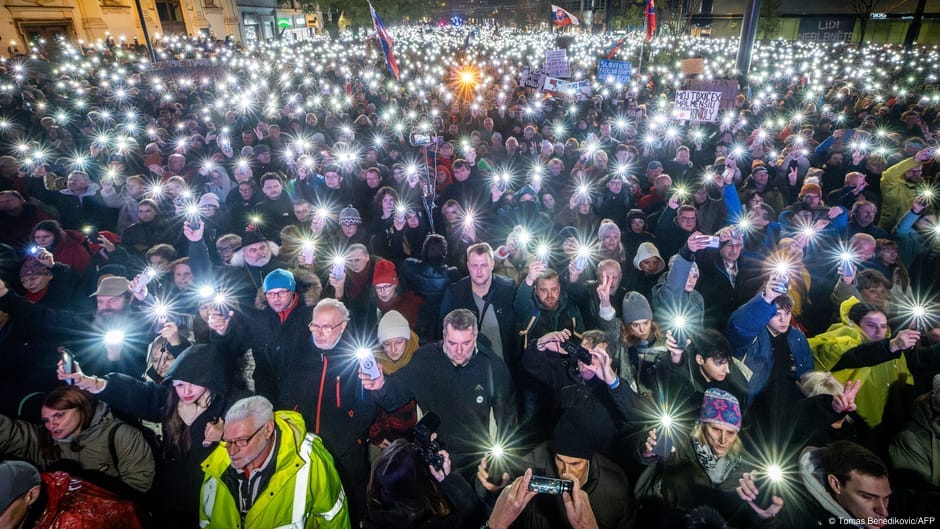
Thousands of people took to the streets across Slovakia to protest against Prime Minister Robert Fico’s government, using the anniversary of the 1989 Velvet Revolution to warn that the country’s democratic institutions are being weakened. The demonstrations focused on alleged violations of the rule of law, the government’s links with the Kremlin, policies aimed at controlling the media and restrictions affecting LGBT rights.
The rallies were held on Monday, November 17, and marked the 37th anniversary of the start of the Velvet Revolution in Czechoslovakia. That historical reference gave the protests a significance extending beyond immediate party politics. The peaceful uprising of 1989 ended communist rule and opened the way for democratic government and a market-based economy, making its anniversary a potent setting for criticism of state power and institutional decline.
The largest gathering took place in Bratislava’s Slovak National Uprising Square. Progressive Slovakia, the country’s largest opposition party and the organizer of the demonstration, estimated that about 25,000 people attended. Protesters chanted “We have had enough of Fico” and carried banners demanding the resignation of the three-party government led by the prime minister.
“I do not want a country from which I will have to flee,” read one of the placards carried at the demonstration.
Other signs declared, “Russians, go home.” Some demonstrators told AFP that they were angered by Slovak Foreign Minister Juraj Blanár’s recent visit to Moscow. The reaction illustrated how foreign policy has become intertwined with domestic concerns about Slovakia’s political direction and the durability of its post-1989 alignment.
Institutional confidence carries an economic premium
Although the demonstrations were primarily political, the issues raised have direct economic implications. The rule of law is not merely a constitutional principle; it is also part of the infrastructure on which investment, credit and long-term business planning depend. Companies making decisions about factories, hiring or regional headquarters assess whether regulations will be applied consistently, contracts will be enforced and public institutions will remain insulated from political pressure.
Concerns about media control can carry similar consequences. A pluralistic media environment helps expose corruption, policy failures and conflicts of interest before they become larger fiscal or corporate risks. If businesses, households or investors believe that public information is incomplete or politically managed, uncertainty rises. That can weaken confidence even before any measurable deterioration appears in headline economic data.
The protests over LGBT rights also point to a broader structural issue: a country’s ability to retain and attract workers. The placard warning of a future in which citizens feel compelled to leave reflects a longstanding economic danger for smaller European states. When politically dissatisfied professionals, students and younger workers emigrate, the losses extend beyond population numbers. The economy can lose skills, entrepreneurial capacity and future tax revenue, while demographic pressures on public finances intensify.
The unfinished economic legacy of 1989
The Velvet Revolution began a transformation that was simultaneously political and economic. Czechoslovakia moved away from one-party rule and central planning, while its successor states became integrated into European production, trade and investment networks. Slovakia’s modern economic model is therefore inseparable from the institutions developed after 1989: competitive politics, legal predictability and openness to European markets.
This history explains why protesters selected the anniversary as the focal point for their campaign. Their argument is implicitly economic as well as democratic: the benefits of market integration cannot be treated as wholly separate from the legal and political framework that supported them. Historical experience across post-communist Europe has shown that formal market institutions may survive periods of political centralization, but their quality can erode if oversight bodies, independent media and legal constraints lose authority.
Relations with Moscow add another layer of uncertainty. The demonstrations did not set out a detailed economic program, but opposition to the government’s Kremlin ties signals anxiety about Slovakia’s strategic orientation. For businesses and workers whose prospects depend on stable access to European markets and cross-border supply chains, geopolitical ambiguity can become a material concern. Even without an immediate policy rupture, conflicting signals may complicate investment calculations and weaken perceptions of predictability.
A weakened coalition, but no clear route to elections
The political pressure is rising as Fico’s governing coalition has recently lost its absolute majority in parliament following the departure of several lawmakers. The opposition has since called for an early parliamentary election. It does not, however, have enough votes to approve such a move, leaving Slovakia in a period of political stalemate.
That arithmetic limits the protesters’ immediate ability to force a change of government. It may also make economic policymaking more difficult. A coalition without a secure majority can struggle to pass legislation, sustain fiscal measures or provide a dependable timetable for reforms. At the same time, political weakness can encourage short-term bargaining and sharpen competition over public resources.
The demonstrations therefore expose a broader tension in Slovakia’s development. The country’s post-1989 economic gains were built during an era of institutional convergence with democratic Europe, yet a substantial part of the public now fears that this direction is being reversed. Whether the protests alter parliamentary calculations remains uncertain. Their scale nevertheless shows that questions of law, information, civil rights and geopolitical alignment have become central to the debate over Slovakia’s future economic resilience.