Ukraine Sanctions Organizers of Russian Duma Vote in Occupied Regions
Kyiv’s measures target 44 people tied to Moscow’s parliamentary elections in occupied Ukrainian territories, as the EU signals parallel action.
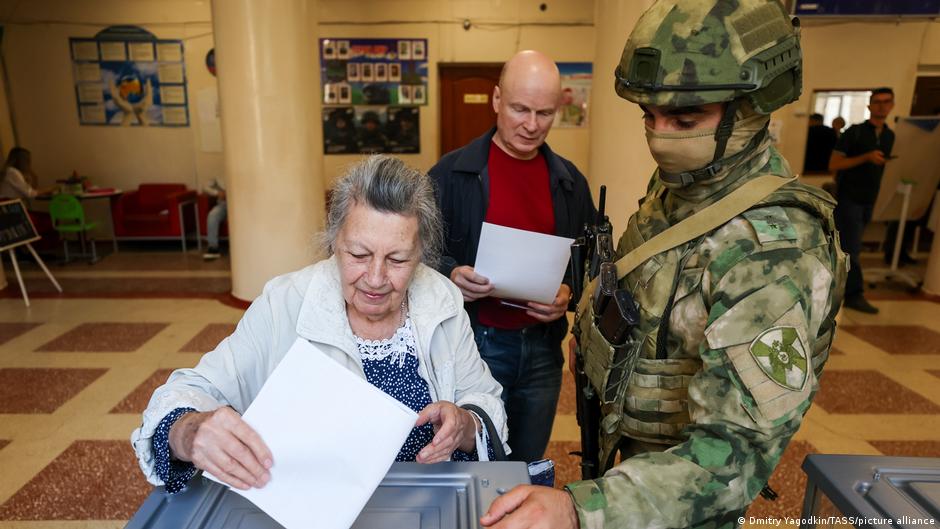
Ukrainian President Volodymyr Zelensky has imposed sanctions on individuals involved in organizing Russia’s State Duma elections in occupied Ukrainian territories, widening Kyiv’s effort to raise the political and economic costs of Moscow’s incorporation strategy. The measures, introduced on Saturday, September 27, target 44 people, 38 of whom hold both Ukrainian and Russian citizenship, according to the Office of the President of Ukraine.
The sanctions follow Russia’s parliamentary elections, held from September 18 to 20, during which Russian authorities organized voting for the first time in occupied areas of Ukraine’s Kherson, Zaporizhzhia, Donetsk and Luhansk regions. Ukraine and its Western allies have declared both the process and the results illegal. The European Union has also said it is prepared to add people who helped conduct the vote in occupied Ukrainian territory to its sanctions lists.
For Kyiv, the sanctions are not only a legal response to an electoral exercise it rejects as illegitimate. They are also part of a broader policy aimed at preventing occupation authorities from normalizing Russia’s administrative, fiscal and political control over seized regions. Elections in such territories serve more than symbolic purposes: they create officeholders, budget channels, legal claims and patronage networks that can bind local institutions to Moscow’s state system.
Ukraine and its Western allies have recognized the voting process and its results as illegal.
A Vote as an Instrument of Integration
Russian authorities created separate single-mandate districts for Ukrainian regions occupied after 2022 for the 2026 State Duma elections. That institutional step matters. By designing electoral districts around territories seized during the war, Moscow sought to treat them as regular components of the Russian political map, rather than exceptional areas under military occupation. The economic implications are direct: representation in the Duma can influence the distribution of public funds, infrastructure priorities, subsidies and administrative appointments.
According to the announced results, Russia said several candidates were elected from single-mandate districts in the occupied territories. In the so-called Donetsk People’s Republic, those included Irina Kuksenkova, a war correspondent for Channel One, and Alexander Borodai, a former “head” of the self-proclaimed republic. In the so-called Luhansk People’s Republic, Russia declared Denis Kolesnikov and Ivan Sanayev, described as “local parliament deputies,” elected. In occupied Zaporizhzhia, the declared winner was Alexei Tikhomirov; in occupied Kherson, it was Elena Dmitruk, described as a deputy chair of the local parliament. All of them ran for United Russia.
In addition to single-mandate candidates, eight more representatives of the “authorities” in occupied Ukrainian territories entered the Russian State Duma through federal party lists. Among them was Serhiy Arbuzov, a former first deputy prime minister of Ukraine under President Viktor Yanukovych and former head of the National Bank of Ukraine, who was nominated by A Just Russia.
Sanctions and the Economics of Recognition
The Ukrainian president’s office said that some of the sanctioned individuals had already been “elected” as so-called deputies of illegally formed local councils in temporarily occupied Ukrainian territory. That continuity is important because it indicates a layered process: first local occupation structures, then participation in Russia’s national legislature. Each step makes reversal more complicated by expanding the number of individuals with political, financial and personal stakes in the occupation system.
Sanctions are designed to disrupt precisely those incentives. While the source information does not specify the individual penalties, Ukrainian sanctions typically seek to limit access to assets, financial systems and official cooperation. In economic terms, they transform participation in occupation governance from a route to status and resources into a source of personal liability. If the European Union follows with its own listings, the cost of involvement could rise further, especially for people with property, banking links, relatives or business interests exposed to European jurisdictions.
The dual citizenship of 38 of the 44 sanctioned individuals also underscores the social and administrative complexity of occupied regions. Russia has promoted citizenship and documentation as tools of control, while Ukraine continues to regard residents of those territories as its citizens. Sanctioning dual nationals involved in the electoral process sends a message that holding Russian documents does not remove accountability under Ukrainian policy.
Historically, disputed elections in occupied or annexed territories have functioned as mechanisms of consolidation. They do not merely produce legislatures; they help convert military control into bureaucratic routines. Once deputies, party lists, districts and committees are established, public spending and administrative reporting begin to follow the logic of the occupying power. That is why Kyiv and its allies have focused not only on military and diplomatic responses, but also on sanctions against organizers, candidates and local intermediaries.
The economic consequences may unfold over time. If sanctions lists expand, businesses connected to sanctioned figures may face higher compliance risks. Banks and counterparties may avoid transactions involving occupation-linked officials. Regional projects promoted through Russian federal channels could become harder to finance internationally, even indirectly. For Moscow, the vote is meant to signal permanence. For Kyiv, the sanctions aim to ensure that participation in that signal carries a durable cost.
The dispute over the Duma elections therefore sits at the intersection of sovereignty, public finance and institutional control. Russia is attempting to convert occupied territories into ordinary electoral constituencies. Ukraine is attempting to block that conversion by denying legitimacy, targeting participants and encouraging allied sanctions. The result is a contest not only over ballots, but over whether political offices created under occupation can become gateways into recognized economic and administrative life.