Ukraine Says 28 Killed in Russian Barrage as War Costs Return to Focus
The attack across 13 Ukrainian regions sharpened Kyiv’s argument that sanctions relief and oil revenue are sustaining Moscow’s war economy.
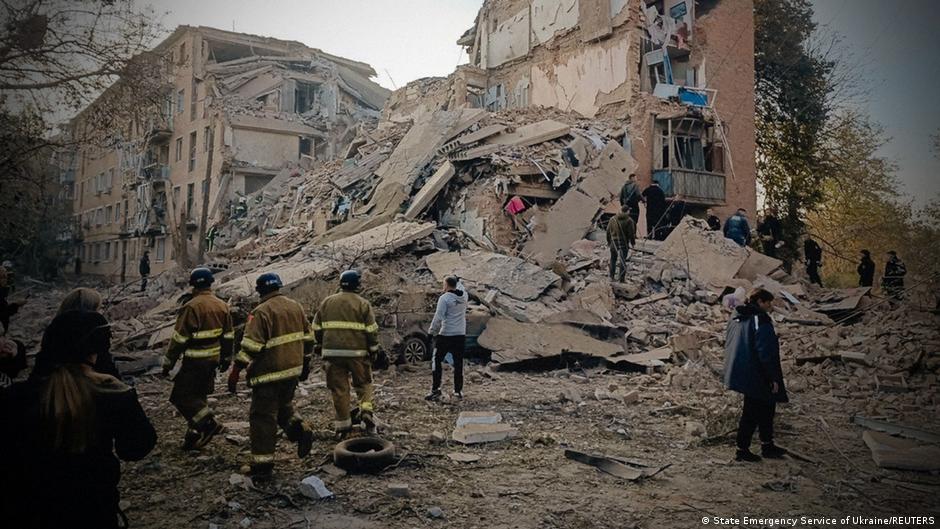
Ukraine said 28 people were killed after a large-scale Russian attack using missiles and drones, a strike that Kyiv framed not only as another episode of wartime destruction but also as evidence that the economic architecture around the war remains unresolved.
Interior Minister Ivan Vyhovsky said in a Telegram post on Wednesday evening, October 7, that 28 people had died in Ukraine as a result of the mass shelling by Russian forces. According to him, emergency service workers and police officers managed to pull people from rubble, evacuate them from damaged buildings and rescue them from fires. In all, 29 people were saved in those operations.
The most severe reported toll was in Pryluky, in Chernihiv region, where a missile hit a residential apartment building. Vyhovsky said 20 people were killed there, including five children. Three of the children were one year old. He added that debris-clearing work in Pryluky had continued for more than 14 hours.
President Volodymyr Zelensky said later that same evening that 100 people had been wounded in the attacks. He described the strike as combined in nature, involving many ballistic missiles, many cruise missiles and Shahed drones. During the day, he said, further attacks followed using Shahed drones and aerial bombs.
“Putin still can sell oil, and when he counts profit in dollars and euros, the war still pays off,” Zelensky said, arguing that the conflict remains economically advantageous for Moscow.
The economics behind escalation
For Kyiv, the casualty figures were accompanied by a broader political-economic claim: that Russia’s ability to continue fighting is being reinforced by revenue streams and by what Zelensky described as signals of normalization. The Ukrainian president linked any weakening of sanctions against Russia, as well as signals about lifting sanctions on oligarchs, to a message being sent to Moscow that the war can be absorbed into the international system rather than treated as a continuing emergency.
That argument is central to Ukraine’s diplomacy. Zelensky said Russia was moving further toward escalation, killings and shelling, and he stressed the importance of leaders not remaining silent about what had happened. In his view, Russian President Vladimir Putin does not feel that such attacks create problems for him. The implication is structural: if the costs imposed on Russia are insufficient, the incentives to continue the war remain intact.
The attack, according to Zelensky, struck 13 Ukrainian regions on October 7. He said Russian forces used 70 missiles, including many ballistic missiles, along with Shahed drones. The scale and geographic spread of such a barrage point to the dual burden Ukraine faces: immediate civilian protection and the long-term economic strain of defending infrastructure, housing, logistics networks and public services under repeated attack.
Vyacheslav Chaus, head of the Chernihiv regional military administration, had earlier reported more than 50 people injured as a result of the attack. Those figures were part of a wider picture of human and material damage that continues to place pressure on local administrations, emergency services and reconstruction capacity.
Sanctions, oil revenue and wartime endurance
Zelensky’s comments placed the attack within a wider debate over sanctions effectiveness. He argued that through the weakening of sanctions measures against Russia and signals about removing sanctions from oligarchs, Moscow is receiving signals about the normalization of the war against Ukraine. The central economic claim is that Russia can still sell oil, receive revenue in major currencies and use those proceeds to sustain military operations.
For an economics readership, that point highlights one of the defining tensions of the conflict: sanctions are intended to raise the cost of aggression, but their effect depends on enforcement, market adaptation and political cohesion among sanctioning states. If energy sales continue to produce substantial income, then the fiscal pressure on Moscow may be less than Kyiv believes is necessary to change the Kremlin’s calculations.
Zelensky described the issue as one not only for Ukraine and its people, but for all of Europe and the Western world. His framing reflects a broader wartime logic: the economic consequences of the conflict are not confined to the battlefield. They reach into energy markets, defense budgets, reconstruction planning, public finances and the credibility of sanctions as a tool of economic statecraft.
Historically, prolonged wars often become contests of production, finance and endurance as much as territory. Ukraine’s latest statements suggest that Kyiv sees Russia’s war effort through precisely that lens. The question is not only how many missiles or drones were launched on a particular day, but whether Russia’s revenue base, external trade channels and elite expectations continue to make escalation affordable.
The immediate facts remain stark. Ukraine says 28 people were killed, 100 were wounded and 13 regions were attacked. In Pryluky, rescue workers continued clearing rubble after a missile struck an apartment block. Kyiv’s political message is that the deaths are inseparable from the economic conditions that allow the war to continue: oil income, sanction fatigue and any perception in Moscow that the costs of further escalation remain manageable.