U.S. Says It Destroyed Five Iranian Oil Tankers After Missile Attacks
CENTCOM said the strikes followed two ballistic missile attacks on a U.S. Navy ship and targeted vessels tied to Iran’s shadow oil network.
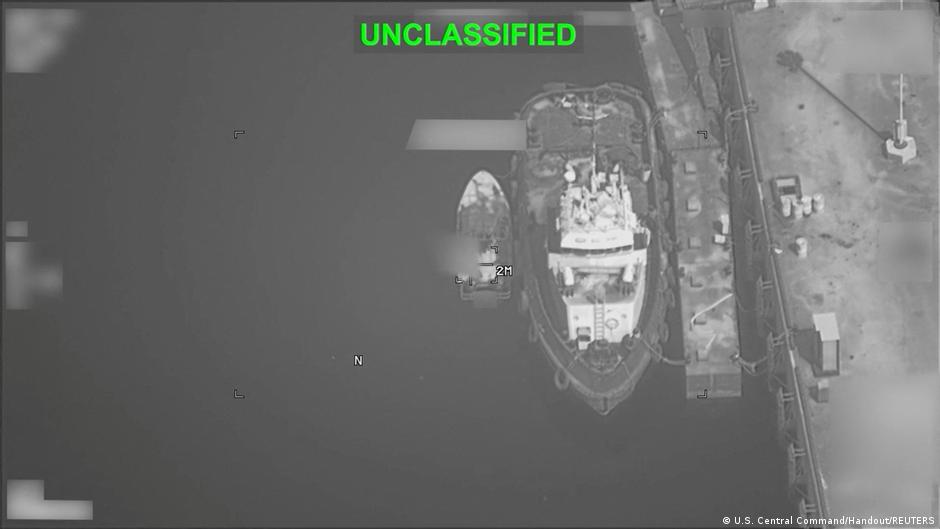
U.S. Central Command said it destroyed five Iranian oil tankers on Tuesday, September 8, after the Islamic Revolutionary Guard Corps twice attacked a U.S. Navy ship with ballistic missiles over the previous two days. The command said the U.S. vessel successfully evaded the attempted attacks and continued patrolling regional waters. No U.S. personnel were injured.
The strikes mark a further escalation in a conflict centered increasingly on maritime power, oil logistics and control of the Strait of Hormuz. CENTCOM said the vessels were used by Iran as part of a multibillion-dollar “shadow” network that finances the IRGC and its regional proxies. According to the U.S. military, Tehran lacks the means to defend those ships.
CENTCOM identified the tankers destroyed in the Gulf of Oman as M/T Kaviz, M/T Charminar, M/T Horizon 1 and M/T Riesco. A fifth vessel, M/T Derya, was struck near Kharg Island in the Persian Gulf. U.S. forces instructed the crews to leave the vessels before they were hit and disabled, the command said.
U.S. forces instructed the crews to abandon the tankers before the vessels were struck and disabled, according to CENTCOM.
Oil Logistics Become a Central Battlefield
The immediate military sequence is clear: alleged Iranian missile attacks on a U.S. Navy ship were followed by U.S. strikes against vessels Washington says help finance the IRGC. The broader economic significance is more complex. Tankers are not only military targets in this conflict; they are financial infrastructure. If the U.S. assessment is accurate, the vessels formed part of a system designed to move oil, generate revenue and sustain Iran’s ability to project force through affiliated groups in the region.
Shadow shipping networks have long been a structural feature of sanctioned oil economies. They rely on opaque ownership, vessel transfers, complex routing and maritime practices that make cargo origin and destination harder to track. For Iran, such networks can serve a strategic function: converting restricted energy resources into usable revenue despite sanctions and military pressure. For Washington, striking tankers connected to that system is therefore not simply a tactical response. It is an attack on the revenue chain behind Iran’s military and political influence.
The destruction of five tankers also follows an earlier U.S. operation on September 5, when CENTCOM forces destroyed three Iranian oil tankers after the IRGC attempted to attack a U.S. aircraft carrier and a guided-missile destroyer. Taken together, the reported strikes suggest a shift from episodic military retaliation toward sustained pressure on maritime assets linked to Iran’s oil economy.
The Hormuz Precedent and the Cost of Maritime Control
The Strait of Hormuz remains the strategic core of the confrontation. Before hostilities began in late February, the waterway was open to shipping. It is now one of the main points of dispute in the war involving the United States and Israel against Iran, and both Iranian and U.S. armed forces now claim control over it. That contest carries implications well beyond the immediate theater of conflict because the strait plays a crucial role in global oil supplies.
Historically, conflicts around chokepoints have imposed costs even when shipping is not fully halted. Insurance rates rise, routing becomes less predictable, chartering grows more expensive and energy markets price in a risk premium. In the current case, the destruction of tankers near the Gulf of Oman and close to Kharg Island underscores how quickly the economic geography of the Persian Gulf can become militarized. Kharg Island itself is a symbolically and operationally important location because of its association with Iran’s oil export system.
Washington had not struck Iran since late July before the current round of operations. U.S. President Donald Trump had explained the pause as an effort to continue negotiations with Tehran over the fate of the Strait of Hormuz, sanctions and Iran’s nuclear program. That pause ended on August 30, when the United States struck two Iranian missile launchers on Larak Island in the Strait of Hormuz. Tehran then said it had carried out retaliatory attacks against U.S. targets in the United Arab Emirates, with dozens of drones attacking “American helicopters and personnel at Al Minhad base” in the UAE.
The sequence points to a familiar economic pattern in regional conflict: negotiation over sanctions and strategic corridors proceeds alongside coercive action against the assets that make those corridors valuable. Oil tankers, missile launchers, naval patrols and drone attacks are part of the same balance sheet. Each side is trying to raise the cost of the other’s posture while preserving its own ability to extract political concessions.
For energy markets, the key issue is not only whether individual vessels are destroyed, but whether the cumulative risk changes expectations about supply reliability. Even when volumes continue to move, uncertainty around Hormuz can affect crude pricing, shipping contracts and the behavior of refiners and traders. A prolonged struggle over control of the strait could encourage buyers to diversify supply, raise the value of alternative routes and increase the premium attached to secure maritime transport.
The U.S. claim that Iran lacks the means to protect these tankers is also economically relevant. If Tehran cannot shield vessels tied to its shadow network, the network’s cost of operation rises. Crews may be harder to recruit, insurers and intermediaries may demand more compensation, and counterparties may reassess the risks of participating. The financial pressure would compound sanctions by making evasion more expensive and less reliable.
At the same time, the targeting of oil infrastructure and transport can deepen the cycle of retaliation. Iran’s reported missile and drone actions show that the conflict is not confined to ship-to-ship or ship-to-shore dynamics. U.S. assets in the Gulf, bases in allied states and commercial energy flows all sit within the same risk environment. That interdependence is what gives the Hormuz dispute its global economic weight.
For now, the reported destruction of five tankers is another indication that the war’s economic front is widening. The battlefield is not only territorial or naval. It is the system of vessels, revenues, sanctions, ports and chokepoints through which oil economies operate under pressure.