Germany Presses Kyiv to Tie Ukraine Aid More Closely to German Industry
Foreign Minister Johann Wadephul said Berlin’s role as a leading backer of Ukraine should also benefit Germany’s defense sector.
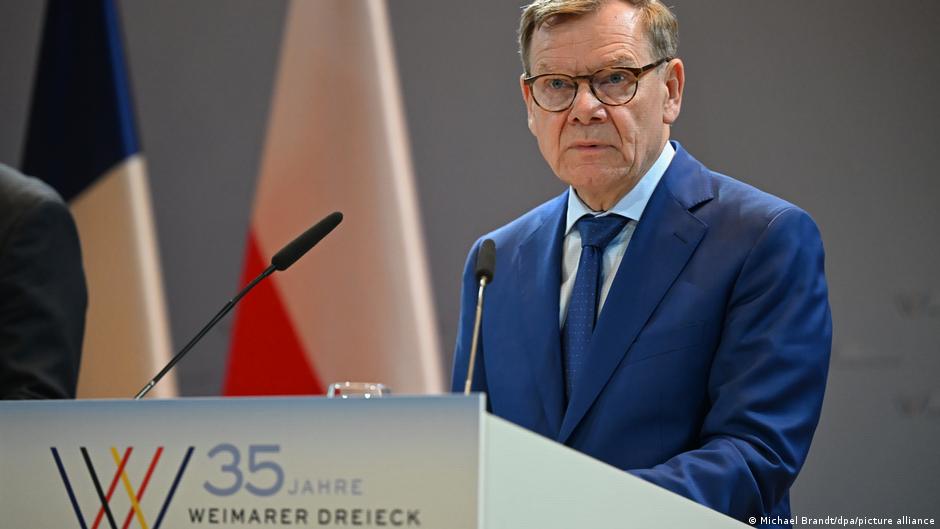
Germany’s foreign minister, Johann Wadephul, has urged Kyiv to pay closer attention to German interests as Berlin continues to provide large-scale financial and military support to Ukraine. His comments, made in an interview with Bild published on Tuesday, September 8, place an explicitly economic and industrial frame around a policy that has often been presented primarily in strategic and security terms.
Wadephul criticized Ukrainian President Volodymyr Zelensky and argued that Germany’s support should be reflected in procurement decisions connected to Ukraine’s defense needs. The message was direct: Germany is not only a donor and political ally, but also an economy with an industrial base, taxpayers and defense manufacturers whose role should be considered in the structure of assistance.
“At the moment, we are Ukraine’s strongest supporter in terms of financial and military assistance,” Wadephul said, adding that “German defense industry must benefit from this.”
According to Wadephul, he raised the issue with Zelensky during a recent visit to Kyiv. He said he told the Ukrainian president that Germany stood with Ukraine and would continue to support it, but that he also had to explain that support to German taxpayers. At a minimum, Wadephul said, German defense companies should participate in all procurement processes.
A Donor’s Industrial Question
The remarks highlight a structural tension that has become more visible as the war has extended over years: the line between military aid, industrial policy and fiscal accountability is increasingly difficult to separate. When a government finances arms, energy supplies, medical equipment or air defense support for another country, the spending is not only a foreign-policy decision. It also becomes a domestic economic question about contracts, production capacity, employment, industrial upgrading and the political legitimacy of long-term expenditure.
Germany has been one of Ukraine’s most important supporters since Russia’s full-scale invasion, and Wadephul’s formulation suggests Berlin is now placing greater emphasis on the domestic return from that support. The logic is familiar in wartime and postwar economies. Major aid programs frequently create procurement systems that shape entire industrial sectors. The question is not only who pays, but who produces, who supplies, who maintains systems and which national industries gain scale from prolonged demand.
For Germany, the issue carries particular weight because its defense industry has had to adapt to a changed European security environment. Ukraine’s demand for weapons, air defense systems, drone protection and related equipment has coincided with a broader reassessment of defense spending across Europe. If German firms are excluded from major procurement flows linked to German-backed aid, Berlin may face a political problem at home: taxpayers fund the support, while industrial gains accrue elsewhere.
Wadephul’s comments therefore point to a more transactional phase in Ukraine support. That does not necessarily imply a reduction in assistance. Rather, it suggests that support may be increasingly tied to expectations about procurement access and industrial participation. In economic terms, aid becomes part of a broader production chain, not simply a transfer.
August Visit and New Commitments
Wadephul visited Kyiv on August 22. At a joint press conference with Ukrainian Foreign Minister Andrii Sybiha, he announced additional aid for Ukraine worth 60 million euros. The package added to Germany’s continuing role in Ukraine’s financing and military support architecture.
Germany will also transfer a further 10 million euros to a NATO fund. According to the source account, that fund is used, among other purposes, for supplies of energy resources, medical equipment and systems designed to protect against drones. These categories show how the economics of the war extend beyond conventional weapons. Energy resilience, medical logistics and counter-drone systems have all become critical procurement fields, and each can generate demand for specialized producers across Europe.
Wadephul also announced further talks with partners from various countries on supplying Ukraine with additional air defense systems. Air defense has been one of Ukraine’s most pressing military requirements, and the procurement and production of such systems are capital-intensive, technologically complex and politically sensitive. For supplier countries, involvement can strengthen industrial capacity and deepen long-term defense relationships.
The foreign minister’s comments should be read against this wider context. The longer the war continues, the more governments that support Kyiv must justify not only the strategic need for assistance but also its budgetary and industrial design. Germany’s position as a major supporter gives it leverage, but it also exposes Berlin to domestic scrutiny over how aid money is spent.
For Kyiv, the challenge is to maintain urgent access to military and civilian support while balancing the interests of multiple donor countries. Each partner may have its own defense firms, procurement priorities and political constraints. As a result, Ukraine’s wartime procurement choices are not only operational decisions; they are also part of the diplomatic management of an international support coalition.
Wadephul’s intervention makes that reality explicit. Berlin is signaling that solidarity and industrial participation are increasingly linked. The economic consequence could be a tighter connection between Ukraine aid packages and the defense production strategies of supporting states. Historically, such patterns can outlast the conflict itself, influencing military standards, supplier relationships and industrial specialization for years.
For Germany, the potential benefit is a stronger domestic defense sector supported by sustained demand. The risk is that assistance may be perceived as less unconditional, complicating the political message of support for Ukraine. For Ukraine, broader participation by German defense industry could help secure supply channels, but it may also add another layer of negotiation to procurement at a time when speed remains essential.
Wadephul’s remarks therefore mark more than a diplomatic complaint. They reflect the emerging economics of a prolonged European security crisis, in which aid, procurement and national industrial interests are becoming part of the same policy equation.