U.S. Strike on Caribbean Drug Boat Raises Costs of a Wider Maritime Campaign
The reported killing of four alleged drug traffickers adds to a yearlong U.S. campaign whose legal risks and regional costs are mounting.
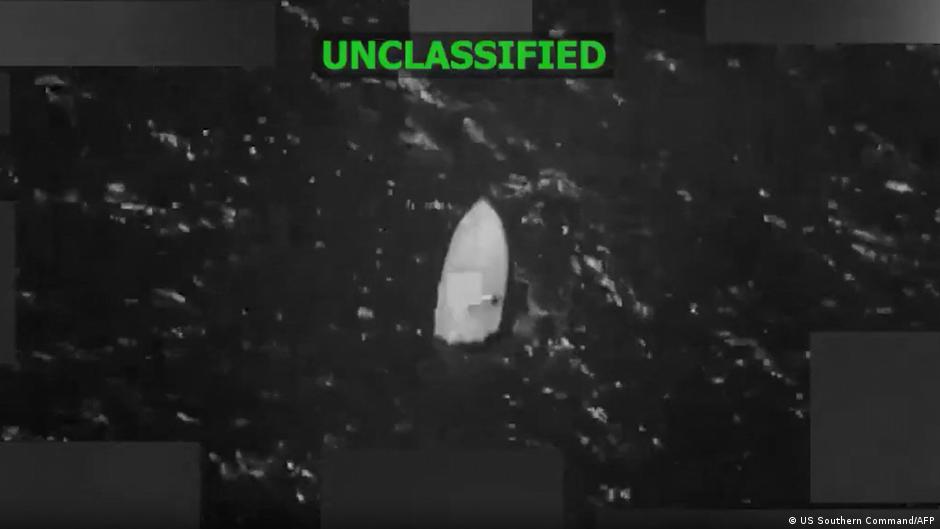
U.S. forces reported a new lethal strike on a vessel in the Caribbean Sea that, according to American military officials, was carrying drugs. Four people were killed in the operation, U.S. Southern Command said, adding another episode to a campaign that has already become a significant security, legal and economic issue for the region.
In a statement issued on Saturday, September 19, Southern Command said it had carried out a “lethal strike” against a speedboat that was “travelling along routes used for the illegal transport of drugs in the Caribbean Sea.” The command said intelligence had established the vessel’s involvement in narcotics trafficking and described the four people killed as “narcoterrorists.”
“Credible intelligence confirmed this vessel’s involvement in narcotics trafficking. During the operation, four narcoterrorists were eliminated,” the military said.
A video released on the social media platform X showed a moving vessel before it disappeared in a bright flash. The United States did not present evidence publicly demonstrating that the vessel was involved in drug trafficking.
The Associated Press reported that, including this case, the number of people killed in U.S. military strikes against vessels of alleged drug traffickers in the Caribbean Sea has reached at least 231. According to the agency’s count, 69 such strikes have been carried out as part of a campaign that has been under way for more than a year.
A Security Campaign With Economic Spillovers
The Caribbean has long been a corridor in the illicit drug economy, linking production zones, transit networks and final consumer markets. The economic logic of interdiction has always been complicated: when enforcement intensifies on one route, traffickers often adapt by raising prices, shifting corridors, using smaller vessels or increasing payments to compensate for higher risk. The result can be a temporary disruption rather than a decisive collapse of the trade.
The latest U.S. strike therefore matters beyond the immediate military claim. It signals that Washington is continuing to treat some maritime drug interdiction not as policing or seizure operations, but as a lethal campaign. That distinction changes the risk environment for Caribbean waters, where legitimate shipping, fishing, tourism and port activity are all central to local economies.
For small island states and coastal economies, maritime security is not an abstract issue. Insurance costs, port inspections, naval patrol patterns and perceptions of regional instability can affect trade and investment. Even when strikes are aimed at alleged traffickers, a sustained military campaign may impose broader costs if commercial actors begin to view certain waters as higher-risk operating zones.
The historical parallel is the long-running U.S. “war on drugs,” which repeatedly shifted pressure across borders and transport networks without eliminating demand. Campaigns in one geography often pushed trafficking into another, while violence and corruption costs were absorbed by transit countries with weaker fiscal and institutional capacity. In that sense, the Caribbean strikes raise a structural question: whether lethal interdiction reduces the underlying market or merely reallocates its risks.
Legal Concerns and Political Signaling
The campaign also carries legal and diplomatic consequences. On October 23, 2025, at a White House press conference, U.S. President Donald Trump said American forces would “kill people” bringing drugs into the country from Venezuela. That statement placed the operations within a highly charged political frame, linking drug enforcement, Venezuela and military action.
On October 31, 2025, United Nations High Commissioner for Human Rights Volker Türk said U.S. attacks on vessels “allegedly linked to drug trafficking” violated international law. Türk called for immediate, independent and transparent investigations into the attacks.
The absence of publicly presented evidence in the latest case is economically relevant as well as legally significant. Markets depend on rules, predictability and credible institutions. When states expand lethal force into activities previously handled through arrest, seizure and prosecution, the boundary between law enforcement and military action becomes less clear. That uncertainty can affect regional cooperation, especially if partner governments face domestic pressure over sovereignty, civilian harm or due process.
From Washington’s perspective, lethal strikes may be intended to raise the expected cost of trafficking and deter crews from using Caribbean routes. But deterrence depends on more than force. It also depends on whether traffickers believe detection is consistent, whether alternative routes are available and whether the profits from successful shipments still outweigh the risk of loss.
Illicit markets are resilient because they are organized around margins. If enforcement destroys some vessels, surviving networks may charge more, recruit more expendable crews or invest in evasion. The public casualty figures cited by the Associated Press, at least 231 deaths in 69 strikes over more than a year, suggest a campaign of considerable intensity. They do not, by themselves, show whether drug flows into the United States have been durably reduced.
The Structural Question
The strike in the Caribbean is therefore part of a larger policy dilemma. Drug trafficking imposes heavy social and economic costs on the United States and on transit countries alike. Yet the tools used to confront it can also generate costs: legal exposure, diplomatic friction, regional insecurity and the potential normalization of extrajudicial force at sea.
For Econpress readers, the central issue is not only whether one speedboat was carrying drugs. It is whether a lethal maritime campaign can alter the economics of narcotics trafficking without creating a wider risk premium for Caribbean economies and international law. The U.S. military says intelligence confirmed the vessel’s role in drug trafficking. Critics point to the lack of public evidence and to the call from the U.N. human rights chief for independent investigations.
The longer the campaign continues, the more its consequences will be measured not only in vessels destroyed or suspects killed, but in the institutional precedents it sets. If interdiction becomes a military kill-chain rather than a law-enforcement process, the Caribbean may find itself at the intersection of counter-narcotics policy, geopolitics and economic uncertainty.