Zelensky Says U.S.-Russia Diesel Deal Risks Financing a Longer War
Ukraine’s president warned that any easing of pressure on Russian fuel exports without a de-escalation deal would strengthen Moscow’s war economy.
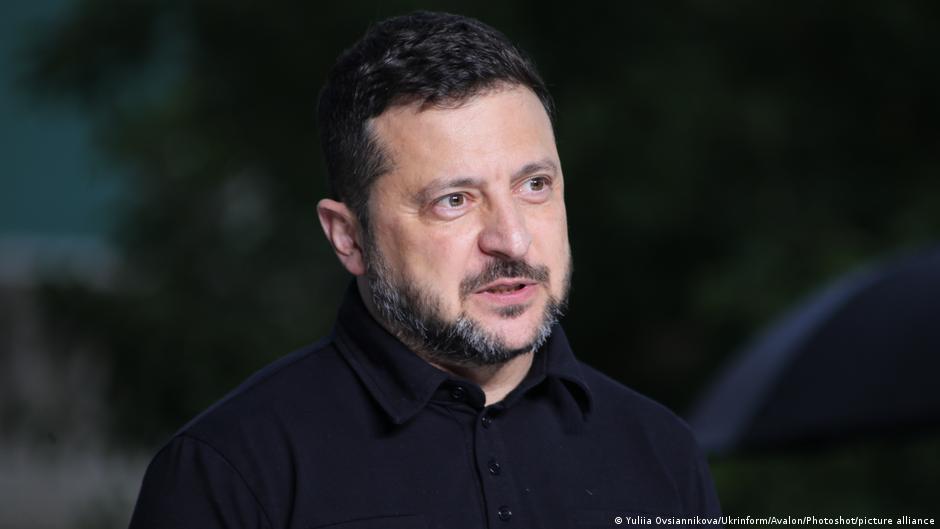
Ukrainian President Volodymyr Zelensky sharply criticized a U.S.-Russian agreement allowing Russian diesel fuel to return to global markets, describing the move as an “investment in war” rather than a step toward peace. His comments, made on Friday, October 9, framed the decision not merely as a sanctions adjustment, but as a structural economic concession to Moscow at a moment when energy revenues remain central to Russia’s ability to sustain its military campaign.
The criticism followed U.S. President Donald Trump’s statement that he had held “very successful” talks with Russian President Vladimir Putin, during which the two sides reached an understanding on supplies of Russian diesel to the United States and the wider global market. On the same day, the U.S. Treasury Department announced that the Office of Foreign Assets Control, acting on Trump’s instruction, was immediately issuing a temporary general license authorizing Russian diesel shipments to the global market.
Zelensky argued that such a move weakens the logic of economic pressure unless it is tied to a clear mechanism for de-escalation. In his view, allowing Russia to sell petroleum products without enforceable commitments risks converting commercial relief into military endurance.
“Permission for Russia to sell petroleum products is an investment in a war that must be ended, not continued,” Zelensky said.
Energy Revenue and the Economics of Attrition
The dispute highlights a familiar dilemma in wartime economic policy: how to balance short-term market stabilization against the long-term strategic cost of relieving pressure on an aggressor’s fiscal base. Diesel is not simply another traded fuel. It is a refined product essential to transport, agriculture, logistics, mining, construction and military mobility. For an economy under sanctions, access to diesel export markets can also provide hard-currency revenue, preserve refinery utilization and support the broader infrastructure of oil production.
Zelensky’s argument rests on that broader economic chain. If Russian refined fuels can reach world markets more freely, Moscow may gain revenue, logistical flexibility and political leverage. The Ukrainian president warned that Russia would “thank” the world for diesel with further “terror” and “vile acts,” linking energy trade directly to the continuation of attacks against Ukraine.
The issue also echoes earlier sanctions debates in which Western governments sought to reduce Russian energy income while avoiding shocks to global fuel prices. Crude oil and refined products sit at the center of that tension. Restrict supply too sharply, and import-dependent economies face inflationary pressure. Allow too much trade, and sanctions lose their coercive force. The diesel agreement, as described by both Washington and Moscow, appears to reopen precisely that trade-off.
Russian Deputy Prime Minister Alexander Novak told TASS that Russia was “immediately” beginning to remove restrictions on diesel exports earlier than previously planned. He also confirmed Trump’s statement that Russian diesel exports could eventually reach 3 million tons per month. That figure, if reached, would represent a significant flow of refined fuel into global channels and would reinforce the economic importance of the arrangement.
A Proposed Energy Ceasefire
Zelensky paired his criticism with a counterproposal aimed at linking energy infrastructure to military de-escalation. He said Ukraine was ready for reciprocal steps, arguing that Kyiv would refrain from burning Russian oil refining capacity if Russia stopped destroying Ukrainian energy infrastructure. The offer casts energy assets as a potential bargaining domain, where mutual restraint could reduce economic destruction and civilian hardship.
“Ukraine will not burn Russian oil refining if Russia does not destroy our energy sector,” Zelensky said, adding that Ukraine was proposing exactly such an arrangement to the United States. He argued that U.S. power was sufficient to achieve such a compromise.
The proposal matters because energy infrastructure has become one of the most consequential economic fronts of the war. Attacks on power systems, refineries and distribution networks affect not only military logistics but also households, industrial output, public finances and winter resilience. For Ukraine, repeated strikes against energy infrastructure have imposed reconstruction costs and created pressure on electricity supply. For Russia, refinery disruptions can affect fuel availability, export capacity and budget revenue.
Zelensky’s framing suggests that sanctions relief should not be treated as a unilateral incentive. Instead, he is pressing for conditionality: any relaxation of restrictions on Russian fuel should be matched by a verifiable reduction in Russia’s attacks on Ukrainian energy assets. Without that, he argued, the concession becomes a sign of weakness.
“Any weakening of sanctions against the Russian Federation without a clear agreement on de-escalation is obvious weakness,” Zelensky said, warning that it would play into Russia’s hands and allow Moscow “to kill more” and “fight longer.”
Sanctions, Signals and Structural Consequences
The economic significance of the diesel license extends beyond the immediate fuel market. Sanctions work partly through direct restrictions and partly through expectations. When markets, shipping firms, insurers, refiners and intermediaries believe restrictions may soften, commercial networks can begin to reorganize around that expectation. Even a temporary general license can therefore send a broader signal about enforcement priorities and political intent.
For Moscow, that signal may be valuable. A partial opening for diesel exports could help Russia demonstrate that Western restrictions are negotiable, especially when global energy needs are invoked. It may also reduce the discount Russia must accept on its energy exports and support the refining sector at a time when export limitations had constrained product flows.
For Ukraine, the concern is that this shifts bargaining power away from Kyiv and toward Moscow. If Russia can receive market access without first reducing attacks or accepting a ceasefire, then the incentive structure changes. The Kremlin may conclude that endurance, rather than compromise, produces economic concessions. That is the core of Zelensky’s warning: fuel trade, in this reading, is not an isolated commercial exception but part of the political economy of a prolonged war.
The United States, by contrast, appears to be presenting the arrangement as a practical outcome of talks with Putin, with Trump emphasizing the success of the negotiations. The Treasury’s immediate issuance of a temporary OFAC license indicates that the policy shift was meant to take effect quickly. The speed of implementation will likely intensify scrutiny over whether the measure is tied to any enforceable Russian commitment, or whether it functions primarily as relief for global fuel markets.
Historically, wartime economic pressure has often weakened when strategic objectives compete with domestic price stability. Governments that impose sanctions on major commodity producers must continually manage the contradiction between punishing the sanctioned state and protecting consumers from higher prices. Diesel, because it feeds directly into freight, food supply chains and industrial activity, is particularly sensitive. That gives Russia leverage, but it also gives sanctioning states a reason to design conditional mechanisms rather than open-ended exemptions.
Zelensky’s response is therefore both diplomatic and economic. He is warning Washington that relaxing sanctions without a de-escalation bargain could undermine the stated objective of ending the war. His proposed reciprocal energy restraint seeks to convert market access into leverage. Whether the United States uses that leverage, or treats diesel flows as a separate market-management issue, will shape not only fuel supply but the economic incentives surrounding the next phase of the conflict.