European Security Charter Signals Shift in Burden-Sharing and Economic Risk
Nearly 40 European states have endorsed common security principles that expand cooperation into hybrid threats, crime and information interference.
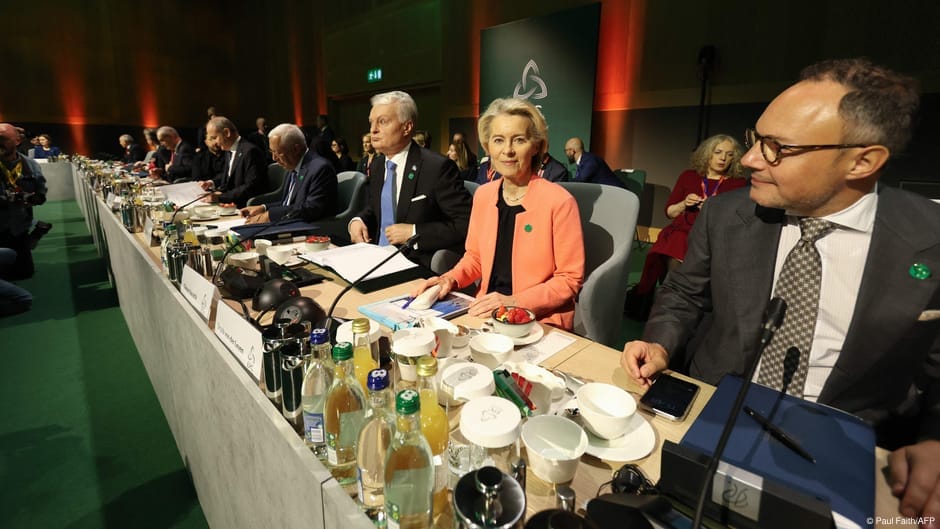
Nearly 40 European countries have agreed on a French-backed charter setting out what they describe as the key principles of European security, in a move that signals a broader redistribution of strategic responsibility across the continent.
Germany, Ukraine, the United Kingdom, Spain and 35 other European states approved the document on Thursday, November 12, during a summit of the European Political Community in Dublin. France initiated the agreement, which brings together established security commitments while extending the agenda into areas that increasingly carry direct economic consequences.
According to AFP, the charter codifies existing foundations of European security and adds newer concerns, particularly hybrid threats. Its signatories condemned in the strongest terms Moscow’s intensified hybrid campaigns and pledged to counter such activity, including information interference.
The document also addresses terrorism, drug trafficking and the illegal smuggling of migrants. By combining military, political and cross-border criminal risks within one framework, the charter reflects a security environment in which threats can no longer be separated neatly from trade, investment, public finances, communications infrastructure and labor mobility.
A wider definition of economic security
The charter’s importance for Europe’s economy lies partly in that widened definition. Hybrid campaigns and information interference can impose costs without taking the form of conventional armed conflict. Governments must finance cybersecurity, intelligence capabilities, border enforcement and institutional resilience, while companies face higher spending on compliance, data protection, supply-chain safeguards and business continuity.
Measures against terrorism, narcotics trafficking and migrant smuggling similarly require sustained investment in policing, customs systems and judicial cooperation. These expenditures may strengthen stability over time, but they also compete with social programs, industrial policy and fiscal consolidation for limited public funds. The resulting trade-offs are likely to become more visible as European governments assume a larger share of the continent’s security burden.
“European countries are taking greater responsibility for security in Europe,” the participating states said, adding that this would have a positive effect on global and transatlantic security.
Journalists who obtained access to the charter said it is grounded in the United Nations Charter, the North Atlantic Treaty establishing NATO and the Treaty on European Union. That legal and institutional continuity is economically significant: rather than proposing an entirely separate security order, the initiative appears designed to reinforce existing structures and reduce uncertainty about how European commitments relate to NATO and the EU.
Burden-sharing after the Ukraine war
British Prime Minister Andy Burnham emphasized the importance of the charter’s reference to NATO. He said the alliance would need to ensure a stable situation in Europe after the war in Ukraine. A draft of the charter also states that any issue concerning European security should be decided together with Europeans, AFP reported.
This principle points to a possible shift in transatlantic burden-sharing. If European states take on greater responsibility, the economic effects could include stronger demand for defense production, digital infrastructure and security-related services. At the same time, countries with limited fiscal room may face pressure to choose between higher security spending, taxation, additional borrowing or cuts elsewhere.
The structural question is therefore not simply how much Europe spends, but whether its states can coordinate procurement, standards and long-term investment. Fragmented national programs can duplicate costs and weaken economies of scale. A shared framework may improve coordination, although the charter’s stated principles alone do not establish detailed funding mechanisms or binding spending commitments.
The initiative also carries a historical echo. European security arrangements have repeatedly evolved when geopolitical shocks exposed gaps between political commitments and the practical capacity to enforce them. The new charter follows that pattern by preserving the established roles of the UN, NATO and the EU while acknowledging threats that operate through information systems, borders and civilian institutions.
Security architecture enters peace negotiations
The broader architecture of European security has also featured in recent negotiations between Russia and Ukraine over a peace settlement. Those discussions covered both the conditions for a ceasefire and the future security framework for Europe.
At talks in Abu Dhabi, US presidential envoy Jared Kushner advocated the creation of a “new” European security architecture. The charter agreed in Dublin does not necessarily resolve that debate, but it gives European governments a collective statement of principles at a moment when the continent’s postwar arrangements are being discussed.
For markets and businesses, the central issue will be whether these principles translate into predictable institutions. A stable framework could lower geopolitical risk, support investment and make cross-border planning easier. Continued ambiguity, by contrast, would sustain risk premiums, raise insurance and financing costs, and encourage governments and companies to retain expensive buffers against disruption.
The charter is therefore both a political declaration and an early indication of Europe’s changing economic priorities. Its long-term impact will depend on implementation: how participating states divide costs, coordinate capabilities and reconcile security investment with already demanding domestic budgets.