Fed Raises Rates for First Time in Three Years as Inflation Pressure Returns
The quarter-point move to 3.75-4 percent signals a renewed anti-inflation stance despite political pressure for cheaper credit.
The U.S. Federal Reserve has raised the federal funds rate by 25 basis points to a target range of 3.75-4 percent, marking its first increase in three years and reopening a familiar policy dilemma for the world’s largest economy: how to restrain inflation without undermining growth, employment and household balance sheets.
The decision, announced by the Fed on Wednesday evening, September 16, was justified by the central bank as a response to persistent inflation in the United States. All 12 members of the Federal Open Market Committee voted in favor of the rate increase, according to the published decision. The move follows a period in which the central bank had been moving in the opposite direction, cutting rates three times in 2024 and three more times in 2025.
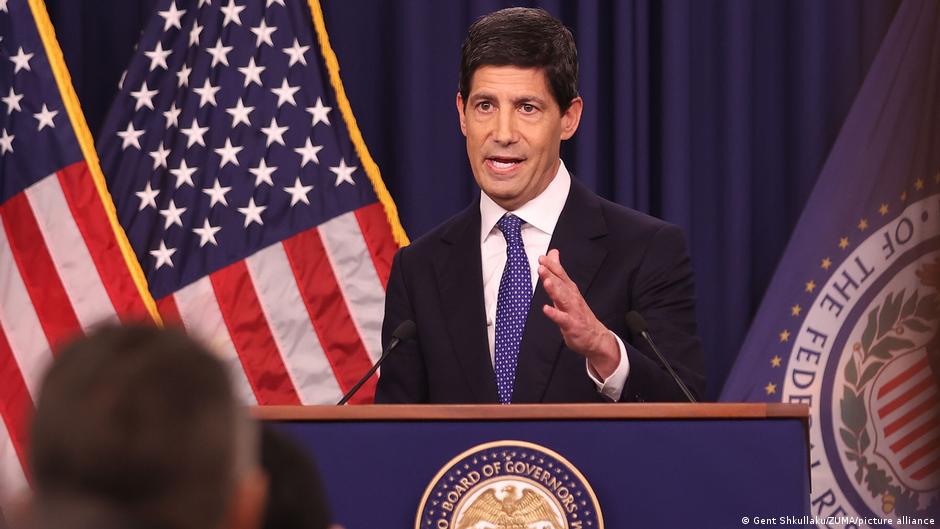
At a press conference, Fed Chair Kevin Warsh framed the decision in terms of the central bank’s core responsibility to restore price stability after a prolonged period of inflation above target.
“Our primary focus within our mandate is on ensuring price stability,” Warsh said. “Quite simply, inflation is too high, and it has been going on for too long. That is a fact.”
The rate rise places the Fed back in tightening mode at a politically sensitive moment. Higher policy rates typically filter through to mortgage costs, business borrowing, credit cards and asset valuations. For households, they can mean more expensive loans and weaker housing affordability. For companies, they can raise financing costs and dampen investment. For markets, they can shift expectations about earnings, liquidity and the relative appeal of risk assets.
A central bank caught between inflation and employment
The Fed’s decision also highlights the particular complexity of the U.S. central bank’s mandate. Unlike the European Central Bank, based in Frankfurt am Main, the Federal Reserve has two formal tasks: securing price stability and supporting a strong labor market. That dual mandate gives the Fed broader responsibility, but it also makes its decisions more exposed to trade-offs when inflation and employment conditions point in different directions.
Warsh said on September 16 that U.S. inflation has remained above the Fed’s 2.0 percent target for five years. In July and August of the current year, inflation stood at 3.4 percent. That level is well below the extremes that have marked some earlier inflationary episodes, but it remains high enough to threaten real household incomes, pricing behavior and long-term inflation expectations if left unchecked.
From an economic-policy perspective, the first rate increase after years of reductions carries significance beyond the immediate quarter-point move. It is a signal that the Fed sees inflation risks as more serious than the downside risks of tighter credit. In practical terms, it tells banks, investors and borrowers that the previous easing cycle may be over, or at least interrupted, unless inflation begins moving convincingly back toward target.
The historical parallel is clear: when central banks allow inflation to remain above target for extended periods, the eventual adjustment can become more costly. Expectations begin to matter. Businesses may price in future cost increases, workers may demand compensation for lost purchasing power, and lenders may require higher returns to account for inflation uncertainty. By acting now, the Fed is seeking to prevent a moderate inflation overshoot from becoming a structural feature of the economy.
Energy shock changes the policy equation
The current inflation backdrop has been intensified by geopolitical conflict. According to AFP, the war by the United States and Israel against Iran, which has been under way since late February, led to a sharp rise in energy prices and, in turn, accelerated inflation. That matters because energy shocks are particularly difficult for central banks to manage. Higher interest rates do not produce oil, gas or electricity. They work instead by cooling demand, tightening financial conditions and reducing the economy’s capacity to pass higher costs through to final prices.
This creates an uncomfortable asymmetry. If inflation is driven by energy prices, rate increases may not directly address the original source of the price shock. But if central banks do not respond, they risk allowing that shock to spread into wages, services, rents and long-term contracts. The Fed’s move therefore reflects a judgment that the second-round risks of inflation are now large enough to warrant tighter policy.
The structural consequences could be broad. A sustained period of higher rates would likely weigh on real estate markets, where affordability is especially sensitive to financing costs. It could also affect public finances by raising debt-service costs over time, particularly if Treasury yields adjust upward. For corporations, especially those dependent on refinancing or leveraged balance sheets, the shift may force a reassessment of capital spending, mergers and acquisitions, and shareholder returns.
That context makes Warsh’s own background notable. He was nominated to lead the Fed by U.S. President Donald Trump and took office in mid-May. From 2006 to 2011, he served on the Federal Reserve Board of Governors. Earlier in his career, Warsh worked as a banker at Morgan Stanley, specializing in mergers and acquisitions. He also advised Trump on economic policy.
According to AFP, Trump had expected Warsh, as Fed chair, to preserve low interest rates, which would have made real estate loans more accessible, among other effects. The rate increase therefore represents not only a monetary-policy turn but also a political rupture between the White House’s preference for cheaper credit and the central bank’s assessment of inflation risk.
Political pressure and central-bank independence
Trump sharply criticized the FOMC decision, saying it was driven by “political motives.” Speaking to reporters in North Carolina on September 16, he said Warsh was “a good man,” but added that “regardless of how well he does his job, he has to deal with hostile leadership.”
Trump went further, accusing FOMC members of raising rates to damage him politically. “They are raising the key rate to cause as much harm as possible to Trump,” he said, adding that the increase was being made for political reasons.
Such criticism brings the issue of central-bank independence to the foreground. For financial markets, the credibility of the Fed rests partly on the belief that monetary policy is set to meet macroeconomic objectives rather than immediate political demands. If investors conclude that the central bank is either too susceptible to political pressure or under sustained political attack, the result can be higher uncertainty around rates, inflation expectations and the dollar.
The Fed’s unanimous vote is therefore important. It suggests that, at least inside the FOMC, the inflation concern was broad enough to overcome any preference for continued accommodation. The unanimity may help reinforce the institutional message that the decision was not an idiosyncratic choice by Warsh, but a collective policy response to inflation above target.
The economic consequences will depend on what follows. A single 25-basis-point increase may have limited direct impact, but it can change expectations if investors and borrowers interpret it as the start of a tightening cycle. The key question is whether inflation eases from 3.4 percent toward the 2.0 percent target, allowing the Fed to pause, or whether energy prices and broader cost pressures force additional increases. For now, the September 16 decision marks the end of a three-year period without rate hikes and a return to the central banking problem that has shaped many past cycles: when inflation persists, cheap money eventually becomes harder to defend.