France Protests Shrink but Expose Deepening Economic and Social Strains
A third consecutive Saturday of nationwide demonstrations drew 320,000 people as living costs and education failures widened the movement.
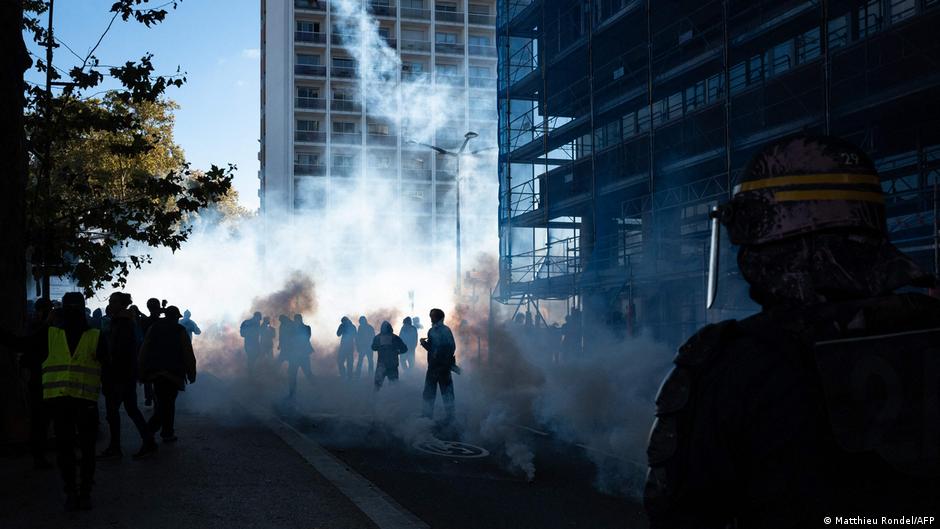
French authorities detained 565 people during a third consecutive Saturday of nationwide protests, as a movement that began with grievances about schools continued to absorb broader anger over living costs and social conditions. The Interior Ministry estimated that 320,000 demonstrators took part across France on October 31, including 70,000 in Paris. Organizers put the national turnout at nearly 500,000.
The official figure points to a significant protest movement, but also to declining participation. Authorities estimated that 550,000 people demonstrated on October 17 and 410,000 on October 24. The downward trajectory may suggest that the mobilization is losing momentum. Yet the persistence of protests for three consecutive Saturdays—and their expansion beyond the education system—indicates that the underlying sources of discontent have not been resolved.
From School Grievances to Economic Anxiety
The demonstrations began in late September with protests by secondary-school and university students. Their complaints included shortages of teachers, overcrowded classrooms, excessively long school days, aging buildings and a lack of modern equipment. Participants also voiced anxiety about their future, including difficulties gaining admission to universities.
Those demands have since attracted people dissatisfied with other social problems, particularly the rising cost of living. This broadening changes the economic significance of the protests. Problems initially framed as failures of education policy are increasingly being connected to household purchasing power, access to public services and confidence in future economic mobility.
Education occupies a central place in that equation. Teacher shortages, inadequate facilities and barriers to higher education affect more than present-day classroom conditions: they influence the skills available to the labor market, regional inequality and the ability of younger people to improve their economic position. When students’ concerns converge with pressure on household budgets, a sector-specific dispute can become a wider challenge to the state’s social and economic model.
Authorities counted 320,000 demonstrators nationwide, while organizers estimated that nearly 500,000 people took to the streets.
The gap between the official and organizers’ estimates is substantial, but both figures show that the movement retains national reach. The difference also illustrates how turnout totals become politically important during mass protests: falling numbers can support the government’s claim that mobilization is weakening, while organizers can point to continued participation across multiple cities as evidence of durable dissatisfaction.
Policing Costs and Escalating Disorder
France deployed 70,000 police officers nationwide to maintain security. Interior Minister Laurent Nuñez said the demonstrations were largely peaceful, but accused members of far-left groups of using “monstrous violence” against law enforcement. In Paris, five officers were injured in clashes with several hundred protesters. Three were wounded by Molotov cocktails; one officer’s clothing caught fire, and he was diagnosed with a burn to his leg.
Protesters in the capital also threw paving stones and rocks at police, who responded with tear gas and batons. In Toulouse, officers used water cannon and tear gas against participants in an unauthorized demonstration. An unauthorized march involving about 10,000 people in Marseille later developed into clashes with police. Violence was also reported in Lyon, where tear gas was used against rioters, according to France24.
The scale of the security deployment reveals a second economic dimension. Sustained nationwide mobilization imposes direct demands on public resources while disruption, vandalism and looting can burden municipalities, businesses and transport networks. The source provides no estimate of those costs, but the deployment of tens of thousands of officers demonstrates the operational pressure created by repeated protests.
The unrest has increasingly included burning rubbish containers and vehicles, vandalism, looting and severe confrontations with police. Such disorder risks separating the movement’s original social demands from public debate about security. Historically, this is a recurring dilemma for broad protest coalitions: escalation can draw attention to grievances, but it can also narrow political discussion to policing and public order.
A Wider European Signal
The demonstrations have also inspired young people in Italy, Germany and Belgium to organize protests. In major German cities, demonstrations on October 31 ended in disorder. The cross-border resonance suggests that the French protests are being watched not merely as a domestic political event but as an expression of pressures shared by younger Europeans.
The grievances identified in France combine immediate material concerns with longer-term uncertainty. Rising living costs affect current consumption, while weak educational infrastructure and anxiety over university access shape expectations about employment and social advancement. This combination can be especially destabilizing because it links present hardship to a belief that future opportunities are also narrowing.
Declining turnout therefore does not necessarily mean that the movement’s economic relevance is fading. Participation has fallen from the official estimate of 550,000 on October 17 to 410,000 on October 24 and 320,000 on October 31. Even so, the protests have evolved from student-led action into a broader vehicle for dissatisfaction, while repeated clashes have increased the political stakes.
The immediate question is whether mobilization continues to contract. The structural question is harder: whether France can address the interaction between strained public education, pressure on household finances and declining confidence among younger citizens. The protests’ durability will depend on organization and public support, but the grievances that produced them reach well beyond a single Saturday’s turnout.