German Conscientious Objections Surge as Berlin Tests a New Recruitment Model
More than 12,000 people declared unwillingness to serve in the German armed forces in the first eight months of 2026, far above last year’s total.
Germany’s effort to rebuild military capacity is producing a revealing economic and social signal: as the state widens the funnel for recruitment, more young people are formally stating that they do not want to serve. From January through the end of August 2026, at least 12,102 people in Germany submitted declarations rejecting military service, according to figures received by the Federal Office for Family and Civil Society Affairs, or BAFzA, and reported by the Funke media group on Monday, October 5.
The scale of the increase is striking. In all of 2025, German authorities received 3,879 applications from people refusing military service. That means the number recorded in only eight months of 2026 was already more than three times the total for the previous year. The jump does not necessarily mean a comparable shift in pacifist conviction across society, but it does show how administrative reform can quickly turn latent preferences into measurable political data.
Part of the increase appears linked to the start of questionnaire mailings from Germany’s Defense Ministry. Under the conscription reform law that took effect on January 1, 2026, 18-year-old men are required from this year to complete a questionnaire asking whether they are prepared to join the German armed forces. Young people also have the right to declare in advance that they refuse military service.
BAFzA said many applications contain errors and “do not meet the requirements” for recognizing an objection as justified, meaning they must be returned without review.
That procedural detail matters. The surge in declarations is not simply a moral or political story; it is also a bureaucratic one. When a state creates a new interface between citizens and the military labor market, it also creates new incentives to respond early, defensively, or imperfectly. BAFzA’s warning that many submissions are being returned without consideration suggests that Germany is not only testing the boundaries of recruitment capacity, but also the administrative capacity needed to process resistance to recruitment.
A labor-market problem in military form
The debate comes against a tense security backdrop and after years in which Germany, like many European states, treated military manpower as a specialized labor-market issue rather than a universal civic obligation. Mandatory service was suspended in 2011. It could now be partially reintroduced by a Bundestag decision through what is being described as a form of “military obligation as needed.” That mechanism is intended to be used if Germany fails to secure the required number of volunteers.
The Defense Ministry’s target is ambitious: by 2035, up to 260,000 people are expected to be serving in the Bundeswehr at the same time. Reaching that level would require not only equipment, training infrastructure and budgetary space, but a sustained supply of recruits in a country facing demographic pressure, tight competition for skilled labor and a younger generation with many alternatives to military employment.
For Econpress readers, the broader question is how Germany prices national security in an economy where labor is already scarce. A larger Bundeswehr absorbs workers who might otherwise enter universities, apprenticeships, civilian public service or private-sector jobs. Conversely, defense employment can offer training, income and stability, especially for younger people at the start of their careers. The state is therefore not merely appealing to patriotism; it is competing in a labor market.
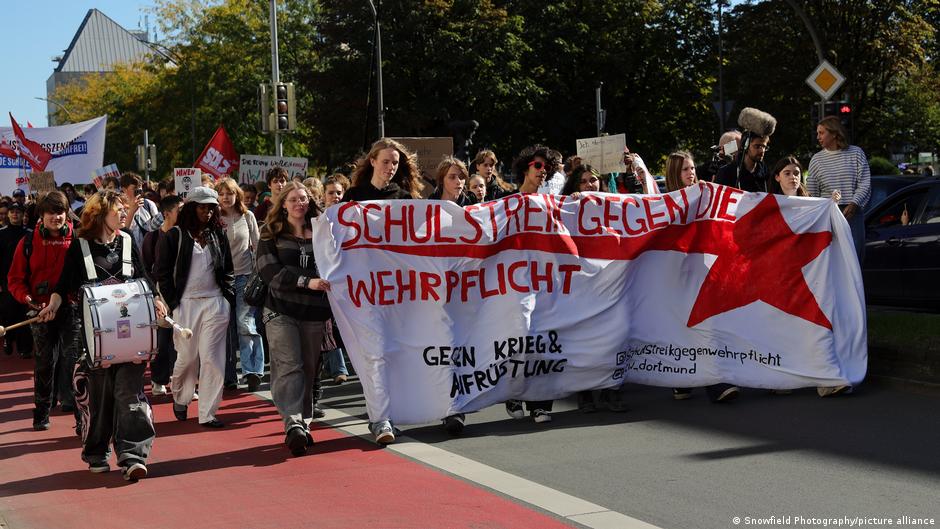
The Bundeswehr has already widened its search for recruits in recent years. Its outreach has included a presence at Gamescom, one of the world’s largest video game exhibitions, held in Cologne. That strategy reflects a modern recruitment economy in which militaries market themselves in the same attention spaces as technology, entertainment and youth culture. Yet the same visibility can generate backlash. German school students have criticized the possible return of “military obligation as needed,” and large protests were held in several cities in September.
Rising objections alongside rising enlistment
The sharp increase in refusal declarations does not mean recruitment is failing outright. At the end of July 2026, Germany’s Defense Ministry reported that the Bundeswehr had reached its highest personnel level in 13 years, with 186,700 service members. Compared with July 2025, that represented growth of more than 2%, or 3,700 personnel.
The ministry also said that of roughly 378,000 people who had been sent questionnaires since the start of 2026, about 2,630 went through the service suitability assessment process in July alone. That was 35% more than in the previous month. By that point, under the new recruitment system, around 12,100 volunteers and short-term contract service members were already serving in the Bundeswehr, about 6% more than a year earlier.
Applications and admissions for contract military service have also increased significantly. In July 2026, 47,300 people submitted applications, 26% more than in the same month of the previous year. By the end of July, the number of new recruits stood at 15,400, a 12% increase compared with 2025.
Those figures point to a more complex structural picture than a simple divide between militarization and refusal. Germany is seeing both more people enter the recruitment pipeline and more people formally reject the possibility of service. That is exactly what might be expected when a previously suspended obligation begins to reappear as a conditional policy option. The state’s demand for military labor becomes more visible, and citizens’ preferences become more formally expressed.
Historically, European conscription systems have served two economic functions: they supplied manpower at controlled fiscal cost, and they distributed the burden of defense across a broad age cohort. The post-2011 German model leaned toward professionalization and voluntarism. The 2026 reform sits between those worlds, preserving a voluntary core while preparing a fallback mechanism if voluntary recruitment falls short.
The long-term consequence may be a more explicit bargaining process between the German state and its young citizens. If Berlin wants a much larger Bundeswehr without fully restoring compulsory service, it may need to improve pay, career pathways, education benefits and the perceived legitimacy of service. If it relies on compulsion or the credible threat of it, the administrative and political costs will rise as well. The 12,102 refusal declarations recorded through August are an early measure of that cost.