German Youth Protests Expose Economic and Generational Fault Lines
Demonstrations over living costs, public services and climate policy descended into disorder across several major German cities.
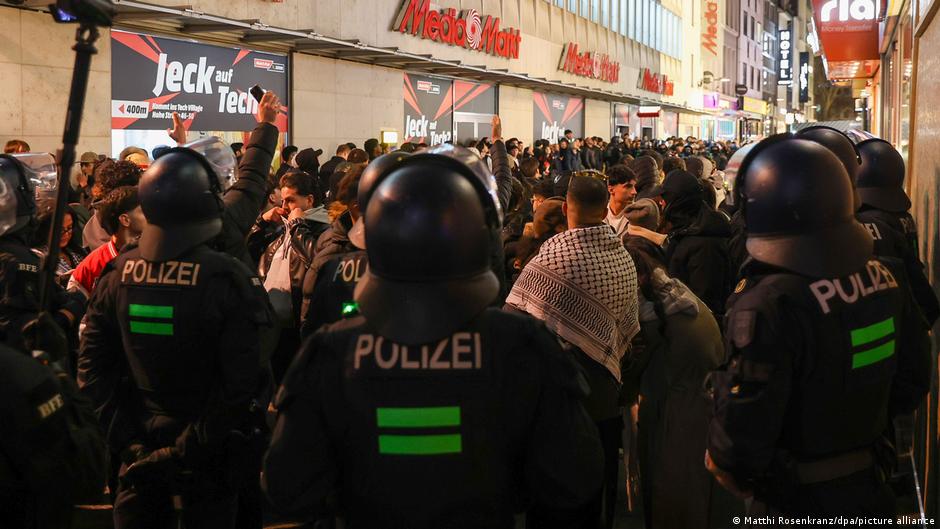
Youth demonstrations across Germany descended into disorder on Saturday, October 31, turning a broad platform of economic and social demands into a major test of public order. The protests, organized by the Gen-Z regelt movement, or “Generation Z Decides,” took place in more than 30 cities and attracted over 100,000 participants, according to organizers.
The movement’s demands reveal a widening generational dispute over how Europe’s largest economy distributes resources and risk. Protesters called for higher-quality education, measures to counter the rising cost of living, stronger climate protection, easier access to psychotherapy and addiction treatment, and the preservation of social spending. Organizers also opposed the introduction of compulsory military service.
Together, those demands span several competing claims on Germany’s public finances. Younger citizens are asking the state to invest in education, health and climate resilience while resisting both welfare retrenchment and a potentially costly expansion of military obligations. The breadth of the agenda illustrates how inflation, strained public services, environmental concerns and security policy have converged into a single generational grievance.
Violence eclipses a wider economic message
In Frankfurt am Main, demonstrations that began peacefully with between 8,000 and 9,000 participants deteriorated into looting and attacks on police. Some protesters smashed shop windows and threw Molotov cocktails at officers. An aggressive group entered a gun shop as well as a Snipes clothing and footwear store. Police confiscated two weapons from those who attacked the gun shop.
Hesse Interior Minister Roman Poseck said the disorder was driven by “around 100 violence-prone left-wing extremists” who had joined the demonstration. Police checked the identification of approximately another 100 people and detained more than 30.
Authorities brought the unrest under control closer to midnight, deploying water cannon, armored police vehicles, a helicopter and drones. Parts of the city center were sealed off during the operation.
“Those who behave like the offenders in central Frankfurt place themselves outside our society,” Hesse Premier Boris Rhein said.
Rhein said the authorities would thoroughly examine the aggressors’ conduct, the composition of the offending groups and the sequence of events before drawing conclusions. The distinction between the mass of demonstrators and the smaller violent contingent will be economically and politically significant: treating a movement of more than 100,000 people solely as a security problem risks obscuring the fiscal and social pressures that mobilized it.
Berlin saw similar tensions. One of two major demonstrations in the capital, attended by about 3,500 people and composed predominantly of members of far-left groups, descended into disorder. Participants threw firecrackers and bottles toward police, launched fireworks, damaged property and violated weapons legislation, according to law enforcement. Police detained 56 people, while 27 officers sustained minor injuries.
In Cologne, police prohibited a planned march and allowed only a stationary gathering after some demonstrators covered their faces and used pyrotechnics, including throwing them at officers. Police deployed water cannon at the end of the event. In Hamburg, some protesters erected and set fire to barricades, then threw bottles and stones at police. Demonstrations ended in similar disorder in Stuttgart and Bremen.
A European pattern of pressure on the social contract
Germany’s protests formed part of a recent wave of youth demonstrations in Europe. Actions in several French cities also developed into vandalism and clashes with police, while Belgium experienced protests of its own. Italy faced particularly intense unrest: organizers said more than one million people demonstrated there on October 30. After severe rioting in Milan, Italian authorities ordered the deployment of 500 military personnel to maintain order.
The cross-border pattern points to pressures that are not confined to one national economy. Younger Europeans are entering adulthood amid higher everyday costs, demands for accelerated climate action and concern that essential services are failing to keep pace with need. At the same time, governments face pressure to strengthen defense, restrain expenditure or redirect budgets, creating sharper competition between military, social and environmental priorities.
Historically, episodes of youth unrest have often intensified when immediate economic pressures combine with a perception that established institutions are unresponsive. The present demonstrations differ across countries, but their shared agenda suggests a struggle over the future of Europe’s postwar social model: who receives public investment, who bears adjustment costs and whether states can meet new security commitments without weakening welfare provision.
The violence may reduce public sympathy for the protesters and strengthen demands for tougher policing. Yet the underlying economic questions will remain after streets are cleared and damaged shops reopen. Germany must balance fiscal constraints, social stability and long-term investment while persuading a younger generation that it will have meaningful access to education, healthcare and economic security. Failure to address that imbalance could make unrest more recurrent, while an exclusively security-led response could deepen distrust between young citizens and the institutions expected to serve them.