Italy Protests Expose the Economic Strain Behind Europe’s Security Shift
Mass demonstrations over housing, fuel and military spending reveal intensifying competition for public resources across Europe.
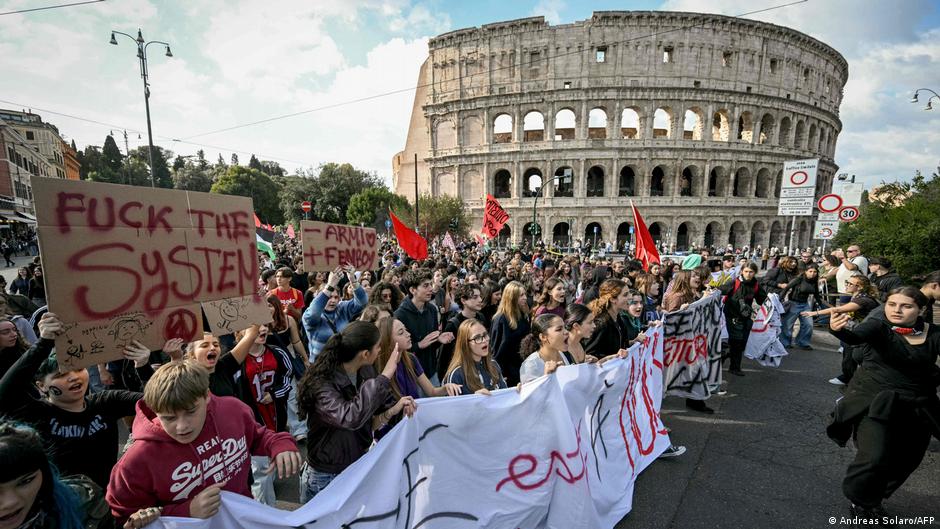
Hundreds of thousands of people took to the streets across Italy on October 30 to protest the rising cost of living and higher military expenditure, while a 24-hour general strike disrupted the country. The demonstrations, held in more than 60 cities, brought together economic grievances that are often treated separately: unaffordable housing, expensive fuel and opposition to shifting public resources toward defence.
The scale of participation was disputed. The Unione Sindacale di Base, or USB, which organized the demonstrations and called the strike, estimated that between 1 million and 1.5 million people participated. Italy’s Interior Ministry put the figure at 255,000. Even the lower official estimate points to substantial public discontent, while the large gap between the two counts illustrates the political contest surrounding the protests themselves.
Demonstrators focused particularly on rising rents and fuel prices. One slogan summarized their argument about national spending priorities:
“We need more housing, not more bombs.”
The message frames the cost-of-living crisis not simply as a consequence of inflation, but as a question of fiscal choice. For households, housing and transport are difficult expenses to avoid. When rents and fuel costs rise faster than incomes, consumers have less money available for other goods and services. That pressure can weaken domestic demand, increase wage demands and deepen tensions between workers, employers and governments.
A conflict over scarce public resources
The protests expose a structural dilemma facing Italy and other European economies. Governments are under pressure to strengthen defence while also financing housing, education, transport and social protection. These objectives compete for limited budgetary capacity, particularly in countries where debt burdens and slow economic growth constrain the room for additional spending.
Military expenditure can support industrial production, research and skilled employment, but its benefits are distributed unevenly and may take time to reach the wider economy. Housing investment, by contrast, directly affects household costs and labour mobility. A shortage of affordable homes can prevent workers from moving to productive cities, widen regional inequalities and make it harder for younger people to establish independent households. The protesters’ slogan therefore captures a broader dispute over which form of spending produces the most immediate social return.
Fuel prices carry similarly wide economic consequences. Higher transport costs affect commuters directly and can also pass through supply chains into food, retail and industrial prices. For lower-income households, which generally have less capacity to absorb sudden increases in essential expenses, the impact is especially severe. Prolonged pressure on these budgets can turn a temporary inflation shock into a lasting political crisis.
Peaceful marches and isolated clashes
The demonstrations were largely peaceful, according to ANSA, but disorder emerged in Rome and Turin during the evening. Some protesters set fire to rubbish bins and threw objects at police. Law enforcement officers responded with tear gas and water cannon.
Interior Minister Matteo Piantedosi said the authorities’ response had been balanced and effective. In a post on X, he argued that the measures protected citizens’ fundamental right to demonstrate peacefully despite attempts by some individuals to provoke disorder and violence.
The distinction between mass peaceful participation and localized clashes matters economically as well as politically. Large demonstrations can increase pressure for budget revisions or targeted relief, while violence may shift attention from household grievances to public order. Governments then face the challenge of responding to demands without appearing to reward disruption or abandoning longer-term fiscal commitments.
A widening European pattern
Italy’s protests formed part of a recent wave of demonstrations in other European countries, including France and Belgium. In France, rallies in several cities escalated into rioting and clashes with police. The geographical spread suggests that the underlying concerns are not confined to one national economy, even though housing markets, wage systems and fiscal conditions differ across Europe.
Historically, periods of rapid increases in essential costs have often intensified disputes over wages, taxation and public expenditure. General strikes have served as a way to convert dispersed household pressure into coordinated economic action. The Italian strike follows that tradition by linking everyday purchasing power to national policy choices rather than presenting inflation as an unavoidable external force.
Similar protests were scheduled for October 31 in more than 30 German cities, organized by the Gen-Z regelt movement, whose name translates as “Generation Z decides.” Tens of thousands of participants, predominantly young people, were expected to object to the rising cost of living and the potential return of military conscription, while calling for greater education spending. Experts expected the German demonstrations to proceed mostly without disorder.
The strong involvement of younger people adds a generational dimension to Europe’s economic debate. Younger households are often more exposed to rental markets and are directly affected by decisions on education and conscription. If they conclude that defence commitments are expanding while access to housing and public services deteriorates, distrust in existing fiscal priorities could become more durable.
The immediate demonstrations may subside, but the allocation problem will remain. European governments must reconcile security commitments with stagnant household purchasing power and mounting demand for civilian investment. Without visible improvements in housing affordability, education and essential costs, protests over prices may increasingly develop into a broader challenge to the economic model underpinning Europe’s security shift.