Kyiv Strike Kills Two as Ukraine’s Energy Grid Faces Renewed Pressure
The latest Russian attack on Kyiv damaged civilian infrastructure, including areas near a maternity hospital, while underscoring the economic stakes of strikes on energy systems.
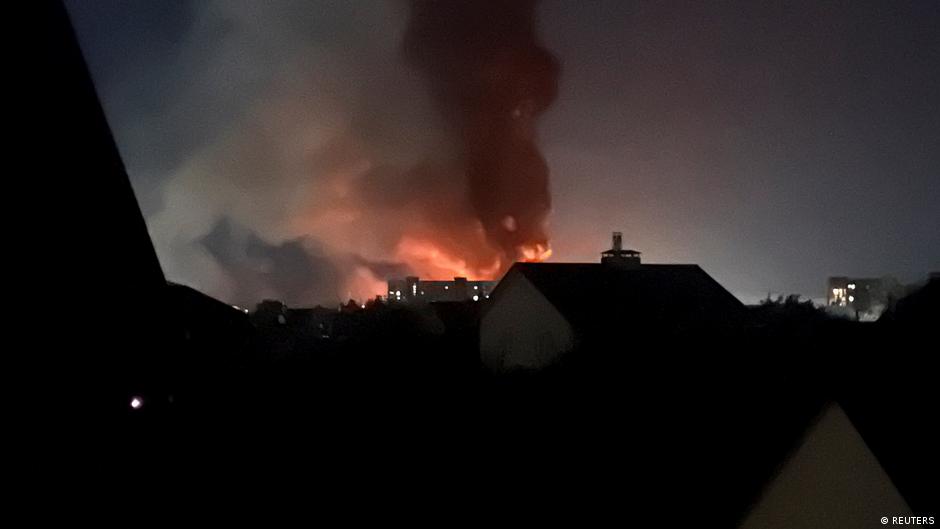
Two people were killed and six others were injured after Russian armed forces shelled Kyiv overnight into Thursday, September 24, according to the city’s mayor, Vitali Klitschko. The attack hit several districts of the Ukrainian capital and caused damage near a maternity hospital, although preliminary information indicated that no one inside the medical facility was hurt.
Klitschko said two of the injured were in serious condition. In the Darnytskyi district, a missile fragment fell onto a roadway. In the Solomianskyi and Podilskyi districts, debris landed on non-residential development sites. In the Dniprovskyi district, fragments fell in the courtyard of a 16-story residential building and private homes, as well as on an administrative building. Private estates were also affected, and one house sustained destruction.
In Podilskyi district, missile debris struck a parking area near a maternity hospital, setting cars on fire. Windows and part of the building’s facade were damaged. Klitschko said, according to preliminary data, there were no casualties inside the medical institution. A nearby clinical and diagnostic center was also damaged.
A Ukrainian Telegram channel, Insider UA, wrote that about 20 missiles of various types were launched at Kyiv over a 35-minute period and that the main target of the attack was the electricity sector. That detail, if confirmed, places the strike within a broader wartime pattern: pressure on Ukraine’s urban life is being applied not only through direct casualties and property destruction, but through repeated attempts to weaken the infrastructure that supports production, hospitals, transport, heating, communications and household activity.
Infrastructure as an economic front
For Ukraine, attacks on energy infrastructure have effects that extend well beyond immediate repair costs. Electricity is the connective tissue of a modern wartime economy. When generation, transmission, substations or district-level distribution systems are damaged, the consequences move through supply chains quickly. Factories face interruptions, small businesses lose operating hours, refrigerated goods become vulnerable, public services slow down, and households are forced to spend more time and money on substitutes such as generators, batteries, fuel, and backup heating.
The reported focus on electricity also matters because infrastructure attacks create cumulative economic strain. A single strike can be repaired; repeated strikes force the state, municipalities, utilities and private firms to hold larger inventories, decentralize systems, invest in redundancy, and divert scarce capital from expansion into survival. In economic terms, the war raises the cost of reliability. What would normally be treated as routine power supply becomes a strategic asset requiring constant defense and rapid restoration.
The damage near a maternity hospital underscores another dimension: the intersection of public health and economic resilience. Even when a medical facility reports no injuries, broken windows, facade damage, fires nearby and harm to adjacent diagnostic services can disrupt care, require emergency spending and increase stress on staff and patients. Hospitals and diagnostic centers are not only humanitarian sites; they are part of the social infrastructure that allows a city to keep functioning under pressure.
“All relevant services are on site. Operational headquarters are being deployed to provide assistance to people,” Serhiy Lysak wrote after reporting damage in Odesa.
That statement came as Serhiy Lysak, head of the Odesa city military administration, reported a separate Russian attack on Odesa. According to him, medical and educational institutions, as well as residential buildings, were damaged. The simultaneous pressure on multiple major cities highlights the fiscal and administrative burden Ukraine faces: local authorities must manage emergency response, housing damage, public safety, utility repairs and social support while the national government continues financing defense.
Historical echoes and structural costs
There are historical parallels in the use of infrastructure as a target during prolonged wars. Industrial economies are vulnerable where civilian and economic systems overlap: railways, power grids, ports, logistics hubs, municipal utilities and communications networks. The strategic logic is to impose costs on the state and population, weaken confidence, and complicate military and economic coordination. In Ukraine’s case, major cities such as Kyiv and Odesa are both civilian centers and nodes in a national economy that must continue operating under wartime conditions.
The structural consequences are likely to be felt over years. Recurrent attacks encourage decentralization of energy supply, greater demand for distributed generation, and investment in backup systems by households, firms and public institutions. That can improve resilience over time, but it is expensive and often inefficient compared with peacetime infrastructure planning. Capital that might have gone into productivity-enhancing investment is instead absorbed by repair, protection and duplication.
Municipal budgets also face a difficult arithmetic. Damage to administrative buildings, housing, medical facilities and educational institutions creates immediate calls for repair and compensation. At the same time, economic disruption can weaken local revenue bases. The result is a widening gap between civic needs and available resources, filled only by national transfers, international assistance, emergency borrowing, deferred maintenance, or private household spending.
For residents, the economic burden is more personal. A damaged home, burned cars near a maternity hospital, broken windows in a medical facility, and debris in residential courtyards each represent private losses layered on top of public danger. Even where insurance, aid or municipal repair programs exist, delays and uncertainty impose real costs. Families must adjust work schedules, relocate temporarily, replace belongings, and navigate public services under strain.
The reported launch of roughly 20 missiles at Kyiv in 35 minutes also points to the asymmetry between the cost of attack and the cost of defense and recovery. Air defense, emergency response, reconstruction and infrastructure hardening are expensive. Yet without them, the cost of lost output and social disruption can be greater. That is the central economic dilemma facing Ukraine’s urban centers: resilience is costly, but fragility is costlier.
Klitschko’s account of the Kyiv strike and Lysak’s report from Odesa together describe more than isolated incidents of damage. They show how the war continues to press on the systems that allow a modern economy to function: electricity, roads, housing, hospitals, schools and local administration. The human toll remains immediate, with two killed and six injured in Kyiv. The economic toll accumulates more slowly, through repairs, lost productivity, altered investment patterns and the long-term reshaping of urban infrastructure around the expectation of repeated attack.