NATO Confirms Russian-Origin Drone Crash in Romania, Raising Security and Legal Concerns
NATO agrees the drone that crashed into a Romanian residential building was Russian-made, highlighting regional security and international law challenges.
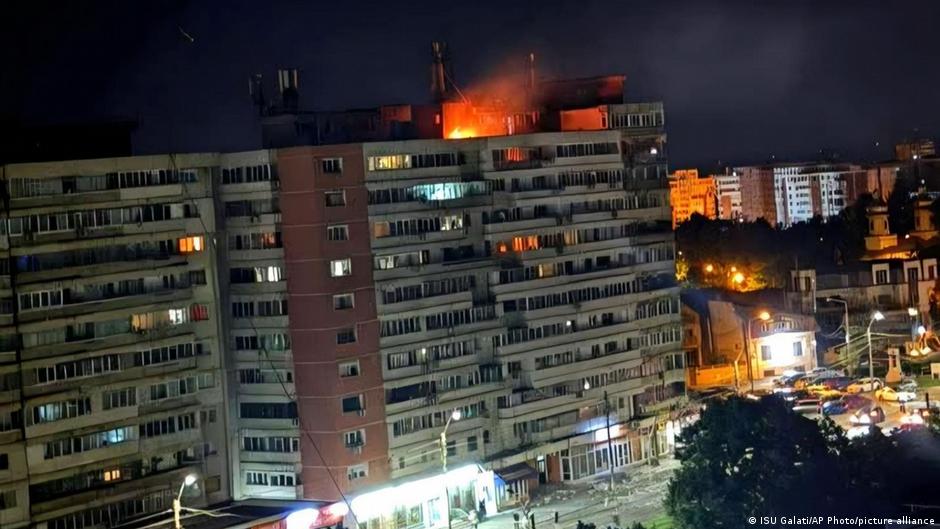
On May 29, a drone crashed into a residential building in the Romanian city of Galați, near the Ukrainian border, causing a fire on the tenth floor and injuring two people. NATO officials have confirmed that the unmanned aerial vehicle (UAV) was of Russian origin, prompting Romania to request enhanced air defense support from the alliance and raising complex questions about the conflict’s spillover into NATO territory.
Incident Details and Immediate Responses
The Supreme Allied Commander Europe’s spokesperson, Martin O’Donnell, confirmed the assessment by Moldovan authorities that the drone was Russian-made. This conclusion is supported by the discovery of serial numbers on the drone debris, which the Romanian Ministry of Defense states unequivocally indicate Russian manufacture.
Romanian President Nicolae Ciucă explained that the drone had likely been intercepted by Ukrainian air defenses while crossing Ukrainian airspace, specifically near the city of Reni, causing it to deviate from its intended path toward Ukraine and crash onto Romanian soil. "Responsibility for the attack on the residential building in Galați clearly lies with Russia," he asserted during a press conference.
Following the incident, Romania declared the Russian consul general in Constanța persona non grata and announced the closure of the Russian consulate, signaling a significant diplomatic escalation.
Broader Security and Economic Implications
"The spillover of military technologies and conflict into NATO territory not only threatens immediate security but also has profound structural economic consequences for the region," an expert on Eastern European security noted.
This event illustrates the intensification of risks faced by NATO member states bordering the conflict zone. The breach of Romanian airspace by a Russian drone and its subsequent crash represent a direct intrusion into NATO territory, raising critical questions about the alliance's air defense capabilities and the strategic calculus of regional security.
Romania’s request for strengthened air defense systems from NATO underlines the pressures on national military budgets and infrastructure. Investing in advanced air and missile defense requires reallocating resources that might otherwise be used for economic development or social programs. This dynamic reflects a broader pattern where geopolitical tensions impose significant opportunity costs on affected nations.
Moreover, the incident underscores evolving challenges in the regulation and control of unmanned aerial vehicles, which have become a force multiplier in modern conflicts. The risk of drones crossing into neutral or allied countries’ airspace complicates international law frameworks and heightens the potential for unintended escalation.
Historical Parallels and Long-Term Structural Concerns
Historically, conflicts near alliance borders have often precipitated broader strategic shifts and economic burdens. The Romanian incident echoes Cold War-era proxy confrontations where incursions into allied airspace prompted military buildups and diplomatic standoffs.
Russia’s use of drones in this conflict represents a new frontier in asymmetric warfare, challenging traditional deterrence postures. The structural economic impact includes increased defense expenditures, disruption of cross-border trade, and heightened investor uncertainty in vulnerable regions.
Russian President Vladimir Putin cast doubt on the drone’s Russian origin, calling for forensic examination prior to conclusions. This stance reflects the ongoing information contest and disinformation campaigns that complicate transparency and crisis management.
In sum, the drone crash in Galați is more than a localized security incident; it is a symptom of the broader geopolitical tensions reverberating through Eastern Europe. The event underscores the intersection of military technology proliferation, alliance dynamics, and economic stability in a region facing sustained strategic pressures.