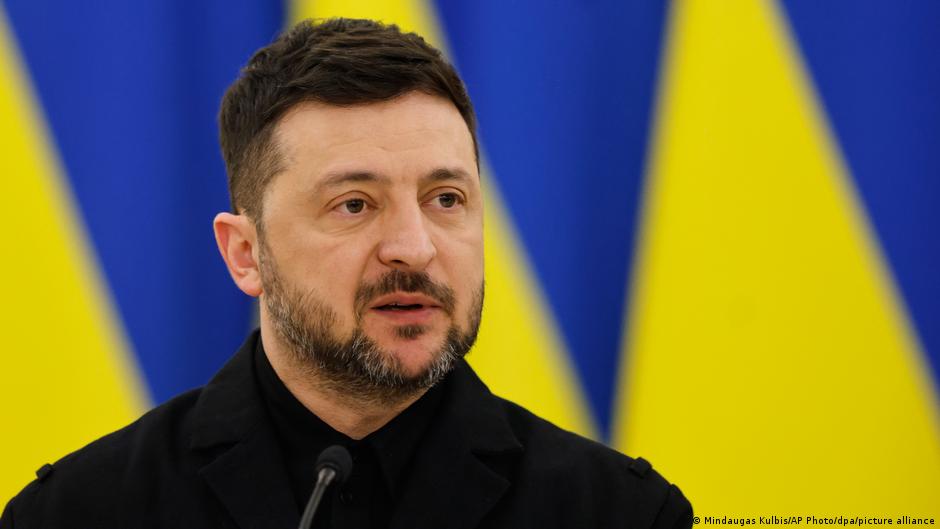
Russia Extends Kyiv Strikes as Urban War Damage Deepens Economic Strain
The latest missile and drone attacks on Kyiv underscore how repeated strikes on civilian and institutional sites compound Ukraine’s wartime economic costs.
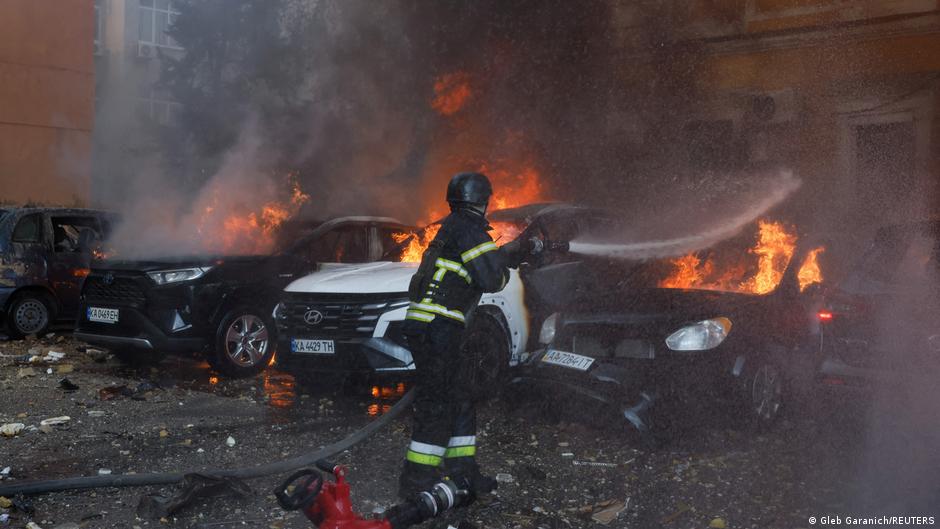
Russia continued its strikes on Kyiv overnight after a day of attacks on the Ukrainian capital, including a strike on the building of the National Academy of Sciences of Ukraine. According to local authorities, debris from a ballistic missile fell near a residential building, while an unmanned aerial vehicle came down on a roadway.
The renewed assault took place overnight into Tuesday, September 29. Kyiv Mayor Vitali Klitschko said debris from a ballistic missile had fallen in the courtyard of an apartment building. No information had been reported about deaths or injuries as a result of the overnight strikes.
“In the Solomianskyi district, missile debris fell in the courtyard of a house. There is no fire. In the Pecherskyi district, there is a fire in a three-story non-residential building,” Klitschko wrote on Telegram.
He later clarified that in the Solomianskyi district, a fire broke out in one of the buildings of an educational institution after the strike. Separately, the Kyiv City Military Administration reported that a drone had fallen on a roadway. Authorities also reported a fire after debris fell onto the roof of a five-story building in the Holosiivskyi district.
The overnight strikes followed daytime attacks in central Kyiv. Since the start of September 28, two people were killed and another 26 were wounded in the city as a result of the strikes, Klitschko said. According to him, eight of the injured required hospitalization, with one of them in serious condition.
Both of those killed died in a drone strike on the building of the National Academy of Sciences of Ukraine. The attack caused a major fire, left people trapped inside, and forced many to escape through windows. Another Russian strike hit the building of the Dobrobut medical center.
Institutional Targets and the Economics of Attrition
For an economic publication, the significance of such attacks lies not only in the immediate human toll, but also in the cumulative damage to the institutions and urban systems that sustain a wartime economy. Kyiv is Ukraine’s political, administrative, research, medical and services hub. Strikes on residential areas, educational premises, medical facilities and scientific institutions create costs that are difficult to capture in headline figures but central to the country’s long-term economic resilience.
The reported strike on the National Academy of Sciences of Ukraine is especially notable in that context. Scientific institutions do not merely occupy symbolic space in a capital city; they are part of a national stock of human capital, accumulated expertise and research infrastructure. Damage to such buildings can disrupt research activity, displace staff, destroy archives or equipment, and add another layer of uncertainty to the already strained environment facing Ukraine’s educated workforce.
Historically, wars that extend into the institutional core of a country have produced economic consequences beyond physical reconstruction. Damage to universities, academies, hospitals and administrative buildings can weaken the networks through which knowledge, public services and professional coordination flow. In Ukraine’s case, those networks are already operating under the pressure of mobilization, displacement, energy insecurity and fiscal dependence on external support.
The attack on the Dobrobut medical center also points to the broader economic role of health infrastructure. Medical facilities are essential not only for treating war casualties and civilians affected by strikes, but also for maintaining labor force participation and social stability. When such facilities are damaged or threatened, the costs ripple outward: emergency services are diverted, private and public insurers face added claims, households absorb new risks, and employers confront further uncertainty over worker availability.
Urban Damage as a Fiscal Burden
Each strike that sets off fires, damages roofs, blocks roads or endangers apartment buildings adds to the municipal and national repair burden. Even when casualties are avoided, the costs of emergency response, inspections, temporary closures, debris removal and reconstruction accumulate. For Kyiv, a city that remains central to government operations and to Ukraine’s domestic economy, repeated attacks create a persistent drag on budgetary planning.
The report that missile debris fell in the courtyard of a residential building, a drone landed on a roadway, and debris caused a fire on the roof of a five-story building illustrates the dispersed nature of the damage. Modern missile and drone attacks often generate multiple impact points, not all of which are the original targets. That dispersion complicates insurance, reconstruction and public safety planning, particularly in dense urban districts where homes, schools, clinics, offices and transport arteries sit close together.
Such costs are also structural because they influence behavior. Businesses facing repeated disruption may delay investment, households may increase precautionary savings or relocate, and institutions may spend scarce resources on protection and continuity rather than expansion. In a wartime economy, this is the logic of attrition: even limited physical damage can impose broad economic inefficiencies when it is repeated often enough.
The absence of reported deaths or injuries from the overnight phase of the attack does not remove the economic significance of the incident. Rather, it highlights the distinction between immediate casualties and longer-term urban vulnerability. Fires in educational or non-residential buildings, damage near homes, and hazards on roads all require response capacity. That capacity has a price, particularly when city services must remain prepared for further attacks.
Ukraine’s economy has already been reshaped by the war through defense spending, infrastructure damage, migration, lost output and reliance on external financing. Continued strikes on Kyiv add pressure at the center of that system. They affect morale, administrative continuity and the functioning of services that support both the civilian population and the state’s wartime operations.
The latest attacks therefore fit into a broader pattern in which military pressure is applied not only at the front line but also against the economic and institutional depth of the country. The immediate facts are specific: two killed during the daytime strikes, 26 wounded, eight hospitalized, one in serious condition, and new overnight reports of debris, fires and a fallen drone. The broader economic reading is that Ukraine’s reconstruction bill and resilience challenge continue to grow with each strike on the capital’s civic infrastructure.