Serbia Faces Renewed Unrest Amid Anti-Government Protests Triggered by Corruption Scandal
Widespread protests and clashes with police in Belgrade highlight deep-rooted governance challenges and economic consequences in Serbia.
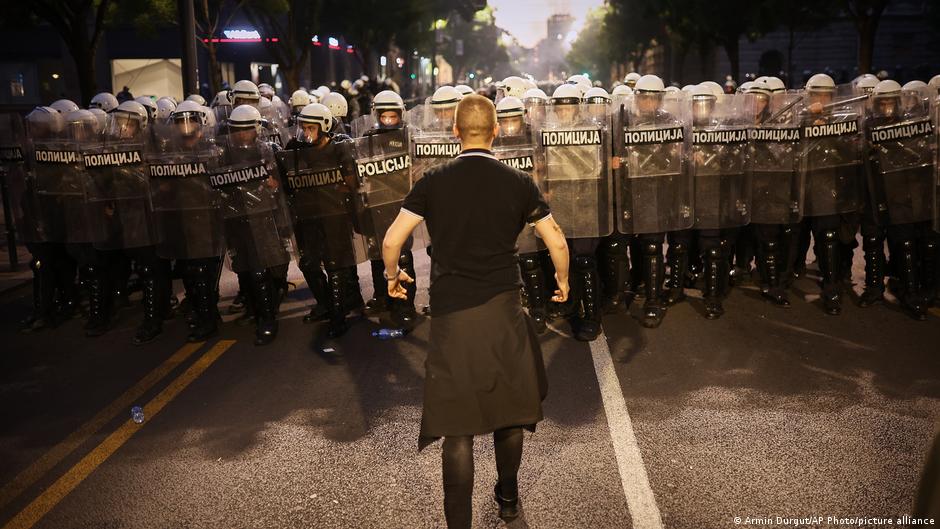
On May 23, 2026, the Serbian capital, Belgrade, witnessed significant unrest following anti-government protests organized primarily by university students. The clashes occurred near Pionirski Park and Slavia Square, where tens of thousands had gathered to express their frustration with the government of President Aleksandar Vučić.
What began as a peaceful demonstration escalated into violent confrontations as protesters reportedly attacked police officers with firecrackers, stones, and improvised explosive devices. Police responded by deploying tear gas and stun grenades, attempting to disperse the crowd near the Faculty of Law and the parliamentary building. Authorities confirmed the detention of 23 individuals in connection with the disturbances, and Interior Minister Ivica Dačić warned that those responsible for attacks on law enforcement would face criminal charges.
Historical Roots and Structural Economic Implications
The protests trace their origins to the tragic collapse of a concrete canopy at the newly renovated railway station in Novi Sad in November 2024, which claimed 16 lives. Public outrage centered on allegations of corruption, negligence, and nepotism in the Serbian political elite, which protesters argue have compromised not only public safety but also the integrity of state institutions.
Since the initial protests began, Serbia has experienced waves of unrest, challenging the stability of its political and economic systems. The resignation of Prime Minister and former Novi Sad mayor Miloš Vučević in January 2025 was one of the first significant political repercussions. His successor, medical professor Đuro Mačut, nominated by President Vučić, has struggled to quell unrest amid demands for early parliamentary elections.
"Democratic countries cannot change election schedules every time protests arise," President Vučić stated earlier, signaling resistance to opposition calls for snap polls.
Economic disruptions have accompanied the political turbulence. The Serbian state railway's decision to cancel all trains to and from Belgrade on the day of the protests was a preventive measure to curb mass mobilization from other regions, reflecting concerns about the scale and potential spread of dissent. This disruption underscores vulnerabilities in Serbia's transport infrastructure and highlights the broader economic ramifications of political instability.
The persistence of protests through 2025, which saw over 40 arrests and injuries to both police and demonstrators, indicates deep-seated grievances that extend beyond isolated incidents. The protesters' demands for systemic change, including the resignation of President Vučić and early parliamentary elections, spotlight ongoing governance challenges.
Looking ahead, the scheduled early parliamentary elections in 2026, confirmed by President Vučić in December 2025, will be a crucial test for Serbia’s democratic institutions and economic resilience. Analysts suggest that unless structural reforms addressing corruption and institutional accountability are undertaken, political unrest may continue to hamper Serbia’s economic development and international standing.
In this context, Serbia’s current turmoil offers a compelling lesson about the interplay between governance quality, public infrastructure safety, and economic stability in transitional economies.