Spain’s Housing Shortage Fuels Mass Protests and Nationwide Strike
The unrest highlights how constrained housing supply, rising rents and weak real-income growth are reshaping Spain’s economy and politics.
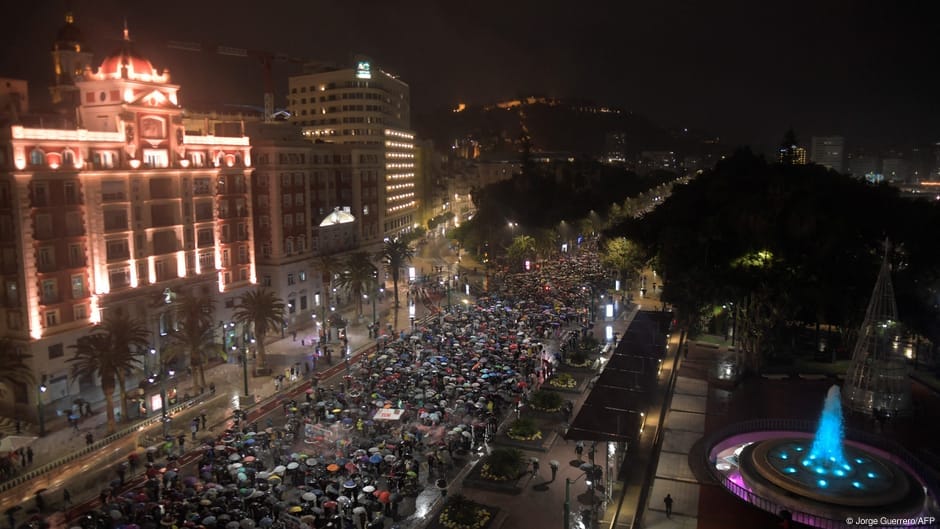
Tens of thousands of people took to the streets across Spain on Wednesday, November 11, at the end of a nationwide general strike called over the rising cost of living and the shortage of affordable housing. Organizers declared the action a “complete success,” while employers said participation was limited, exposing a sharp divide over both the strike’s economic impact and the depth of public support.
Authorities estimated that 120,000 people joined the demonstrations in Madrid. Housing tenant associations that called for the protests put the capital’s turnout at 600,000. In Barcelona, police estimated that 55,000 people participated.
The daylong stoppage, Spain’s first general strike in 14 years, took place just two and a half weeks before the country’s parliamentary election. The timing has turned a long-building housing affordability problem into a central political and economic test.
A strike with disputed economic effects
The general strike partially disrupted public and economic life across Spain. The country’s left-wing government supported the protesters, while the right-wing opposition described the demonstrations as ideologically motivated.
The CCOO trade union confederation said the strike exceeded organizers’ expectations and pointed to falling electricity use as evidence of a broad interruption to normal activity.
“Electricity consumption fell to a level more typical of a Sunday than a working day. Industry and strategically important areas of Spain’s economy came to a standstill.”
The CEOE employers’ organization offered a sharply different assessment, saying fewer than 10% of employees took part and describing participation as “minimal.” Nevertheless, the stoppages affected major industrial and logistics operations, including Volkswagen in Pamplona, the group’s Seat subsidiary in Martorell, wholesale markets and trading ports such as Algeciras.
The conflicting measures illustrate the difficulty of assessing modern strike participation in an economy dominated by services, flexible employment and uneven regional labor markets. Electricity demand and factory shutdowns can indicate significant disruption in energy-intensive sectors even when the overall share of workers formally joining a strike remains relatively low.
Most demonstrations remained peaceful during the evening. In Barcelona, however, disorder began after the main protest had ended. A group of masked right-wing extremists smashed several shop windows, set waste containers on fire and threw bottles, stones and firecrackers at police. Officers used batons against the attackers. Police detained at least 52 people nationwide during the protests.
An eviction becomes a national catalyst
The immediate catalyst for the mass mobilization was the eviction of 87-year-old pensioner Maricarmen Abascal from her Madrid apartment. She had lived there for 70 years and had paid €500 in rent for years. A new company acquired the property in 2018 and increased the rent to a level exceeding her pension.
Abascal was evicted on September 23 and died in hospital only a few days later. Her case crystallized public concern about the imbalance between property ownership, rental income and household security. It also gave a human dimension to a structural problem that has accumulated over years.
Against the backdrop of the protests, Socialist Prime Minister Pedro Sánchez announced on October 5 that parliament would be dissolved and an early election held on November 29, 2026. He attributed the decision to the critical situation created after parliament rejected the government’s housing-market reform.
A widening supply gap
Spain’s affordable housing crisis has intensified as rents and home prices have increased faster than real household incomes. The result is not simply a higher monthly housing bill. It also affects household formation, geographic mobility and consumption: many Spaniards continue living with their parents beyond the age of 30 because they cannot afford to rent homes of their own.
This pattern can weaken domestic demand over time. When households devote a growing share of income to rent, less money remains for other goods and services. Delayed moves into independent housing can also postpone family formation and reduce workers’ ability to relocate to regions offering better employment opportunities.
Housing prices have been pushed higher in part by increased migrant inflows combined with insufficient construction of affordable homes. The Bank of Spain estimates that the country currently lacks about 750,000 homes. The shortfall is expected to exceed one million homes by 2028.
The scale of that projected deficit suggests that short-term rent measures alone are unlikely to resolve the imbalance. Spain faces a longer-term question of how rapidly it can expand housing supply, particularly in high-demand cities and employment centers, while ensuring that new construction is accessible to households whose earnings have not kept pace with property values.
Historically, housing shortages become politically destabilizing when they persist through periods of nominal economic growth. Headline gains in output or employment offer limited reassurance to voters if real incomes cannot secure basic accommodation. Spain’s strike and demonstrations show that housing is no longer only a social-policy concern: it has become a constraint on labor mobility, household spending and political stability.
The November 29 election will therefore take place amid competing interpretations of the same economic strain. Unions view the strike as proof that key industries and infrastructure can be mobilized around housing and living costs. Employers emphasize the limited share of workers who stopped work. Yet the turnout in major cities, the industrial disruptions and the government’s decision to call an early vote all indicate that the housing shortage has moved to the center of Spain’s economic debate.