Trump Says U.S. Will Drop Tariff on Irish Whiskey After Ireland Visit
The announced removal of a 10 percent duty points to the economic and symbolic weight of spirits trade in U.S.-Irish relations.
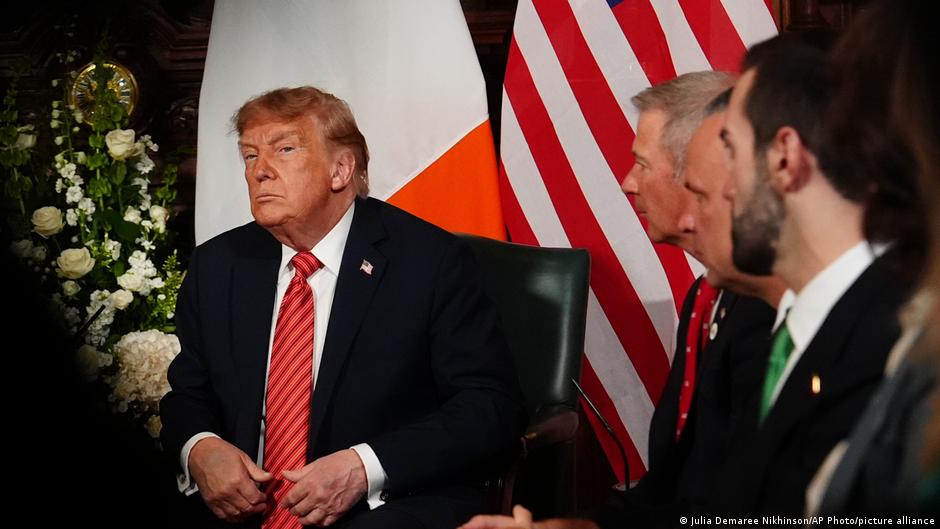
U.S. President Donald Trump said at the end of a visit to Ireland that a 10 percent tariff on Irish whiskey imported into the United States would be removed, presenting the decision as a response to repeated appeals from Irish officials and public figures. The announcement, made on Sunday, September 13, came before a cheering crowd of Irish golf enthusiasts at a tournament held at a golf club owned by Trump’s family.
According to Trump, among those who had asked him to cancel the tariff were Irish Prime Minister Micheal Martin and leading Irish golfer Shane Lowry. The setting of the announcement, a family-owned golf venue in Ireland, gave the decision an unusually personal stage for a trade-policy move that touches one of Ireland’s most recognizable export industries.
The Irish Whiskey Association welcomed the U.S. president’s statement. In a comment attributed to IWA director Eoin O Cathain, the association said that nothing better characterizes trade relations between the United States and Ireland than Irish whiskey. The association also expressed hope that the decision would be fully implemented, Reuters reported.
“Nothing characterizes trade relations between the U.S. and Ireland better than Irish whiskey,” the Irish Whiskey Association said in welcoming the announcement.
At present, the levy is collected as part of broader tariffs applying to all exports of wine and spirits from the European Union to the United States. That structure matters economically: while the announcement focused on Irish whiskey, the existing measure sits within a wider transatlantic trade framework affecting European alcoholic beverages. Removing the duty for Irish whiskey would therefore raise practical questions about implementation, scope and treatment relative to other EU wine and spirits exports.
A Small Tariff With Outsized Significance
A 10 percent import tariff may appear modest compared with the larger trade barriers that have shaped disputes in steel, autos, technology and agriculture. But in consumer goods markets, especially branded beverages, even a relatively limited duty can alter margins, pricing strategies and distributor incentives. Irish whiskey competes in a U.S. spirits market where brand identity, shelf placement and price points are central to growth. A tariff can be absorbed by producers, passed through to consumers, or shared across importers, distributors and retailers. Each route has consequences for investment and market expansion.
For Ireland, whiskey is not merely another manufactured export. It carries a cultural premium and functions as a high-visibility symbol of the country’s food and drink sector. The U.S. market is especially important because it combines scale, purchasing power and a long history of Irish diaspora-linked consumption. That makes tariff relief commercially meaningful even if the precise fiscal effect is not stated in the announcement.
The political economy is also notable. Trump framed the move as a response to requests from prominent Irish figures, including the prime minister and a sports celebrity. That framing turns a trade measure into a bilateral gesture, one that can be read by industry groups as evidence that lobbying, diplomatic pressure and public symbolism still matter in sectors where trade rules are often negotiated at a broader regional level.
Historical Parallels in Transatlantic Trade
The episode fits a recurring pattern in U.S.-European economic relations: sector-specific products often become proxies for much larger political and regulatory disagreements. Alcoholic beverages have long been vulnerable to this dynamic because they are highly visible, geographically branded and politically resonant. Tariffs on wine, whiskey or other spirits can send a message without immediately disrupting the entire architecture of transatlantic trade.
That visibility cuts both ways. For the country whose exports are targeted, the tariff can feel disproportionate because it affects a product bound up with national identity. For the country imposing the tariff, it can serve as a focused instrument that attracts attention while leaving room for negotiation. The Irish Whiskey Association’s response reflects that dual reality: it praised the announcement while emphasizing the need for full implementation.
Implementation is the key economic hinge. A presidential statement can change expectations, but businesses need legal and administrative clarity before pricing, contracts and supply decisions can adjust. Importers may hesitate to revise orders until the tariff treatment is formally changed. Producers may delay changes in U.S. strategy until they know whether the relief is durable and whether it applies cleanly across product categories.
Structural Consequences for Producers and Trade Policy
If the tariff is removed as announced, Irish whiskey producers could gain additional flexibility in the U.S. market. They may be able to protect margins, support promotional spending, or reduce pressure on retail prices. The effect would likely be felt across the supply chain, from distillers and exporters in Ireland to U.S. importers, distributors and retailers. The source article does not provide estimates of the monetary impact, and any assessment beyond the direct tariff change should be treated as structural analysis rather than a reported figure.
The broader consequence lies in the relationship between national economic interests and EU-wide trade rules. The current duty is described as part of tariffs covering all EU exports of wine and spirits to the United States. A move focused on Irish whiskey could underscore the tension between sectoral relief and regional trade policy. Ireland benefits if its whiskey receives an exemption or removal; other European producers may watch closely to see whether similar treatment becomes possible for their goods.
For Washington, the announcement offers a low-cost way to signal goodwill toward Ireland while easing pressure on a politically salient import category. For Dublin and the Irish whiskey industry, it provides a potential commercial opening and a diplomatic win. But the final economic impact depends less on the applause at the golf tournament than on the administrative steps that follow.
The immediate facts are clear: Trump said the 10 percent tariff on Irish whiskey would be canceled; he cited appeals from Micheal Martin and Shane Lowry; the Irish Whiskey Association welcomed the statement and hoped for full implementation; and the tariff currently forms part of wider duties on EU wine and spirits exports to the United States. The next phase will determine whether the announcement becomes a lasting change in transatlantic spirits trade or remains a symbolic moment in a politically charged visit.