Trump Threatens EU Trade Halt Over Plans for Closer Canada Partnership
The U.S. president warned of steep tariffs or a possible trade cutoff if he views Brussels’ proposed associate arrangement with Canada as hostile.
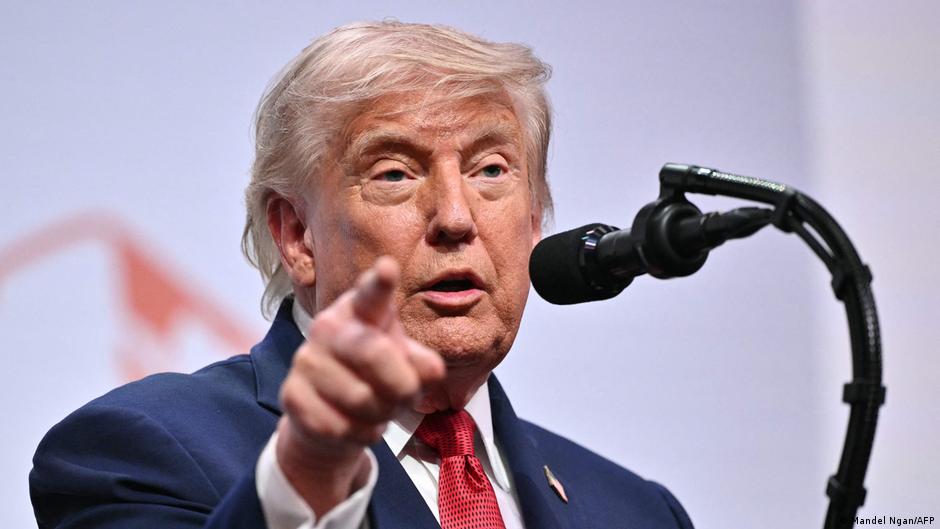
U.S. President Donald Trump has threatened to halt trade with the European Union or impose sharply higher tariffs if Brussels proceeds with plans to deepen its relationship with Canada, injecting a new layer of uncertainty into an already volatile transatlantic trade environment.
Speaking on Wednesday, September 16, at a campaign event in North Carolina, Trump was asked by a journalist to respond to European Commission President Ursula von der Leyen’s proposal to make Canada the EU’s “first associate member.” The U.S. president called the idea “ridiculous” and framed it as a potential test of Europe’s intentions toward Washington.
“If they do that and I consider it even in the slightest degree an unfriendly act, I will impose very high tariffs or stop trade with Europe,” Trump said.
He added that the consequences would depend on how he judged the motives behind the initiative. “If the intentions are good, everything is fine. If the intentions are bad, we will impose very high tariffs on Europe, that is one of the possibilities,” Trump said.
The remarks came the same day that von der Leyen, speaking in the European Parliament in the presence of Canadian Prime Minister Mark Carney, said the European Union wanted to raise its relationship with Canada to “the highest possible level.” She said she wanted to work with Carney so that “Canada becomes the first associate member of the EU.”
Von der Leyen did not provide details on what such a partnership would contain. She did, however, point to cooperation in technology and the defense industry, while stressing that joint work between Canada and the EU “will not be directed against others” and would aim to make both sides stronger.
A Trade Threat With Wider Economic Implications
For markets and policymakers, Trump’s comments matter less as a fully specified trade measure than as a signal of how quickly alliance politics can become tariff politics. The proposed EU-Canada arrangement remains undefined, yet the U.S. president has already linked it to potential punitive action against Europe. That connection underscores a broader structural shift: trade policy is increasingly being used not only to regulate market access, but also to discipline diplomatic alignment.
The economic implications could be substantial if rhetoric turns into policy. The European Union and the United States remain deeply integrated through goods trade, services, investment flows, manufacturing supply chains and defense procurement. A threat to “stop trade with Europe” is sweeping language rather than a technical instrument, but even the prospect of new high tariffs can affect company planning, currency expectations and investment decisions. Firms exposed to transatlantic supply chains may delay contracts, reconsider sourcing or price in additional risk.
The episode also illustrates why Canada and the EU are exploring closer ties. According to AFP, both Canada and the European Union are suffering from the unpredictable trade and foreign policy of Trump, and “that is why both Canada and the European Union are looking at new alliances.” In economic terms, the search for alternative partnerships is a rational response to uncertainty from a dominant trading partner. When access to the U.S. market becomes less predictable, governments have incentives to diversify strategic relationships, especially in sectors such as technology, defense production and public procurement.
There is a historical parallel with earlier periods of trade fragmentation, when political blocs used tariffs and preferences to consolidate spheres of influence. The current situation is different in institutional form, but similar in logic: countries are not simply negotiating tariff schedules; they are reorganizing commercial relationships around questions of trust, resilience and strategic autonomy. The EU-Canada proposal, as described by von der Leyen, fits that pattern. Trump’s warning suggests Washington may interpret such diversification as a challenge rather than as insurance.
Canada Becomes a Test Case
The confrontation is not limited to Europe. The White House said Trump on September 16 signed a memorandum providing for a ban on Canadian goods participating in federal government procurement. According to the release, Washington is taking these measures in response to Canada’s actions, which it said “unreasonably introduced new barriers for American companies seeking access to the government procurement market.”
The procurement ban adds another channel of pressure beyond ordinary customs duties. Public procurement markets are economically significant because they shape demand for industrial goods, infrastructure inputs and strategic technologies. Excluding Canadian goods from U.S. federal procurement would not merely affect exporters; it could also influence investment decisions by firms that produce across the U.S.-Canada border and depend on predictable access to government contracts.
Since September 15, the U.S. administration has imposed additional 50 percent tariffs on cheese, steel, aluminum, paper, furniture, lighting fixtures and other Canadian goods. Trump administration officials said the move was a direct response to Ottawa’s introduction of new tariffs.
Canada’s tariffs on U.S. exports worth about $20 billion also took effect on September 15. Those measures were themselves a response to the entry into force on August 22 of U.S. tariffs of 50 percent on Canadian goods worth $20 billion. On August 21, Canada withdrew from trade negotiations with the United States.
This sequence shows how quickly retaliation can become cumulative. A tariff framed as leverage by one side becomes the justification for countermeasures by the other, and each new measure narrows the political space for compromise. The inclusion of goods such as steel and aluminum also matters because these are core industrial inputs. Tariffs on them can raise costs beyond the directly targeted sectors, affecting construction, manufacturing, furniture production and downstream consumer prices.
For the EU, the immediate question is whether an undefined associate framework with Canada could trigger U.S. retaliation. For Canada, the issue is more acute: it is already inside an escalating trade dispute with Washington. For the wider global economy, the concern is that alliance-building, procurement rules and tariff policy are converging into a single field of conflict.
If the EU-Canada initiative advances, it may become an early test of whether middle powers and large economic blocs can diversify partnerships without provoking punitive action from the United States. Trump’s warning makes clear that, in his view, the boundaries between commercial competition, strategic alignment and political loyalty are increasingly thin.