Warsaw Independence March Draws 250,000 Amid Institutional Strains
President Karol Nawrocki joined the nationalist-led rally as Poland confronts political polarization and mounting institutional uncertainty.
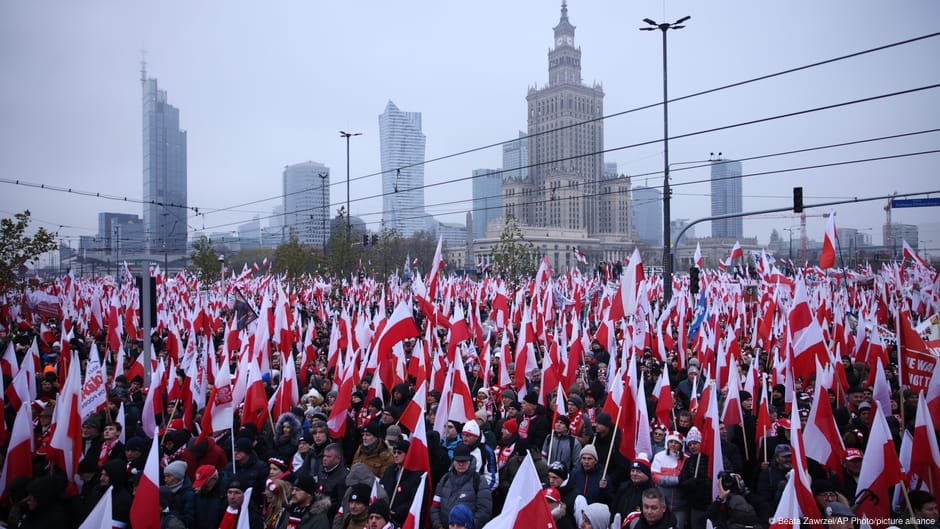
About 250,000 people took part in Warsaw’s annual Independence March on Wednesday, November 11, according to the Polish capital’s authorities, while organizers claimed that attendance exceeded half a million. The substantial gap between the two estimates illustrates not only the political contest surrounding the event but also the broader struggle over legitimacy, institutions and national identity shaping Poland’s economic environment.
President Karol Nawrocki joined the march, which was organized by nationalist and far-right supporters to commemorate Poland’s restoration of independence in 1918. Photographs showed Nawrocki carrying the national flag. He called for a “strong and capable state” and criticized “elites acting against the will of the people.” Prime Minister Donald Tusk declined to attend, instead appealing for unity with the statement: “On November 11, all hearts are white and red.”
The demonstration took place only days after a shooting in central Krakow that killed six people and amid a confrontation between Tusk’s government and Nawrocki’s camp over control of the Constitutional Tribunal. Authorities introduced heightened security measures for the event.
Institutional conflict carries an economic cost
For investors and businesses, the most consequential element of the march may be less the turnout than the political setting in which it occurred. Disputes over constitutional authority can create uncertainty about how laws will be interpreted, whether regulatory decisions will endure and which branch of government ultimately has the power to settle conflicts. Even without an immediate market reaction, prolonged institutional rivalry can complicate long-term planning and weaken confidence in the predictability of the state.
Nawrocki’s emphasis on state capacity therefore carries a dual meaning. A strong state can provide stable rules, public security and effective administration, all of which support economic activity. Yet strength defined through conflict with courts, political opponents or groups presented as external to the nation can produce the opposite result: overlapping claims to authority and less certainty for households and companies.
Poland’s Independence Day has deep economic as well as political resonance. The country re-emerged as an independent state on November 11, 1918, after 123 years of foreign rule by Russia, Prussia and Austria. Restoring sovereignty also required integrating territories that had operated under different administrative, legal and economic systems. The historical memory behind the holiday consequently links national independence with the practical challenge of building institutions capable of holding a fragmented state together.
“On November 11, all hearts are white and red,” Tusk said as he urged Poles to unite rather than join the demonstration.
That history makes the present dispute especially significant. The commemoration is intended to celebrate the recovery of a common state, but this year’s observance exposed competing ideas about who represents that state and how it should function. The division between the president and prime minister risks turning a national holiday into another arena for institutional competition.
Nationalism, migration and economic openness
The march began with the Polish national anthem. Many participants wore red and white, waved national flags and carried torches whose smoke enveloped parts of the procession. Near the Palace of Culture and Science, tents and stalls formed a so-called “city of independence,” distributing rosaries, prayer books, red-and-white wreaths, hot tea and sauerkraut. Journalists also reported antisemitic and anti-Ukrainian books, along with objects displaying far-right symbols.
Some participants carried banners reading “Make Europe white again,” “Poland is not for sale” and “Remigration, deportation.” Such slogans place migration and ethnic identity at the center of the movement’s political message. Their structural economic significance lies in the tension between exclusionary politics and the movement of people, capital and goods on which modern European economies depend. Calls for deportation or remigration can affect perceptions of social stability and the country’s openness, even when they have not been translated into government policy.
The slogan “Poland is not for sale” also reflects a recurring political concern about sovereignty in economic decision-making. In periods of polarization, questions about ownership, foreign influence and national control can move from the margins into mainstream debate. The risk is that ordinary disputes over investment, regulation or trade become framed as tests of patriotism, narrowing the space for pragmatic policy choices.
Far-right groups have organized the annual demonstration since 2011. Its endurance has made the march a recurring measure of nationalist mobilization, but the participation of a serving president gives this year’s event greater institutional weight. Nawrocki’s presence may strengthen the organizers’ claim to represent a broad national constituency, while Tusk’s absence underscores the political divide.
The conflicting crowd estimates are themselves part of that contest. Warsaw authorities reported approximately 250,000 participants; organizers put the figure above 500,000. Regardless of which estimate is closer to the actual attendance, the march demonstrated the capacity of nationalist forces to mobilize on a large scale. For Poland’s economy, the longer-term question is whether that energy is absorbed into stable democratic competition or intensifies conflict over courts, migration and the boundaries of state power.