Yabloko Clears Novgorod Threshold, Preserving a Route Into Duma Races
The liberal party’s projected regional mandate carries practical consequences for ballot access after federal setbacks and tighter electoral constraints.
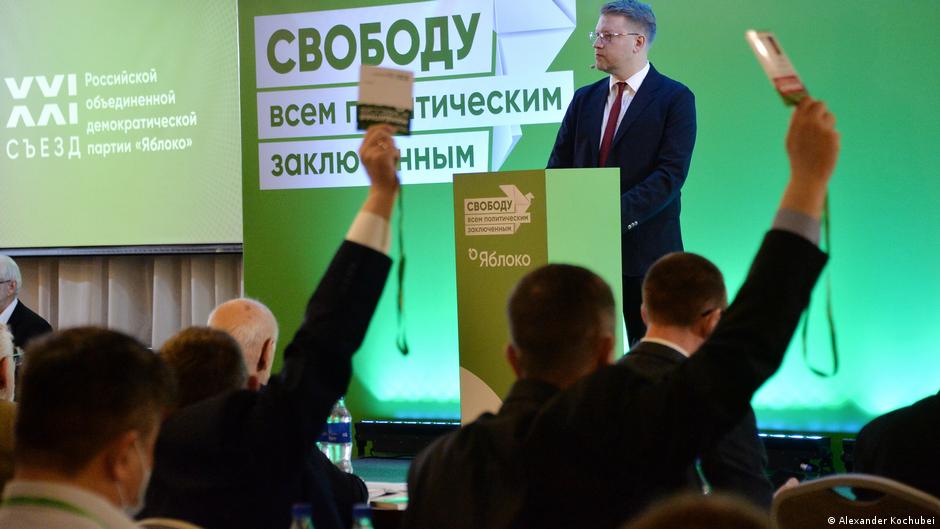
Russia’s Yabloko party is set to enter the Novgorod regional legislature after receiving 6.2% of the vote with 96.86% of protocols counted, according to Russia’s Central Election Commission. The result, reported overnight on Monday, September 21, puts the party above the 5% threshold required to win representation in the eighth convocation of the Novgorod Regional Duma.
For a party that has long occupied a narrow space in Russia’s formal political system, the result is more than a local electoral gain. It may also preserve a practical channel into future national contests. A deputy in a regional parliament allows Yabloko to continue taking part in State Duma elections without having to collect signatures, a procedural requirement that can be politically and administratively costly.
The vote also marks a notable improvement from the previous election at the same level. In 2021, Yabloko received 3.83% of the vote in the Novgorod regional election. Its projected 6.2% showing this time is therefore a rare upward movement for a party facing significant pressure and legal constraints.
A Small Regional Result With National Implications
According to the figures cited by the Central Election Commission, United Russia led the Novgorod Regional Duma election with 38.37% of the vote. The Communist Party of the Russian Federation received 14.54%, the Liberal Democratic Party of Russia 12.01%, New People 9.87%, A Just Russia 7.7%, and the Party of Pensioners 5.55%.
In ordinary electoral accounting, Yabloko’s share would be a modest regional result. In the present institutional context, however, the economic and political significance lies in access: the ability to compete without signature collection reduces transaction costs, limits exposure to disqualification risks, and preserves organizational continuity. For parties operating under administrative pressure, ballot access can function as a scarce asset, almost like regulatory permission in a tightly controlled market.
A source in Yabloko told DW, on condition of anonymity, that the Novgorod result had practical importance for the party. Before these elections, the source said, the party had three factions: in Pskov, St. Petersburg, and Karelia. But the lists there were removed.
“For the party it has a quite practical significance: having a deputy in a regional parliament will allow Yabloko to continue participating in State Duma elections without collecting signatures,” the source said.
The statement underlines how Russian electoral competition increasingly turns on procedural thresholds and eligibility rules as much as on voter preference. For parties outside the dominant system, the difference between representation and exclusion can hinge on whether they maintain at least one legally recognized foothold in a regional legislature.
Administrative Barriers and the Cost of Political Entry
The campaign in Novgorod took place under difficult conditions, the Yabloko source said. The entire party list on the ballot was marked with a label related to “foreign agent” status because the list leader, party deputy chair Anna Cherepanova, had been recognized as affiliated with a “foreign agent.” The source also said Cherepanova herself was removed from the election because of an administrative case under Article 20.3 of Russia’s Code of Administrative Offenses.
Despite that, the source argued that neither the ballot marking nor the removal of the list leader prevented the party from achieving a strong result. In structural terms, the episode illustrates the layered costs faced by opposition organizations: reputational labeling, candidate exclusion, legal uncertainty, and the risk that lists can be removed from a race. Such frictions can weaken fundraising, volunteer mobilization, and voter coordination even before election day.
Those pressures sit within a broader historical pattern in Russia’s post-Soviet party system. Regional assemblies have often served as the remaining institutional infrastructure for parties that struggle to compete nationally. A seat in a regional parliament does not merely confer legislative influence; it can sustain party status, visibility, staffing, and future campaign capacity. For a small party, one mandate can help preserve the machinery needed to remain present in the electoral economy.
The Novgorod result follows a major federal setback. On August 10, Russia’s Supreme Court removed Yabloko’s federal list from the State Duma election in response to a lawsuit by Rodina, which accused the party, among other things, of copyright infringement and illegal payments for election campaigning. Even so, Yabloko candidates are taking part in voting in single-mandate districts.
Yabloko has also been politically distinct among Russian parties because it alone opposed the war in Ukraine. In a comment to DW, Jurgen Hardt, the foreign policy spokesman for the CDU/CSU parliamentary group in the Bundestag, said that by excluding the party, Russian President Vladimir Putin had removed the last significant opposition voice from the electoral process.
From an economic perspective, the relevance of Yabloko’s Novgorod performance is not limited to the fate of one liberal party. Political pluralism affects the predictability of institutions, the credibility of policy debate, and the ability of interest groups to transmit information into the legislative system. When opposition parties lose access to ballots, the political market becomes less competitive and less informative. Regional representation, even on a small scale, helps preserve at least a minimal channel for dissenting policy signals.
The projected Novgorod mandate therefore carries disproportionate weight. It does not alter the balance of power in Russia’s party system, where United Russia remains dominant. But it may keep Yabloko legally and organizationally positioned for future federal participation. In a system where formal eligibility can matter as much as electoral appeal, crossing the 5% threshold in one regional legislature can have consequences well beyond the region itself.